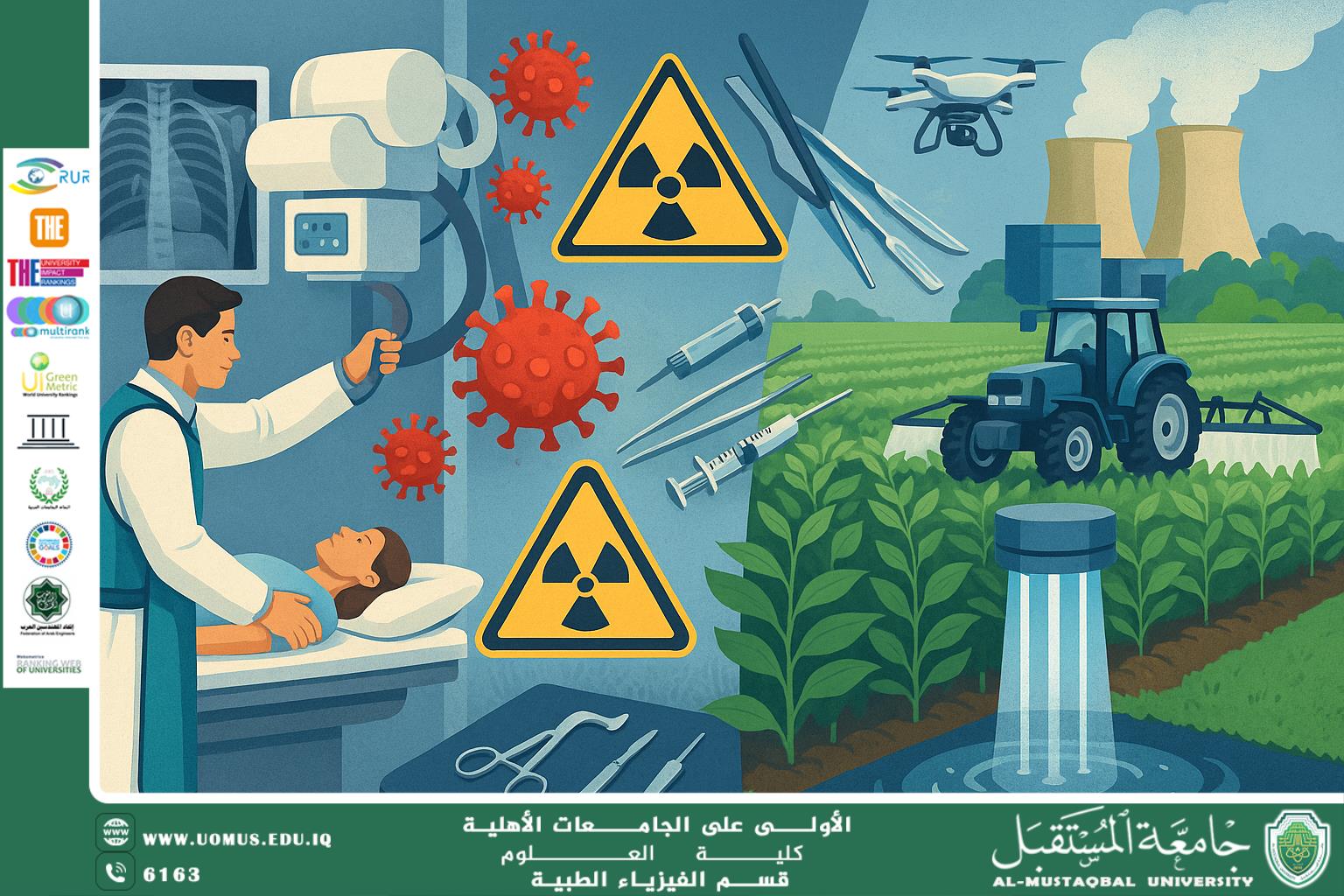
A scientific article by the lecturer (Assistant Lecturer Fatima Basem) entitled “Radiation techniques between medical treatment and agricultural pollution monitoring”
Introduction<br />Radiation technologies are considered vital tools in various fields, most notably in medicine and agriculture. In medicine, these technologies are used for diagnosis and treatment, while in agriculture, they contribute to improving product quality and monitoring contamination.<br /><br />First: Medical Applications of Radiation Technologies<br />1. Medical Diagnosis<br />X-rays, Magnetic Resonance Imaging (MRI), and Computed Tomography (CT) are used to diagnose a wide range of medical conditions, enabling physicians to identify diseases accurately and develop effective treatment plans.<br /><br />2. Radiation Therapy<br />Radiation therapy is used to treat cancerous tumors, where specific doses of radiation are directed to destroy cancer cells while minimizing damage to healthy tissues.<br /><br />3. Sterilization of Medical Equipment<br />Ionizing radiation such as gamma rays is used to sterilize medical equipment, including bandages, gloves, and syringes, ensuring they are free of biological contaminants without compromising their quality.<br /><br />Second: Agricultural Applications of Radiation Technologies<br />1. Improving Crop Quality<br />Ionizing radiation is used to sterilize food and grains, which extends their shelf life and enhances their quality.<br /><br />2. Monitoring Radiation Contamination in Agriculture<br />Radiation technologies are used to monitor levels of radioactive contamination in soil, water, and plants, helping to take necessary actions to reduce pollution and ensure the safety of agricultural products.<br /><br />3. Treatment of Agricultural Wastewater<br />Ultraviolet (UV) radiation and gamma rays are used to treat agricultural wastewater by breaking down organic pollutants and killing harmful microorganisms.<br /><br />Third: Challenges and Precautions<br />Despite the benefits of radiation technologies, their use requires strict precautions to ensure the safety of humans and the environment. It is essential to adhere to international radiation safety standards and provide adequate training for personnel in this field.<br /><br />Conclusion<br />Radiation technologies demonstrate wide-ranging capabilities in medicine and agriculture, contributing to improved quality of life and the safety of food and the environment. With ongoing technological advancements, it is expected that the use of these technologies will expand to new fields, requiring continuous adaptation and strict adherence to safety standards.<br /><br /><br /><br />"AL_mustaqbal University is the first university in Iraq"<br/><br/><a href=https://uomus.edu.iq/Default.aspx target=_blank>al-mustaqbal University Website</a>