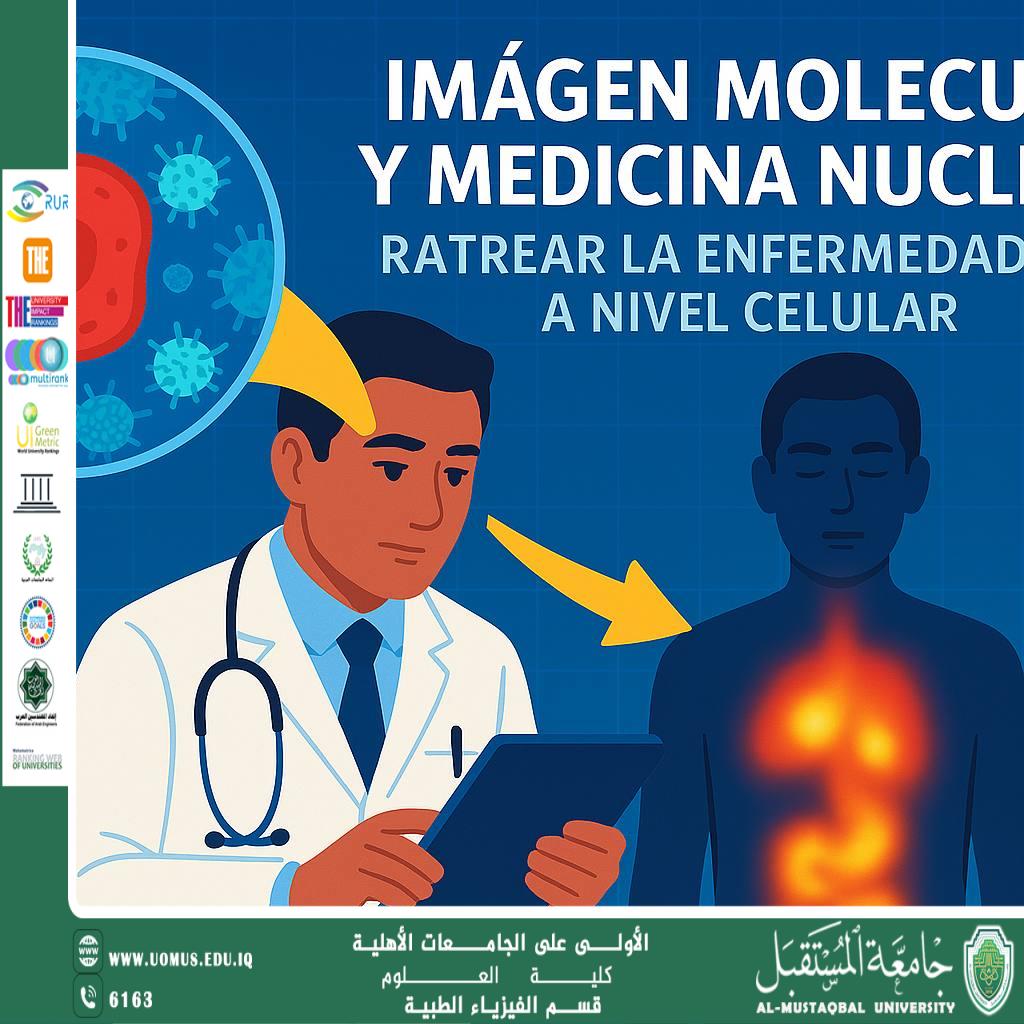
A scientific article by the teaching assistant (Maryam Muhammad) “Molecular Imaging and Nuclear Medicine: Tracking Disease at the Cellular Level”
In the realm of modern medicine, diagnosis has evolved beyond merely visualizing organs and structures. Today, we are able to observe biological changes at the cellular and molecular levels, thanks to the powerful tools of molecular imaging and nuclear medicine. These cutting-edge techniques allow physicians to detect diseases in their earliest stages and monitor how they progress or respond to treatment in unprecedented detail.<br /><br />⸻<br /><br />🧬 What Is Molecular Imaging?<br /><br />Molecular imaging is a medical imaging field that allows the visualization of biological processes at the molecular and cellular level in living organisms. It uses radiotracers or biological markers to track specific molecules as they interact within the body.<br /><br />⸻<br /><br />☢️ What Is Nuclear Medicine?<br /><br />Nuclear medicine is a medical specialty that uses small amounts of radioactive materials (radiopharmaceuticals) for diagnosis or therapy. Advanced imaging technologies such as:<br /> • SPECT (Single Photon Emission Computed Tomography)<br /> • PET (Positron Emission Tomography)<br /><br />are used to capture detailed images of how the body functions. A radiotracer is introduced into the patient’s body, targeting specific tissues or organs, and a camera tracks its distribution and activity.<br /><br />⸻<br /><br />🔍 Main Applications of Molecular Imaging and Nuclear Medicine<br /> 1. Cancer Detection and Staging<br />PET and SPECT scans can detect cancer before structural changes occur, and help assess how a tumor responds to treatment.<br /> 2. Cardiac Imaging<br />Used to evaluate blood flow and identify damaged heart tissue in coronary artery disease.<br /> 3. Neurological Disorders<br />Essential in diagnosing conditions like Alzheimer’s disease, epilepsy, and Parkinson’s disease, by tracking changes in brain function.<br /> 4. Infection and Inflammation Detection<br />Especially valuable in cases where traditional imaging cannot localize the issue.<br /><br />⸻<br /><br />💡 PET vs. SPECT: What’s the Difference?<br /><br />Technology Type of Radiation Spatial Resolution Cost Common Uses<br />PET Positrons High Higher Oncology, Neurology, Cardiology<br />SPECT Single photons Moderate Lower Bone scans, Thyroid, Cardiac stress tests<br /><br /><br />⸻<br /><br />✅ Advantages of Molecular Imaging and Nuclear Medicine<br /> • Early disease detection before anatomical changes occur.<br /> • Non-invasive and functional diagnosis.<br /> • Accurate monitoring of treatment response.<br /> • Personalized therapy planning based on molecular insights.<br /><br />⸻<br /><br />⚠️ Challenges and Considerations<br /> • Radiation exposure, though minimal and controlled.<br /> • High equipment and radiopharmaceutical costs.<br /> • Need for trained specialists in physics and nuclear medicine.<br /> • Limited access in developing countries.<br /><br />⸻<br /><br />🧠 Conclusion<br /><br />Molecular imaging and nuclear medicine are not just about seeing—it’s about understanding what’s happening inside the body at its most fundamental level. As medical physics and technology continue to advance, these fields will play a growing role in early diagnosis, personalized medicine, and targeted therapies that improve outcomes and save lives.<br /><br /><br /><br />"AL_mustaqbal University is the first university in Iraq"<br/><br/><a href=https://uomus.edu.iq/Default.aspx target=_blank>al-mustaqbal University Website</a>