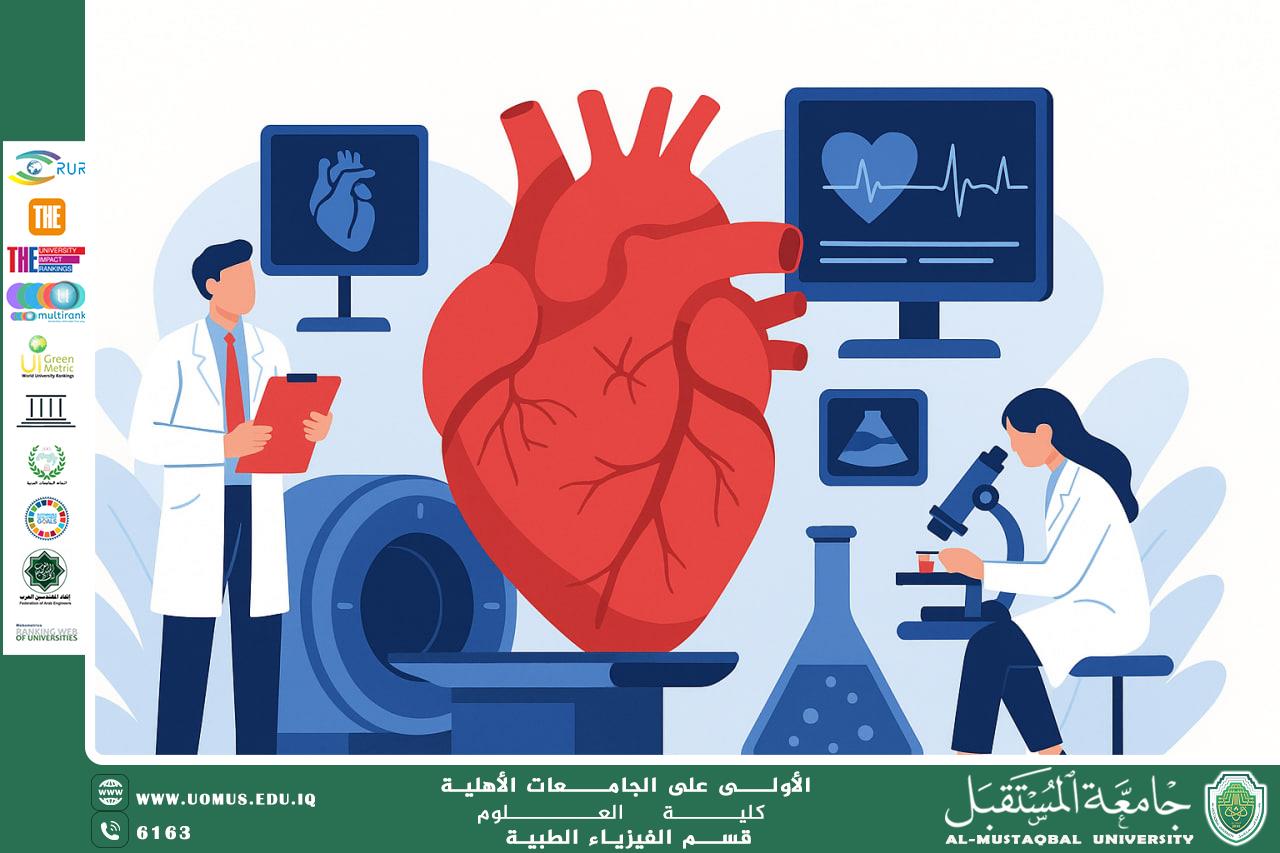
A scientific article by the teaching assistant (Iftikhar Thamer) entitled “Medical Physics in Cardiology: Using Radiology to Accurately Assess Heart Function”
With the rapid advancement of medical technologies, the medical physicist has become an essential partner in cardiac care teams. Through the use of advanced imaging techniques, medical physics enables precise evaluation of heart function, allowing for earlier diagnoses and more effective treatment of cardiovascular diseases — the leading cause of death worldwide.<br /><br />⸻<br /><br />💓 What Is the Role of Medical Physics in Cardiology?<br /><br />Medical physics applies the principles of physics to medicine, including the operation, analysis, and development of imaging systems used in cardiology. It also ensures radiation safety and image quality for both patients and medical staff.<br /><br />⸻<br /><br />🖥 Key Imaging Techniques in Cardiac Assessment<br /> 1. Cardiac MRI (Magnetic Resonance Imaging):<br />Uses strong magnetic fields and radio waves to produce detailed, radiation-free images of the heart’s structure and function.<br /> 2. Cardiac CT (Computed Tomography):<br />Assesses coronary arteries, calcifications, and can be used to measure ejection fraction and detect structural anomalies.<br /> 3. Nuclear Cardiology (SPECT & PET):<br />Involves injecting radioactive tracers to evaluate blood flow to the heart and assess myocardial function.<br /> 4. X-ray Angiography:<br />Commonly used during catheterization to visualize blockages in the coronary arteries.<br /> 5. Echocardiography (Ultrasound):<br />A safe, non-ionizing method used to assess heart valves, chamber motion, and cardiac output.<br /><br />⸻<br /><br />🔬 The Role of the Medical Physicist<br /> • Optimizing radiation doses based on patient characteristics.<br /> • Calibrating and maintaining imaging equipment for accurate diagnostics.<br /> • Quantitative image analysis using advanced software tools.<br /> • Implementing radiation protection protocols to ensure patient safety.<br /><br />⸻<br /><br />✅ Benefits of Imaging in Cardiology<br /> • Non-invasive diagnosis of heart conditions.<br /> • Quick and accurate functional assessment of heart chambers and coronary vessels.<br /> • Identifying damaged areas after myocardial infarction.<br /> • Guiding interventions such as catheterization and cardiac surgery.<br /><br />⸻<br /><br />⚠️ Challenges and Considerations<br /> • Exposure to ionizing radiation requires strict monitoring.<br /> • High cost of equipment and technology.<br /> • Continuous training for physicians and physicists.<br /> • Interpretation of results must be extremely accurate to avoid misdiagnosis.<br /><br />⸻<br /><br />🧠 Conclusion<br /><br />Integrating medical physics into cardiology is not just a technological luxury—it’s a scientific necessity. Through collaboration between physicians and medical physicists, we are now able to understand the human heart like never before, delivering faster, safer, and more precise cardiac care.<br /><br /><br /><br />"AL_mustaqbal University is the first university in Iraq"<br/><br/><a href=https://uomus.edu.iq/Default.aspx target=_blank>al-mustaqbal University Website</a>