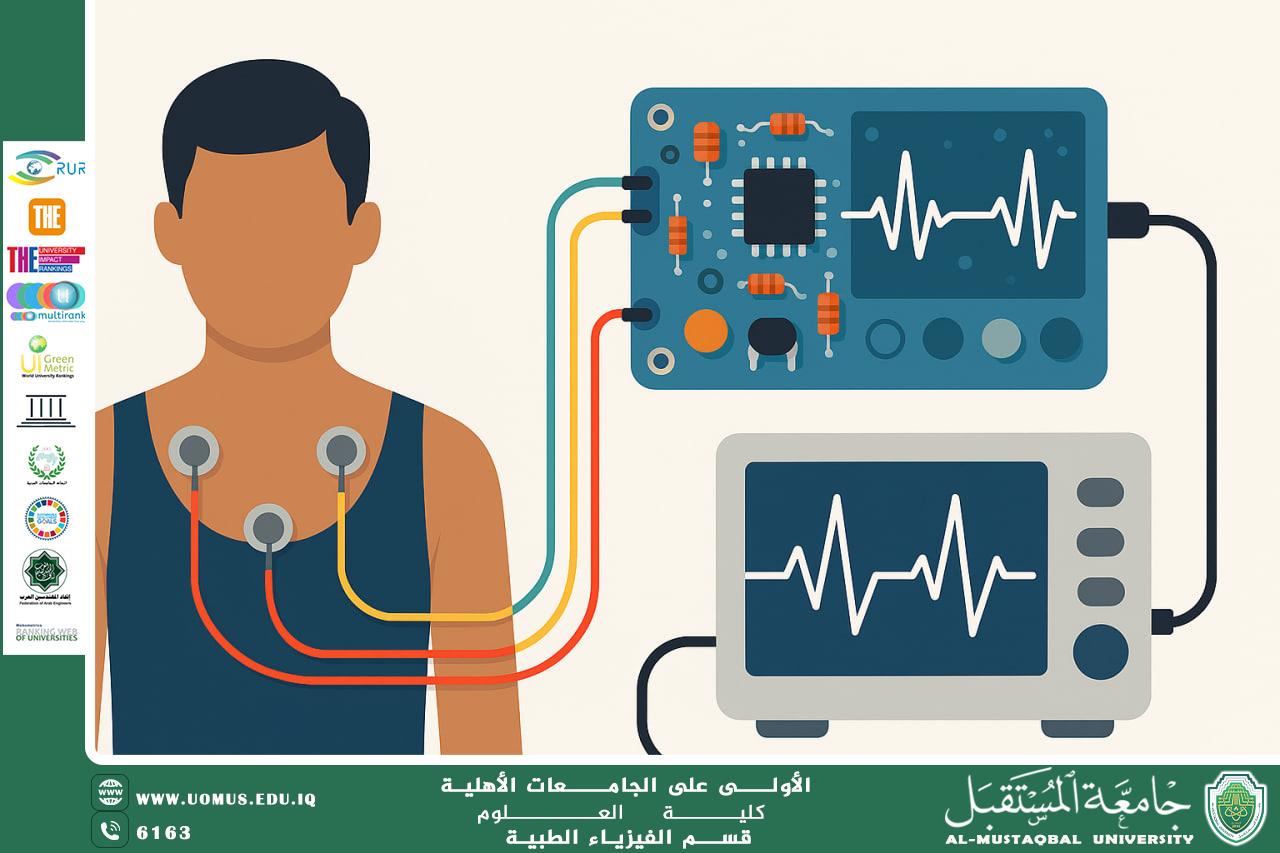
A scientific article by the lecturer (Assistant Lecturer Ammar Karim) entitled “Design of electronic circuits for medical diagnostic devices: A case study on the electrocardiogram (ECG) device.”
🧩 Introduction<br />Medical diagnostic devices play a vital role in monitoring and diagnosing patients’ health conditions. The Electrocardiogram (ECG) machine is one of the most essential of these devices. It operates by capturing the heart’s electrical signals and recording them as waveforms used to analyze cardiac function. Designing the electronic circuits of the ECG machine is a key challenge that combines applied medical physics and biomedical electronics.<br /><br />🔌 Main Components of the ECG Circuit<br />Electrodes:<br />Capture the bioelectrical signals from the skin surface and convert them into measurable signals.<br /><br />Amplifiers:<br />Differential amplifiers (Instrumentation Amplifiers) are used to amplify the very weak bio-signals (in millivolts) without losing accuracy.<br /><br />Signal Filters:<br /><br />Low-pass filters to eliminate high-frequency noise.<br /><br />High-pass filters to remove baseline wandering caused by movement.<br /><br />Notch filters to suppress powerline interference (50 or 60 Hz).<br /><br />Analog-to-Digital Converter (ADC):<br />Converts the analog signal into a digital signal that can be processed by microcontrollers.<br /><br />Microcontrollers:<br />Read, process, and display the digital data, or send it for storage or transmission.<br /><br />⚙️ Design Challenges<br />Weak Signal Strength: ECG signals are very weak and require precise amplification without distortion.<br /><br />Electrical Isolation: Circuits must be designed with patient safety in mind, ensuring full electrical isolation.<br /><br />Noise Reduction: The design must protect against environmental and electromagnetic interference.<br /><br />Power Efficiency: Especially important for portable or wearable ECG devices.<br /><br />🧠 Advanced Applications<br />Wireless ECG: Uses Bluetooth or Wi-Fi to transmit data to smartphones or medical computers.<br /><br />Wearable ECG Devices: Allow continuous patient monitoring outside hospitals.<br /><br />Artificial Intelligence: Enables smart analysis of ECG signals for early detection of cardiac problems.<br /><br />✅ Conclusion<br />Designing electronic circuits for ECG machines is one of the most important applications of medical physics and biomedical electronics. It requires integrating knowledge in signal processing, electronics engineering, and medical safety. With technological advancements, these devices have become smaller, more accurate, and user-friendly, contributing to improved healthcare quality and early detection of heart diseases.<br /><br /><br /><br /><br />"AL_mustaqbal University is the first university in Iraq"<br/><br/><a href=https://uomus.edu.iq/Default.aspx target=_blank>al-mustaqbal University Website</a>