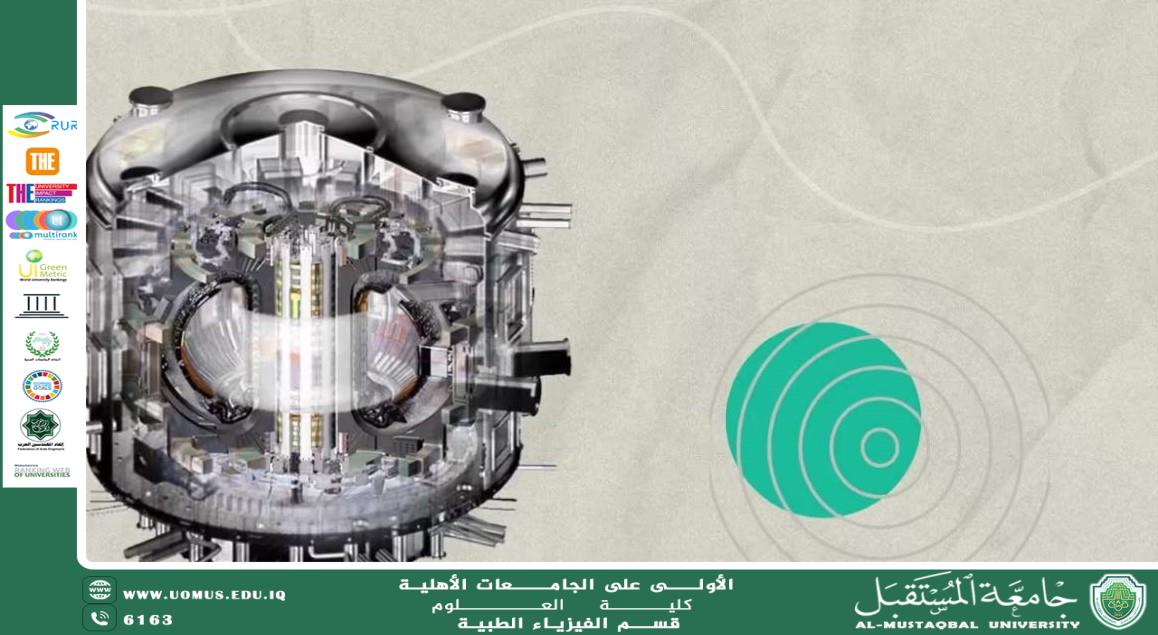
A scientific article by the lecturer (Dr. Karim Abis Handoul) entitled “A giant magnet lifts an aircraft carrier like a feather: The era of clean nuclear energy begins here!”
The World's Most Powerful Magnetic System Installed in France’s ITER Project<br />The central solenoid alone weighs 3,000 tons and helps contain plasma in the fusion reactor.<br />The project aims to generate 500 megawatts of power using only 50 megawatts of heating energy.<br />It involves collaboration between over 30 countries in an unprecedented global effort in energy history.<br />A Revolutionary Milestone in Clean Energy<br />In a groundbreaking achievement in the quest for clean and sustainable energy, the International Thermonuclear Experimental Reactor (ITER) has announced the completion of the world's most powerful superconducting magnetic system. This system is theoretically capable of lifting an aircraft carrier six feet into the air.<br />This announcement is not merely a technological advancement—it is a huge step toward fulfilling a long-awaited dream: harnessing nuclear fusion energy, just like the process that powers the sun, to meet humanity's energy needs in a clean and sustainable manner.<br />A Global Achievement in Fusion Energy<br />According to a report from Interesting Engineering, ITER, located in southern France, represents the largest international effort to prove that nuclear fusion can be a practical energy source. More than 30 countries are collaborating on this project, aiming to build a nuclear reactor that generates electricity through fusion reactions without carbon emissions.<br />Recently, the project announced a significant milestone: the successful installation of the largest and most powerful pulsed superconducting magnetic system ever built. This system is the core of the Tokamak reactor, designed to control fusion reactions.<br />The Heart of the Magnetic System: The "Central Solenoid"<br />At the heart of this engineering marvel lies the "Central Solenoid," a massive magnet manufactured and tested in the United States before being transported to the French site. This component alone weighs approximately 3,000 tons—the equivalent of an aircraft carrier—and serves as the nucleus that initiates plasma reactions and maintains their containment within the reactor.<br />According to project engineers, the entire system will operate in sync with six ring-shaped magnets, known as "poloidal field coils," which have been manufactured by Russia, Europe, and China, reflecting an unprecedented level of international cooperation in nuclear engineering.<br />How Does This System Generate Energy?<br />Nuclear fusion follows the same principles as the processes occurring within the sun. Inside the Tokamak reactor, hydrogen isotopes (deuterium and tritium) are injected into a vacuum chamber, where an electric current is passed through the gases using the central magnet, transforming hydrogen into highly energized plasma.<br />At this stage, superconducting magnets manipulate and control the plasma, ensuring it remains suspended without touching the reactor walls. The plasma is then heated to an astonishing 150 million degrees Celsius—ten times hotter than the sun’s core. Under these extreme conditions, atomic nuclei fuse together, releasing vast amounts of thermal energy.<br />A statement from ITER explains:<br />"At this temperature level, plasma nuclei merge, releasing immense thermal energy. It is expected that the plasma will reach the stage known as 'burning plasma,' where fusion reactions sustain themselves without an external heat source."<br />Unprecedented Efficiency in Clean Energy Production<br />The ultimate goal of ITER is to prove that nuclear fusion can become a viable alternative to conventional energy sources. Upon full operation, the reactor is expected to generate 500 megawatts of power using only 50 megawatts of input heat—achieving an efficiency ratio of ten to one, an achievement never recorded in energy history.<br />This means the reactor will produce self-sustaining fusion energy, eliminating the need for continuous external heating, paving the way for commercial fusion reactors in the near future.<br />International Cooperation: A Key to Success<br />This ambitious project would not have been possible without extensive international collaboration. More than 30 countries have contributed to designing and assembling Tokamak components, each leveraging its expertise and technological capabilities. The United States was responsible for constructing the central solenoid, while Russia, China, and the European Union produced the poloidal field coils. Meanwhile, Japan, South Korea, and India supplied critical components such as the vacuum chamber and thermal shielding.<br />ITER’s Director-General, Pietro Barabaschi, stated:<br />"What makes the ITER project exceptional is not just its technical complexity, but also the international framework that has thrived despite global political fluctuations. It is a testament to hope and a pathway to a sustainable and peaceful energy future."<br />Conclusion: A Step Toward a Fusion-Powered Future<br />With the completion of this giant magnet system, the world is now one step closer to achieving a revolutionary breakthrough in energy. If successful, ITER will demonstrate that nuclear fusion is not only possible but can be scaled to provide clean and limitless energy for future generations.<br /><br /><br /><br />"AL_mustaqbal University is the first university in Iraq"<br/><br/><a href=https://uomus.edu.iq/Default.aspx target=_blank>al-mustaqbal University Website</a>