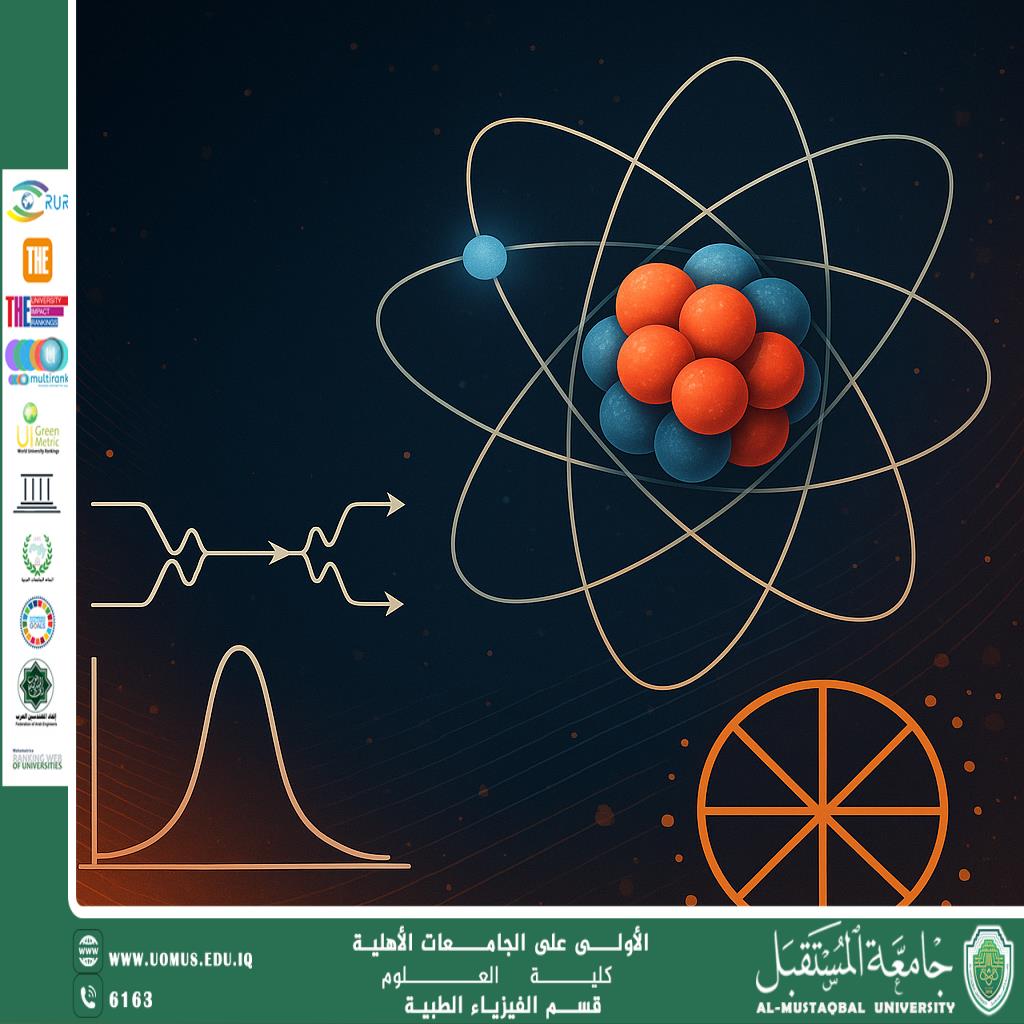
A scientific article by the lecturer (Assistant Lecturer Ali Salman) entitled “Nuclear Physics in Light of Modern Development”
Introduction<br />Nuclear physics is one of the most vital branches of physical sciences, concerned with the study of atomic nuclei, their interactions, and the fine structure of matter. With rapid advancements in technology and scientific instruments, nuclear physics has undergone significant development, becoming more precise and effective, and expanding its applications in various fields such as medicine, energy, industry, and scientific research.<br /><br />Recent Developments in Nuclear Physics Tools and Techniques<br />In recent decades, there have been major advancements in detection and nuclear measurement technologies, such as:<br /><br />High-precision detectors: Like silicon detectors and noble gas detectors, which allow scientists to track nuclear particles with great accuracy.<br /><br />Modern particle accelerators: Such as the Large Hadron Collider (LHC), enabling access to high energy levels to simulate conditions of the early universe.<br /><br />Supercomputing and Artificial Intelligence: Enabling researchers to analyze the massive data produced in nuclear experiments and simulate nuclear interactions with advanced precision.<br /><br />Modern Applications of Nuclear Physics<br />Nuclear Medicine<br />Nuclear medicine now heavily relies on radioactive isotopes for diagnostics and treatments, such as iodine-131 used in treating thyroid cancer.<br /><br />Energy Production<br />Nuclear energy remains a major source of electricity in many countries. Current developments include Generation IV reactors and nuclear fusion as safer and more sustainable energy alternatives.<br /><br />Industrial and Agricultural Fields<br />Radioisotopes are used for detecting structural flaws in metals, sterilizing products, and increasing crop yield through radiation-induced mutations.<br /><br />Nuclear Physics and the Search for the Origin of the Universe<br />Nuclear physics has contributed to understanding the origins of the universe by studying particle interactions during the early moments of the Big Bang. Modern theoretical models such as the "Grand Unification Theory" and "String Theory" attempt to bridge nuclear physics with astrophysics.<br /><br />Future Challenges<br />Nuclear Waste Management: One of the biggest challenges to the peaceful use of nuclear energy.<br /><br />Nuclear Safety: As nuclear technologies spread, there's an increasing need for effective protection systems to prevent accidents and nuclear terrorism.<br /><br />Cost of Research and Development: Nuclear experiments require significant financial and technical investments, posing a challenge especially for developing countries.<br /><br />Conclusion<br />Nuclear physics today represents one of the most advanced and complex scientific fields. It has led to the development of technologies that transformed human life in many areas. With continued research and innovation, it is expected to play an even greater role in achieving sustainability and solving future challenges related to energy and health.<br /><br /><br /><br /><br />"AL_mustaqbal University is the first university in Iraq"<br/><br/><a href=https://uomus.edu.iq/Default.aspx target=_blank>al-mustaqbal University Website</a>