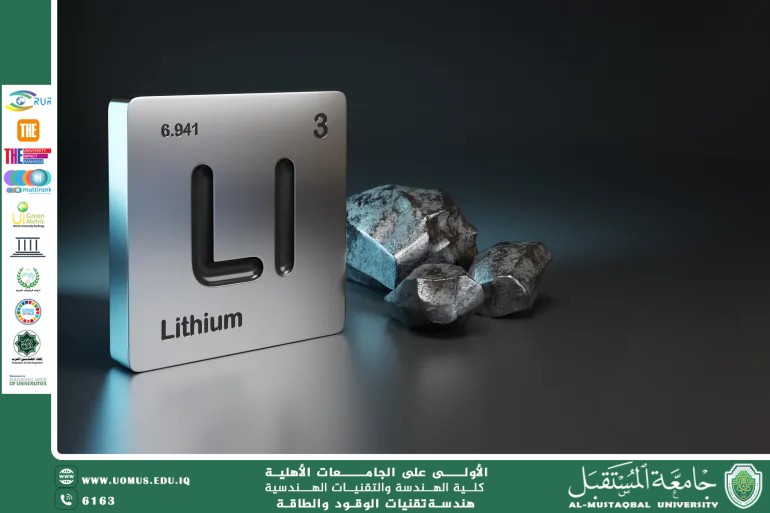
Lithium: Properties, Applications, and Future Prospects
Lithium: Properties, Applications, and Future Prospects<br />Eng. Nourhan Thamer Assi.<br /><br />SDG 3: Good Health and Well-being<br />SDG 7: Affordable and Clean Energy<br />SDG 9: Industry, Innovation, and Infrastructure<br />SDG 12: Responsible Consumption and Production<br />Abstract<br />Lithium (Li) is a soft, silvery-white alkali metal with unique chemical and physical properties that make it a critical material in modern technology. Its applications span from rechargeable batteries to pharmaceuticals, ceramics, and aerospace alloys. This article reviews lithium’s characteristics, extraction methods, industrial uses, and emerging trends in sustainable energy storage.<br />1. Introduction<br />Lithium, atomic number 3 and atomic weight 6.94, is the lightest metal and the least dense solid element. Discovered in 1817 by Johan August Arfwedson, lithium has gained global importance due to its role in lithium-ion batteries, a cornerstone of portable electronics and electric vehicles.<br />2. Physical and Chemical Properties<br />Physical State: Soft, silver-white metal<br />Melting Point: 180.5 °C<br />Density: 0.534 g/cm³ (lowest among metals)<br />Reactivity: Highly reactive, especially with water, forming lithium hydroxide and hydrogen gas. It readily forms compounds with oxygen, halogens, and nitrogen.<br />Lithium’s high electrochemical potential (−3.04 V) makes it ideal for energy storage applications.<br />3. Occurrence and Extraction<br />Lithium is primarily obtained from two sources:<br />Mineral deposits: Such as spodumene and petalite in pegmatite rocks.<br />Brine deposits: Saline water bodies like salt flats (e.g., Salar de Uyuni in Bolivia) contain dissolved lithium salts.<br />Extraction from brines involves evaporation techniques, whereas mineral sources require roasting and acid leaching.<br />4. Industrial Applications<br />4.1 Batteries<br />Lithium-ion batteries dominate the portable electronics and electric vehicle markets due to their high energy density, long cycle life, and low self-discharge rates. Lithium cobalt oxide (LiCoO₂), lithium iron phosphate (LiFePO₄), and lithium nickel manganese cobalt oxide (NMC) are common cathode materials.<br />4.2 Pharmaceuticals<br />Lithium salts, especially lithium carbonate, are used to treat bipolar disorder and other psychiatric conditions by stabilizing mood swings.<br />4.3 Alloys and Ceramics<br />Lithium is alloyed with aluminum and magnesium to create lightweight, strong materials used in aerospace and automotive industries. Lithium compounds also enhance the strength and thermal properties of ceramics and glass.<br />5. Environmental and Sustainability Considerations<br />The growing demand for lithium raises concerns about environmental impact, including water consumption in arid regions and chemical waste from mining. Sustainable extraction methods and recycling of lithium-ion batteries are critical for reducing ecological footprints.<br />6. Future Prospects<br />Research focuses on improving lithium battery efficiency, developing solid-state lithium batteries for enhanced safety, and exploring alternative lithium sources. The transition to renewable energy and electric mobility continues to drive lithium’s strategic importance.<br />7. Conclusion<br />Lithium’s unique properties underpin its central role in modern technology, especially energy storage. Balancing demand with sustainable practices remains a key challenge for future development.<br />"Al-Mustaqbal University – The No. 1 Private University in Iraq"<br /><br /><br />