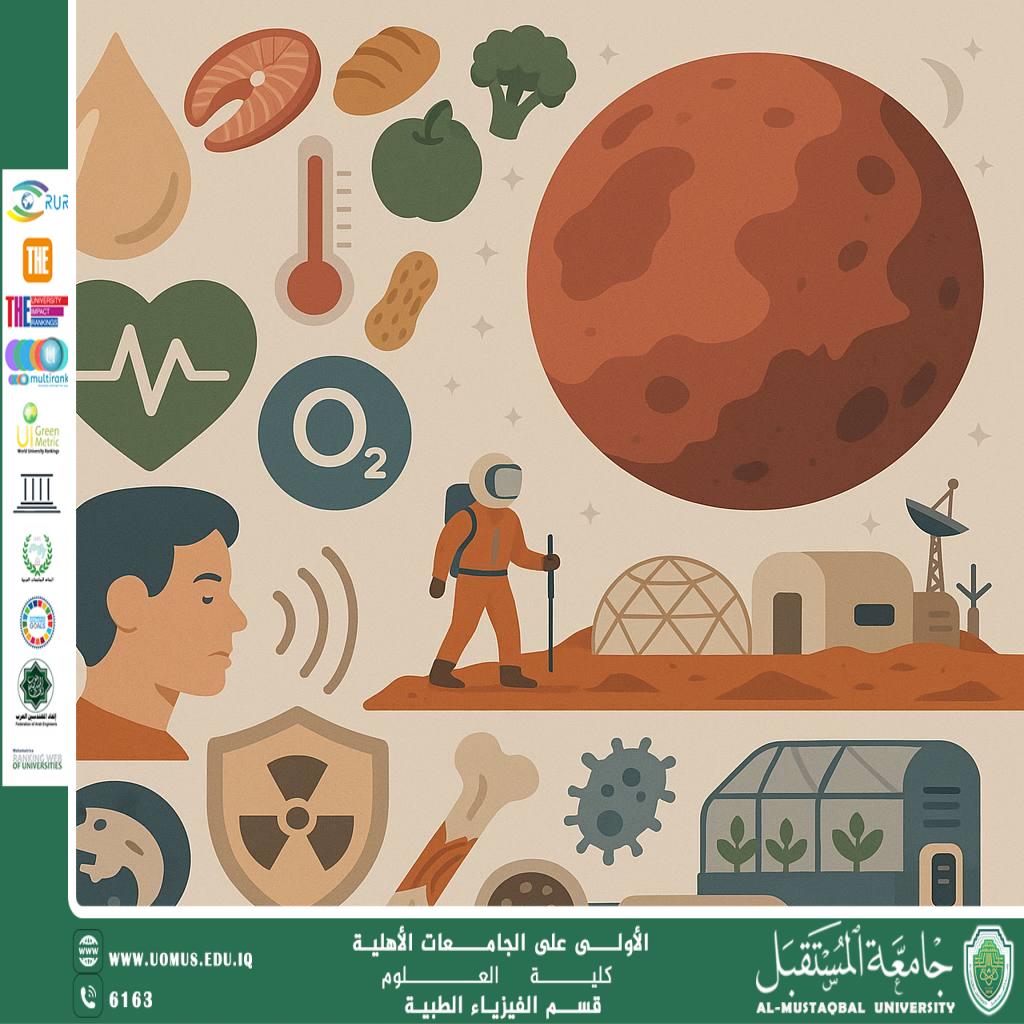
A scientific article by the teaching assistant (Mohamed Gamal) entitled "Is it possible to live on a planet other than Earth?"
For decades, scientists have explored the possibility of living beyond Earth, especially with the great advancements in space science and biomedical research. But can humans truly survive on another planet? And what are the medical and health challenges involved in such a mission?<br /><br /><br /><br /><br />1. Basic Human Life Requirements<br /><br />For humans to live in a new environment, several conditions similar to those on Earth must be met, including:<br /><br />Oxygen: Humans need about 21% oxygen concentration in the air to breathe normally.<br /><br />Proper atmospheric pressure: Essential for normal gas exchange in the lungs.<br /><br />Moderate temperature: Ideally between 0°C and 40°C.<br /><br />Liquid water: Vital for all biological processes in the body.<br /><br />Balanced nutrition: Including proteins, carbohydrates, fats, vitamins, and minerals.<br /><br /><br /><br /><br /><br />2. Mars as a Potential Alternative<br /><br />Mars is currently the most studied candidate for future human settlement because:<br /><br />It has an atmosphere (though thin) composed mostly of carbon dioxide.<br /><br />Evidence suggests the presence of frozen water.<br /><br />A Martian day is close to an Earth day (about 24.6 hours).<br /><br /><br />However, Mars presents major medical challenges, such as:<br /><br />Low gravity: Can lead to muscle atrophy and bone density loss.<br /><br />Space radiation exposure: Increases the risk of cancer and tissue damage.<br /><br />Psychological isolation: May cause mental health issues due to long-term isolation.<br /><br />Inadequate air pressure and composition: Requiring advanced life-support systems.<br /><br /><br /><br /><br /><br />3. Potential Medical Effects<br /><br />Studies conducted on astronauts aboard the International Space Station have shown significant physiological changes, including:<br /><br />Decreased bone density.<br /><br />Weakened immune response.<br /><br />Fluid redistribution within the body.<br /><br />Vision problems due to increased intracranial pressure.<br /><br /><br />Such effects require preventive medical strategies, like daily exercise, nutritional supplements, and pharmaceutical support.<br /><br /><br />---<br /><br />4. Proposed Solutions<br /><br />To overcome these obstacles, researchers are working on:<br /><br />Designing pressurized habitats that simulate Earth-like conditions.<br /><br />Growing food using hydroponic systems in closed environments.<br /><br />Developing radiation-shielding technologies.<br /><br />Creating smart medical devices for real-time health monitoring.<br /><br /><br /><br /><br />Conclusion<br /><br />Living beyond Earth is theoretically possible but requires advanced medical and engineering technologies to ensure human safety and health. Mars may be the most viable target, but many space medicine challenges remain. The future holds great potential, and perhaps the next generation will be the first to turn the dream of "life beyond Earth" into a reality.<br /><br /><br /><br />"AL_mustaqbal University is the first university in Iraq"<br/><br/><a href=https://uomus.edu.iq/Default.aspx target=_blank>al-mustaqbal University Website</a>