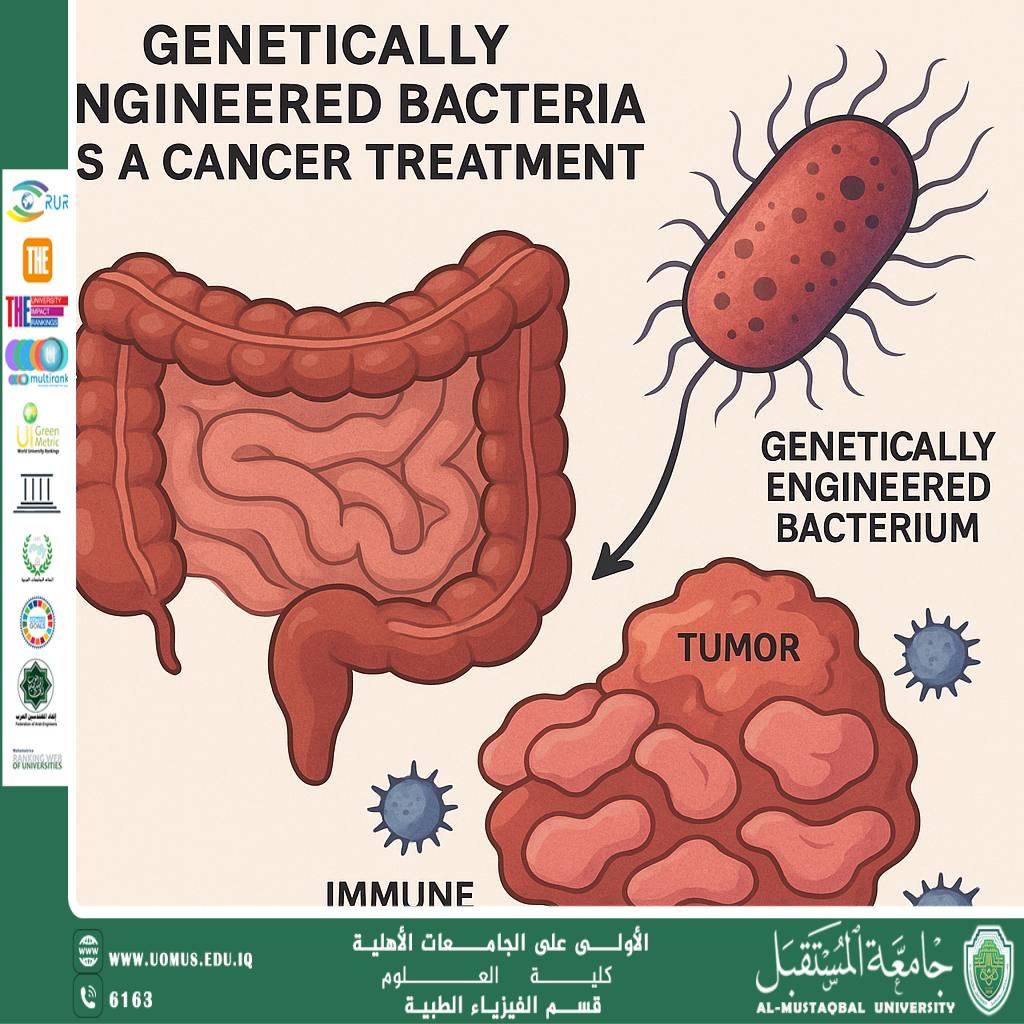
A scientific article by Assistant Professor (Maryam Reda Al-Sharaa) entitled “Genetically Modified Bacteria as a Treatment for Cancer: A Biological Revolution in the Fight Against the Disease”
Introduction<br /><br />In recent decades, significant progress has been made in understanding and treating cancer, from chemotherapy to immunotherapy. However, a new and unconventional technique has recently emerged: using genetically modified bacteria to attack cancer cells.<br />Could bacteria—long associated with disease—become an ally in the fight against one of the deadliest illnesses in the world?<br /><br />⸻<br /><br />What’s the Idea Behind Using Bacteria to Treat Cancer?<br /><br />Bacteria naturally thrive in low-oxygen environments (like the center of tumors) and can be genetically engineered to:<br /> • Specifically target cancer cells without harming healthy tissues<br /> • Release toxins or immune-stimulating substances that attack tumors<br /> • Deliver drugs or therapeutic agents directly into tumors<br /><br />These characteristics make bacteria an ideal biological delivery system for precise and effective cancer treatment.<br /><br />⸻<br /><br />Key Types of Bacteria Used<br /> 1. Genetically modified Salmonella<br />After removing their toxicity, these bacteria are programmed to attack tumors and trigger immune responses.<br /> 2. Clostridium<br />Thrive in oxygen-poor tumor environments and can be modified to produce anti-cancer agents.<br /> 3. Escherichia coli (E. coli)<br />Engineered to deliver cancer-fighting drugs directly to tumor sites.<br /><br />⸻<br /><br />How Are the Bacteria Genetically Engineered?<br /><br />Using tools like CRISPR, scientists add or remove genes that make the bacteria:<br /> • Safe for human use<br /> • Capable of producing therapeutic proteins<br /> • Targeted to specific locations in the body<br /><br />⸻<br /><br />Success in Animal and Human Trials<br /> • Trials in mice have shown encouraging results, with significant tumor shrinkage after bacterial treatment.<br /> • Some early-phase human clinical trials in the U.S., China, and Europe have demonstrated promising safety and strong immune responses in certain patients.<br /><br />⸻<br /><br />Potential Benefits<br /> • High precision in targeting tumors without widespread side effects like those from chemotherapy<br /> • Stimulation of the immune system to fight cancer<br /> • Can be combined with other treatments (e.g., immunotherapy or radiation)<br /><br />⸻<br /><br />Challenges and Risks<br /><br />Despite the promise, challenges remain:<br /> • Controlling bacterial behavior inside the body to avoid complications<br /> • Preventing bacteria from spreading to unintended parts of the body<br /> • Ensuring the immune system doesn’t destroy the bacteria prematurely<br /> • Ethical and regulatory concerns surrounding genetically modified organisms in medicine<br /><br />⸻<br /><br />Conclusion<br /><br />Using genetically engineered bacteria for cancer treatment represents a biological revolution combining biotechnology with precision medicine. While the journey is still in its early stages, the future looks promising. In the coming years, we may see “smart” bacteria that destroy tumors from within—minimizing harm to the rest of the body.<br /><br /><br /><br />"AL_mustaqbal University is the first university in Iraq"<br/><br/><a href=https://uomus.edu.iq/Default.aspx target=_blank>al-mustaqbal University Website</a>