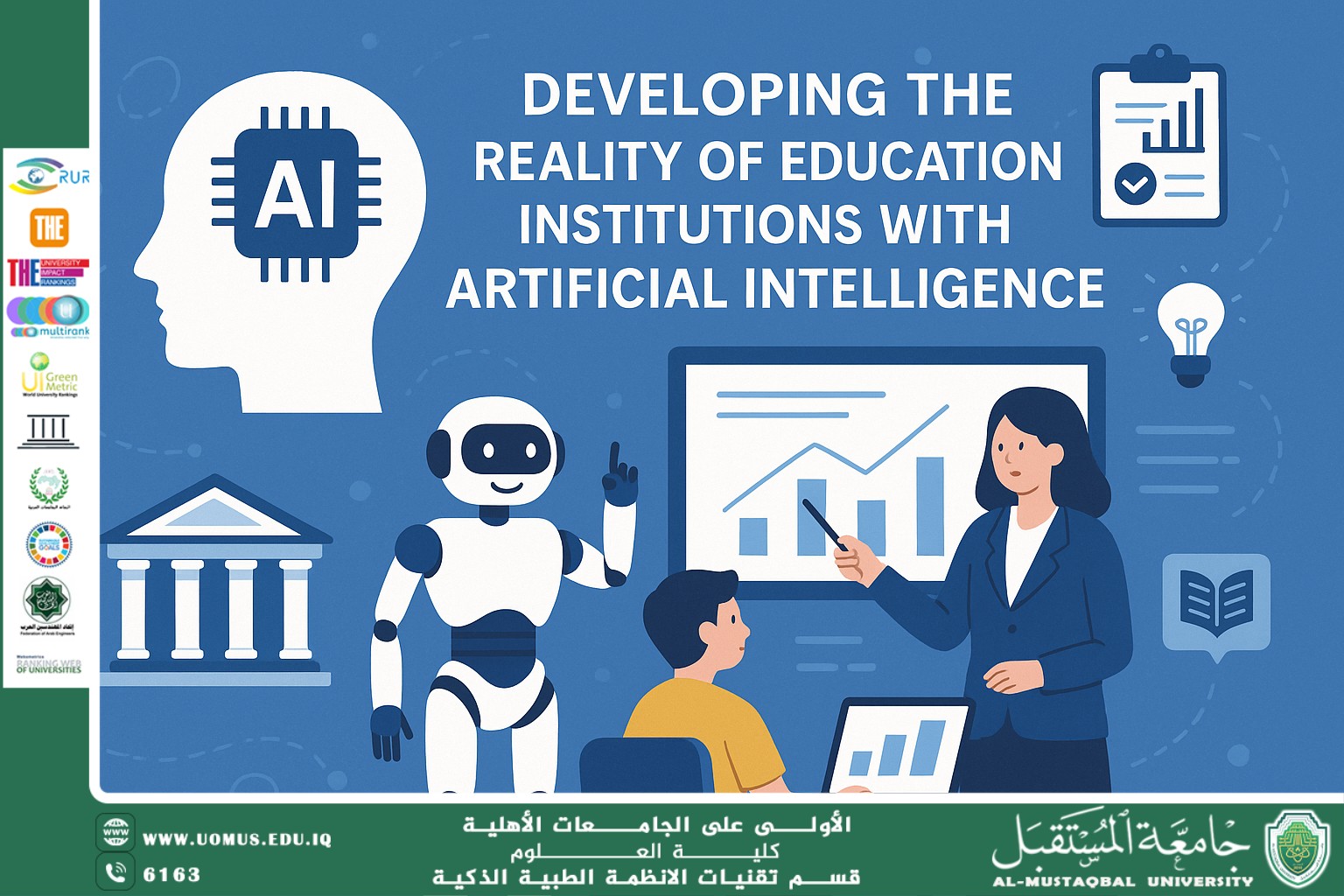

Enhancing the Reality of Educational Institutions Through Artificial Intelligence: From Automation to Smart Learning (Prof. Dr. Mehdi Ebady Manaa)
In recent decades, educational institutions have undergone a significant transformation due to rapid technological advancements, with Artificial Intelligence (AI) playing a prominent role in this shift. AI is no longer limited to supporting administrative infrastructure; it has become an active partner in the educational process through intelligent learning systems, educational data analysis, personalized content delivery, and enhanced assessment quality.<br />• Artificial Intelligence in Educational Administration<br />The integration of AI into educational institutions began with:<br />• Automation of administrative processes: including registration, scheduling, human resource management, and smart responses to student inquiries.<br />• Learning analytics: to monitor student performance and identify early warning signs of academic risk.<br />• Data-driven decision-making: through smart dashboards that help academic and administrative leadership improve planning and execution.<br />• AI in the Classroom<br />AI entered classrooms through:<br />• Adaptive learning systems: which offer educational content tailored to each student’s level and learning speed.<br />• Educational robots: functioning as intelligent teaching assistants or interactive instructional tools.<br />• AI-powered virtual and augmented reality: providing realistic simulations that enhance students' practical understanding of various subjects.<br />• Smart Assessment and Student Experience Enhancement<br />AI enables advanced methods of assessment, including:<br />• Automated grading systems using natural language processing to evaluate open-ended student responses.<br />• Sentiment analysis models to assess student engagement during online learning sessions.<br />• Smart content recommendations (books, videos, resources) based on student behavior and preferences.<br />• AI and Educational Equity<br />One of the key roles of AI is promoting educational fairness through:<br />• Supporting students with special needs: via text-to-speech and speech recognition tools.<br />• Expanding access to education: through MOOCs and e-learning platforms enhanced by personalized recommendation engines.<br />• Challenges and Future Directions<br />Despite its vast potential, AI in education faces several challenges:<br />• Protecting student data and privacy.<br />• Resistance to change from some traditional educational staff.<br />• The need for professional development to train educators on using smart tools effectively.<br />Future directions include:<br />• Smart schools integrating IoT and AI technologies to create connected, intelligent learning environments.<br />• Predictive learning models to guide students before academic failure occurs.<br />• AI-augmented teachers, where AI serves as a true instructional partner to the human educator.<br /><br />Al-Mustaqbal University: The Leading University in Iraq<br />