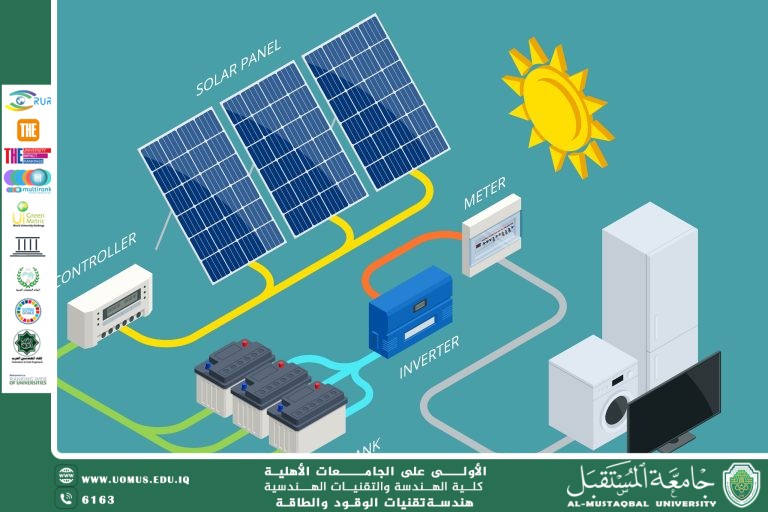
Batteries for solar cell (photovoltaic) systems
Batteries for solar cell (photovoltaic) systems<br />Assist. Prof. Malik Mustafa Mohammed<br /><br />(SDG 7): Affordable and Clean Energy <br />(SDG 9): Industry, Innovation, and Infrastructure <br />(SDG 12): Responsible Consumption and Production <br />When choosing batteries for solar cell (photovoltaic) systems , the goal is to store excess electricity generated during the day for use at night or during cloudy periods. The best battery depends on your specific needs, such as:<br />- System size (residential vs. commercial)<br />- Budget <br />- Energy storage capacity required <br />- Lifespan and maintenance <br />- Environmental impact <br />Here are the most commonly used and best-performing battery types for solar energy systems in 2024–2025:<br /> Top Battery Types for Solar Power Systems<br /> 1. Lithium-Ion Batteries (Most Popular) <br /> Pros:<br />- High energy density<br />- Long lifespan (5,000–7,000 cycles)<br />- Low maintenance<br />- Compact and lightweight<br />- Deep depth of discharge (DoD) (~90%)<br />- Scalable for residential and commercial use<br /> Cons:<br />- Higher upfront cost compared to lead-acid<br />- Sensitive to extreme temperatures (needs thermal management)<br /> Best For:<br />- Residential solar systems<br />- Off-grid and grid-tied systems<br />- Applications where space and efficiency matter<br /> Common Brands:<br />- Tesla Powerwall<br />- LG Chem RESU<br />- BYD B-box<br />- Polytech US Series<br /> 2. Lead-Acid Batteries (Traditional Option) <br /> Pros:<br />- Lower upfront cost<br />- Proven technology<br />- Easy to recycle<br /> Cons:<br />- Shorter lifespan (500–1,500 cycles)<br />- Lower DoD (~50%)<br />- Heavy and bulky<br />- Requires regular maintenance<br />- Slower charging<br /> Best For:<br />- Small off-grid systems with limited budgets<br />- Backup power applications where high performance isn’t critical<br /> Common Types:<br />- Flooded Lead-Acid (FLA)<br />- Sealed Lead-Acid (SLA), including AGM and Gel<br /> 3. Saltwater (Sodium-Ion) Batteries <br /> Pros:<br />- Non-flammable and non-toxic<br />- Environmentally friendly<br />- Fully recyclable<br />- Long cycle life (3,000–5,000 cycles)<br /> Cons:<br />- Lower energy density<br />- Heavier than lithium-ion<br />- Limited availability<br />- More expensive per kWh stored<br /> Best For:<br />- Eco-conscious users<br />- Indoor installations (no fire risk)<br />- Grid-scale or community solar projects<br />Example Brand:<br />- Aquion Energy (discontinued but inspired similar technologies)<br />- Natron Energy (sodium-ion batteries using Prussian blue chemistry)<br />4. Nickel-Cadmium (NiCd) Batteries <br /> Pros:<br />- Very durable in extreme temperatures<br />- Long cycle life<br />- Reliable in harsh environments<br /> Cons:<br />- Toxic materials (cadmium)<br />- Environmental disposal concerns<br />- Expensive<br />- Less efficient than lithium-ion<br /> Best For:<br />- Industrial or remote telecom systems in extreme climates<br /> 5. Flow Batteries (Vanadium or Organic Redox) <br /> Pros:<br />- Long lifespan (10,000+ cycles)<br />- Easily scalable<br />- Can be fully discharged without damage<br />- Separated power and capacity design<br /> Cons:<br />- Large footprint<br />- Complex system requiring pumps and tanks<br />- Lower energy density<br />- Higher initial cost<br /> Best For:<br />- Utility-scale or large commercial solar storage<br />- Long-duration energy storage (>6 hours)<br /> Example Companies:<br />- Invinity Energy Systems (vanadium redox flow)<br />- ESS Inc. (iron-based flow batteries)<br /> Key Considerations When Choosing a Solar Battery<br />1. Depth of Discharge (DoD) – How much of the battery’s capacity you can safely use.<br />2. Round-Trip Efficiency – How much energy is lost during charge/discharge (e.g., 90% means 10% loss).<br />3. Warranty & Lifespan – Look for long-term guarantees (e.g., 10 years or 10,000 cycles).<br />4. Safety – Especially important indoors; lithium-ion and saltwater are safest.<br />5. Integration – Ensure compatibility with your solar inverter and system setup.<br />6. Cost per kWh – Helps compare value across different battery sizes and chemistries.<br /> Recommended Batteries by Use Case<br />Use Case Recommended Battery<br />Best Overall Lithium-Ion (Tesla Powerwall, Pylontech)<br />Most Affordable Lead-Acid (for small off-grid systems)<br />Eco-Friendly Saltwater / Sodium-Ion<br />Longest Lifespan Flow Batteries (vanadium or iron-based)<br />Extreme Environments Nickel-Cadmium (NiCd)<br />Grid-Scale Storage Vanadium Redox Flow Batteries<br /><br /> Future Trends<br />- Solid-State Batteries: Promising higher safety, longer life, and better efficiency (coming soon from companies like QuantumScape, Toyota).<br />- Sodium-Ion Batteries: Cheaper and more sustainable alternative to lithium, gaining momentum in China and Europe.<br />- Second-Life EV Batteries: Repurposed electric vehicle batteries being tested for home and grid storage.<br />"Al-Mustaqbal University – The No. 1 Private University in Iraq"<br /><br /><br />