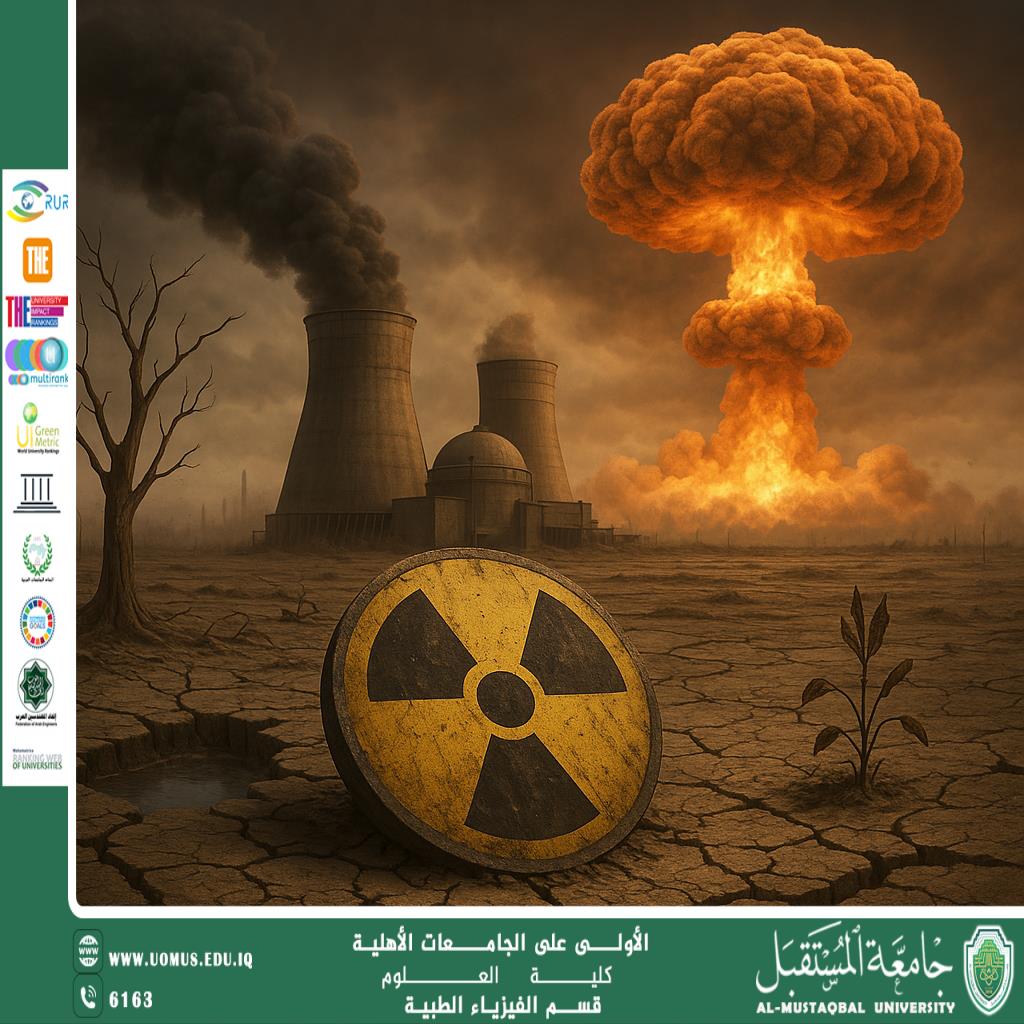
A scientific article by the Head of the Department of Medical Physics (Prof. Dr. Anis Ali) entitled “Nuclear Pollution in the Event of War: Environmental and Health Risks and Effects”
As a Result of the Ongoing Regional Conflicts between the Islamic Republic of Iran and Israel, and the Potential Risk of Nuclear Contamination due to Their Possession of Nuclear Reactors<br /><br />Given the escalating regional tensions between the Islamic Republic of Iran and Israel, and the potential threat of nuclear contamination should any of their nuclear reactors be targeted or damaged, this article aims to shed light on nuclear pollution, its dangers, and environmental impacts.<br /><br />Nuclear pollution is considered one of the most dangerous forms of environmental contamination. Its risk increases significantly during wartime, especially with the use of nuclear weapons or the targeting of civilian or military nuclear facilities. Nuclear pollution results from the release of radioactive substances such as uranium, plutonium, and cesium, which can spread through air, water, and soil, causing long-term harm to living organisms and ecosystems.<br /><br />1. Sources of Nuclear Pollution in Wars<br />Nuclear Weapons: Nuclear explosions generate intense thermal waves and shockwaves, in addition to immediate and residual radiation (known as radioactive fallout).<br /><br />Targeting Nuclear Reactors: Bombing or destruction of nuclear reactors can lead to the release of massive amounts of radioactive materials into the environment, as witnessed in the Chernobyl disaster (1986) in Ukraine, and almost occurred at the Zaporizhzhia plant during the Russia-Ukraine war.<br /><br />Use of Depleted Uranium Munitions: While not fully nuclear, these weapons release radioactive particles upon use, causing long-lasting localized contamination.<br /><br />2. Health Impacts<br />Ionizing Radiation can damage DNA, increasing the risk of cancer, blood disorders such as leukemia, birth defects, and infertility.<br /><br />Acute radiation exposure may lead to Acute Radiation Syndrome (ARS), which can be fatal within days.<br /><br />3. Environmental Effects<br />Contamination of water and soil with radioactive substances leads to the destruction of ecosystems, the death of plants and animals, and entry of radiation into the food chain, causing bioaccumulation in living organisms.<br /><br />Nuclear pollution has long-lasting effects; some radioactive isotopes, such as plutonium, remain active for hundreds or even thousands of years.<br /><br />4. Challenges and Solutions<br />Detection and Remediation: Technologies for detecting nuclear contamination and analyzing radioactive substances are essential for identifying hazardous areas. However, nuclear decontamination is technically complex and costly.<br /><br />International Law: Treaties such as the Nuclear Non-Proliferation Treaty (NPT) and the Comprehensive Nuclear-Test-Ban Treaty (CTBT) prohibit the use of nuclear weapons, yet enforcing these agreements remains a challenge during armed conflicts.<br /><br /><br /><br />"AL_mustaqbal University is the first university in Iraq"<br/><br/><a href=https://uomus.edu.iq/Default.aspx target=_blank>al-mustaqbal University Website</a>