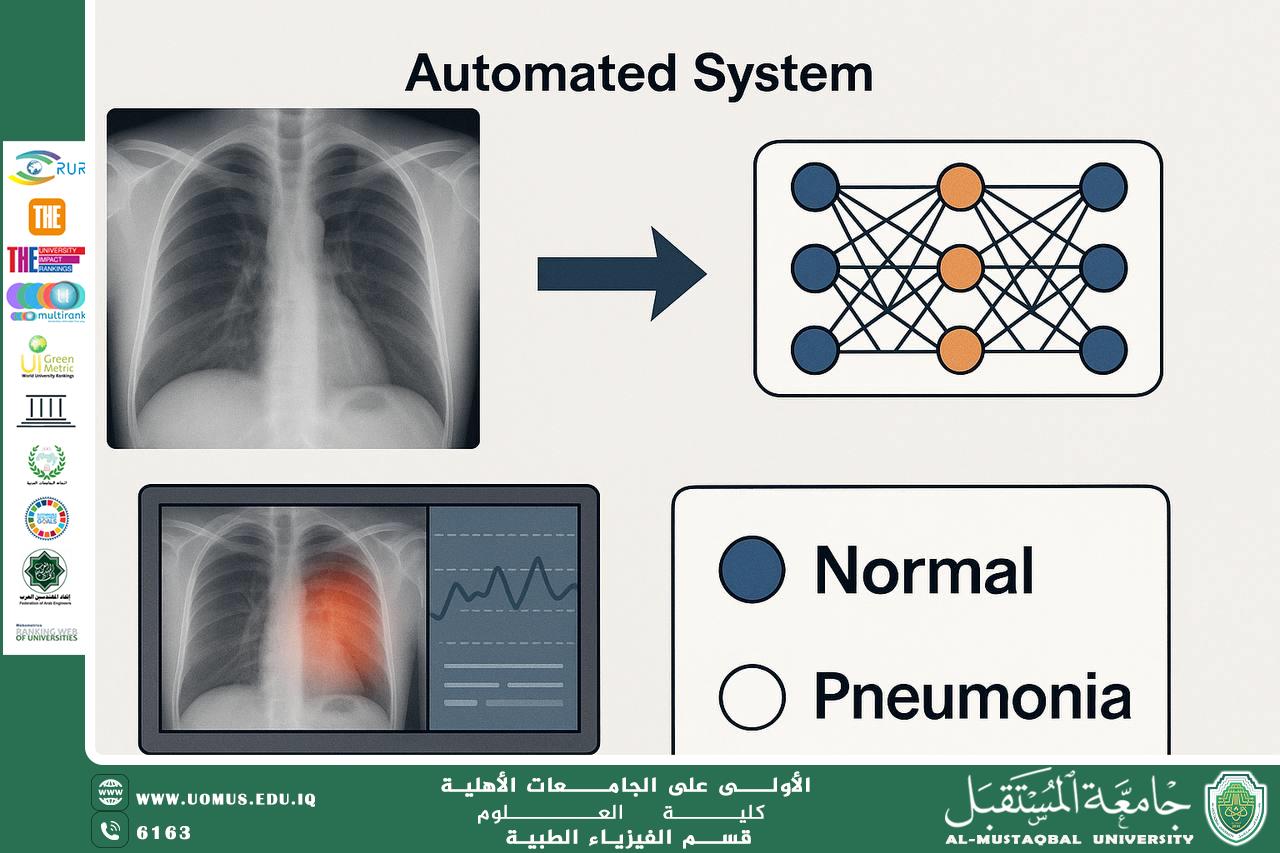
A scientific article by the lecturer (Assistant Lecturer Lubna Ali) entitled “Designing an automated system to detect pulmonary diseases from X-ray images using image processing techniques.”
With the advancement of artificial intelligence technologies and the increasing reliance on medical imaging as a diagnostic tool, there is an urgent need for intelligent solutions to assist physicians in the early and accurate detection of diseases—particularly those affecting the lungs, such as pneumonia, tuberculosis, and even COVID-19. From this need arose the idea of designing an automated system that uses X-ray images to detect pulmonary diseases through image processing techniques and machine learning algorithms.<br /><br />In this context, the X-ray image represents a visually rich input, but it requires precise analysis to extract prominent features that indicate the presence of a disease or abnormalities in lung tissue. The task is not easy; the image may be low in contrast, contain noise, or be unclear in certain areas due to differences in patient positioning or the type of imaging device used. Therefore, the first stage in building the automated system is the “preprocessing” phase, which includes contrast enhancement, noise reduction, and standardizing image dimensions. The goal of this phase is to prepare the images so that the algorithms can accurately and efficiently extract features.<br /><br />After the initial enhancement, the system moves to the feature extraction stage, where the image is analyzed to identify patterns that differentiate diseased lungs from healthy ones. Multiple techniques can be used in this stage, including algorithms that analyze edges, detect abnormal masses, or measure tissue density in specific regions. With advances in computing, deep neural networks—especially convolutional neural networks (CNNs)—have become the most effective method at this stage, as they can automatically learn features from large datasets without direct human intervention.<br /><br />Once important features are identified, the classification stage follows, where these features are fed into a pre-trained model that makes a decision: does the image indicate a healthy lung or the presence of disease? Various classification models can be used here, such as SVM, KNN, or even deep neural networks. These models are trained on large databases containing X-ray images with known diagnoses (i.e., previously confirmed by medical professionals), enabling the system to generalize its decisions on new, unseen images.<br /><br />A key advantage of such a system is not only its speed in diagnosis, but also its high accuracy—ranging from 85% to over 95% in some models—which competes with human interpretation, particularly in common or mild cases. Moreover, the system does not suffer from fatigue, psychological, or environmental factors, and can operate 24/7 with the same efficiency.<br /><br />One of the most impactful benefits of this type of system is its applicability in areas lacking specialized physicians or advanced medical infrastructure. With just a simple computer and a digital camera or image scanner, an X-ray image can be sent to the system for instant analysis—allowing medical teams in remote villages or isolated regions to receive a quick preliminary opinion that aids in decision-making.<br /><br />Despite its great advantages, the project faces challenges. For instance, system accuracy may vary from one hospital to another due to differences in imaging devices or image quality. Additionally, some pulmonary diseases may not be clearly visible in X-ray images and may require advanced imaging like a CT scan. Therefore, it is crucial that such a system be used as an assistant to physicians, not as a complete replacement—it enhances human decision-making, but does not eliminate it.<br /><br />In conclusion, designing an automated system for detecting pulmonary diseases from X-ray images represents a major step toward making healthcare smarter and more inclusive. It is a project that brings together computer science, image engineering, and medicine—and embodies the collaboration of various disciplines in achieving a noble humanitarian goal: saving lives and improving quality of life.<br /><br /><br /><br />"AL_mustaqbal University is the first university in Iraq"<br/><br/><a href=https://uomus.edu.iq/Default.aspx target=_blank>al-mustaqbal University Website</a>