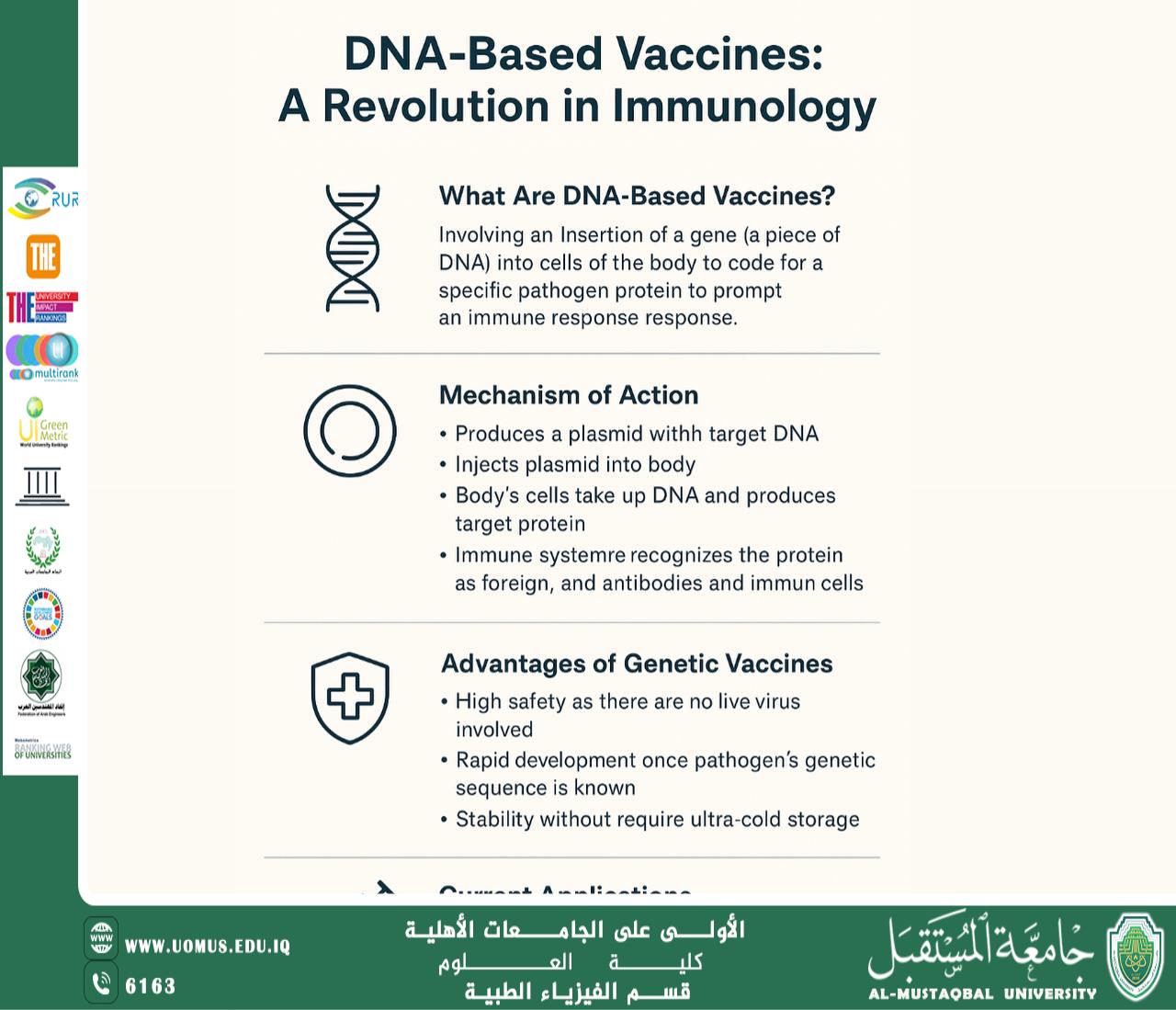
A scientific article by the teaching assistant (Maryam Reda Al-Sharaa) entitled “DNA-based vaccines: a revolution in immunology”
Introduction<br /><br />With the rapid advances in molecular biology and genetic engineering, a new generation of vaccines has emerged — most notably, DNA-based vaccines. These vaccines represent a true revolution in the field of immunology and preventive medicine due to their speed of production, modifiability, and relative safety compared to traditional vaccines.<br /><br />⸻<br /><br />What Are DNA-Based Vaccines?<br /><br />DNA-based vaccines work by introducing a gene (a piece of DNA) into the body’s cells. This gene carries the instructions for making a specific protein from a virus or bacterium. The body’s cells then produce this protein internally, prompting the immune system to recognize and respond to it, thus developing protective immunity without the person being infected.<br /><br />⸻<br /><br />How They Work<br /> 1. A DNA plasmid containing the target gene is created.<br /> 2. The plasmid is injected into the body, typically into muscle tissue.<br /> 3. The cells absorb the DNA and begin producing the target protein.<br /> 4. The immune system recognizes the protein as foreign and generates antibodies and immune cells against it.<br /> 5. If the person later encounters the actual virus or bacterium, their immune system is prepared to fight it off effectively.<br /><br />⸻<br /><br />Advantages of DNA Vaccines<br /> • High safety: They do not contain live viruses, so they cannot cause disease.<br /> • Rapid development: Can be produced quickly in the lab once the genetic sequence of the pathogen is known.<br /> • Stability: Often more stable and do not require extremely cold storage.<br /> • Ease of modification: The DNA sequence can be easily updated to match virus mutations.<br /><br />⸻<br /><br />Current Applications<br /> • DNA vaccines have been developed for COVID-19, such as the ZyCoV-D vaccine in India.<br /> • They are also being explored for Zika virus, influenza, HPV (human papillomavirus), and even cancer.<br /><br />⸻<br /><br />Challenges and Limitations<br /> • Low cellular uptake: DNA may not always efficiently enter cells.<br /> • Need for special delivery tools: Such as electroporation devices to enhance DNA entry into cells.<br /> • Lack of long-term data: More research is needed to understand long-term safety and immune response duration.<br /><br />⸻<br /><br />Conclusion<br /><br />DNA-based vaccines represent a new era of vaccination technology — fast, safe, and highly adaptable. As scientific research continues, these vaccines are expected to play a major role in fighting infectious diseases and even cancer in the near future.<br /><br /><br /><br />"AL_mustaqbal University is the first university in Iraq"<br/><br/><a href=https://uomus.edu.iq/Default.aspx target=_blank>al-mustaqbal University Website</a>