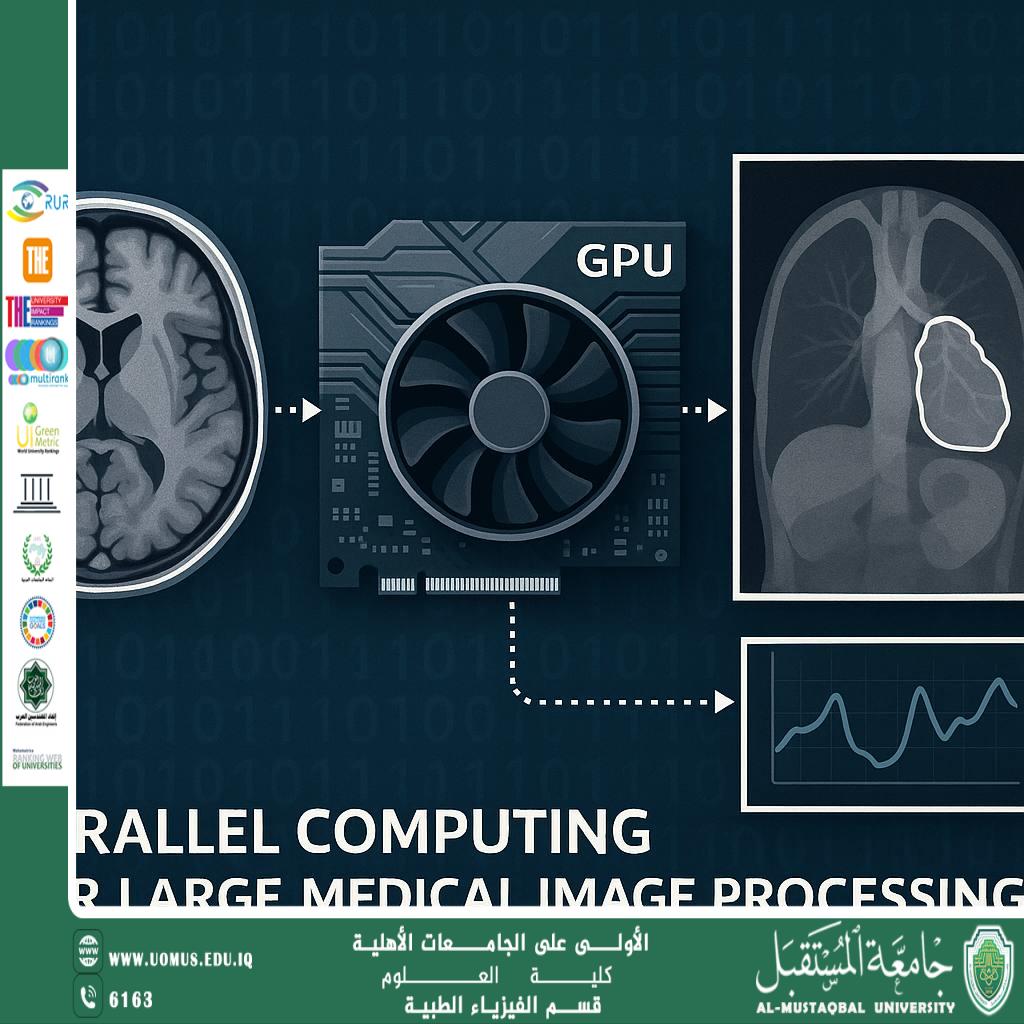
A scientific article by the lecturer (Assistant Lecturer Lubna Ali) entitled “Using parallel computing to process large medical images using GPU processors”
With the rapid advancements in medical imaging technologies, healthcare institutions today are dealing with massive amounts of image data generated by devices such as Magnetic Resonance Imaging (MRI), Computed Tomography (CT), and Ultrasound. These images, often 3D or time-sequenced, are not only important for display purposes, but also require fast and accurate analysis to extract crucial diagnostic information.<br /><br />Given the enormous increase in both volume and resolution of such data, it has become evident that traditional Central Processing Units (CPUs) are no longer sufficient to process medical images with the required efficiency. This is where the revolutionary role of parallel computing using Graphics Processing Units (GPUs) emerges as an effective solution to accelerate and enhance the performance of medical image processing systems.<br /><br />GPUs were not originally designed for this purpose; they were built to handle graphics and gaming. However, they are architected to perform thousands of calculations simultaneously, making them ideal for dealing with large and complex images. While the CPU typically executes instructions sequentially, GPU cores can work in parallel on multiple data units—a concept at the heart of parallel computing.<br /><br />Let’s consider a common scenario: a doctor wants to analyze an MRI scan of the brain consisting of 512 × 512 × 200 voxels, with each voxel carrying a specific medical value. This image represents over 50 million data points. If the doctor wishes to run a segmentation algorithm to separate a tumor from healthy tissue, the process might take several minutes or even hours on a CPU—a delay that could be critical in emergency cases. However, when this algorithm is deployed on a GPU using frameworks such as CUDA or OpenCL, it can be executed in mere seconds.<br /><br />This paradigm shift would not have been possible without the efforts of computer engineers, who not only adapted legacy code but also developed entirely new algorithmic frameworks tailored to the parallel architecture of GPUs. For example, filtering, edge detection, and feature extraction algorithms have been re-engineered to run simultaneously across individual pixels, dramatically reducing processing time.<br /><br />Beyond the academic domain, these techniques are now actively implemented in major hospitals and research centers. There are integrated systems capable of analyzing imaging data immediately upon acquisition, providing preliminary assessments in seconds. Some companies have even begun developing cloud-based applications, where images are uploaded, processed on GPU servers, and results are sent back to physicians in real time.<br /><br />However, this field is not without its challenges. Building an effective GPU-based software environment requires advanced expertise in parallel programming, and the hardware itself can be expensive and not always accessible in every medical setting. Moreover, the accuracy of results can vary depending on data types, image quality, and algorithm training.<br /><br />Despite these hurdles, this field is considered one of the most promising, with researchers predicting that parallel computing will become a standard component of medical diagnostic systems in the near future—especially with the rise of artificial intelligence and machine learning, which also demand immense computational power only GPUs can provide.<br /><br />In conclusion, parallel computing using GPUs has not only accelerated medical image processing but has fundamentally changed the landscape. It has opened the door to new diagnostic applications and empowered doctors with more effective tools for faster and more accurate decision-making. Thanks to this advancement, medical images are no longer static snapshots—they are dynamic inputs that can be analyzed, understood, and compared in real time, all in the service of human health and well-being.<br /><br /><br />"AL_mustaqbal University is the first university in Iraq"<br/><br/><a href=https://uomus.edu.iq/Default.aspx target=_blank>al-mustaqbal University Website</a>