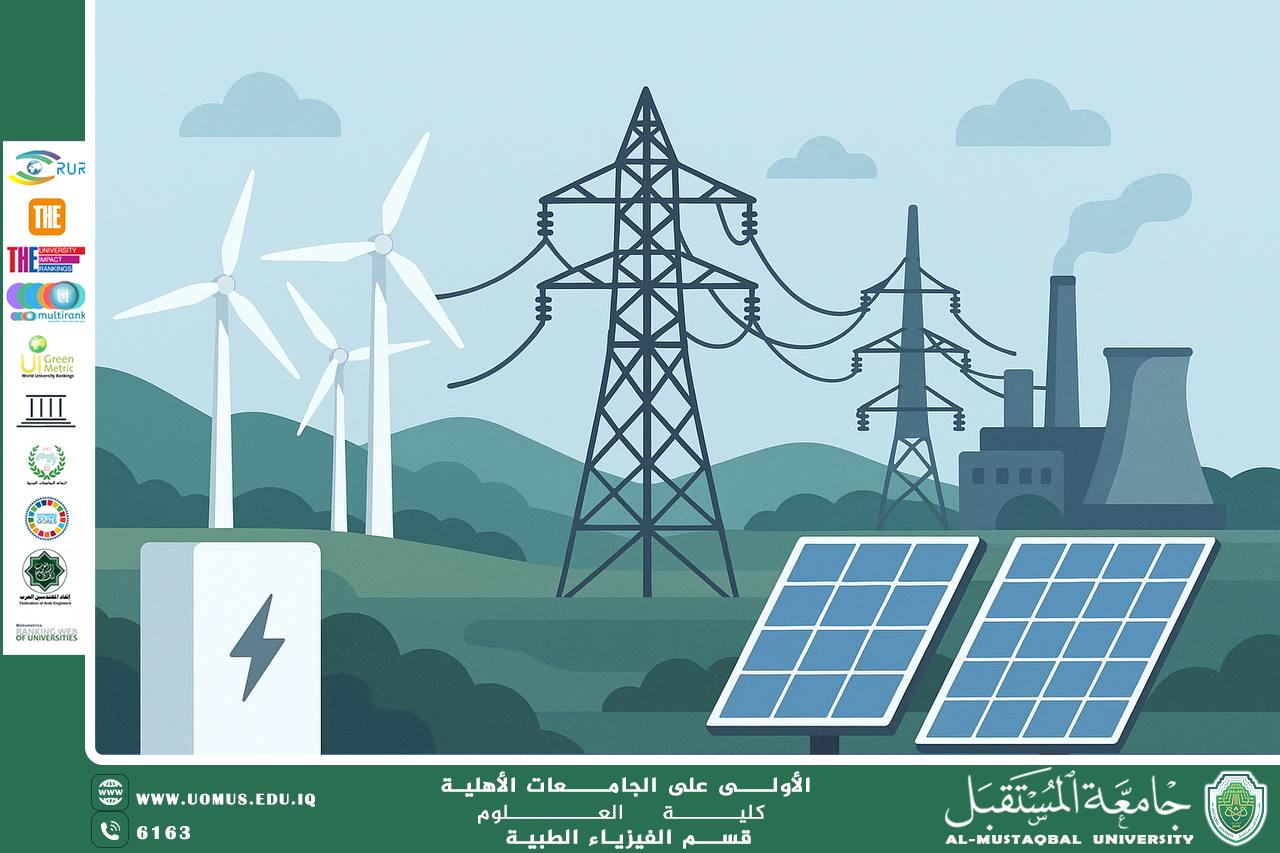
A scientific article by the Medical Physics Department rapporteur (Assistant Professor Israa Hussein Amwishi) entitled “Studying the impact of distributed energy sources on the stability of electrical networks.”
In recent decades, electric power systems have been undergoing a fundamental transformation with the increasing integration of renewable energy sources, particularly Distributed Energy Resources (DERs) such as solar panels, wind turbines, and fuel cells. These relatively small-scale sources, typically installed near load centers, offer effective solutions to reduce energy losses, improve efficiency, and enable communities to access sustainable energy. However, despite these advantages, the integration of DERs into traditional power grids presents major challenges regarding Power System Stability.<br /><br />To begin with, it is important to distinguish between the different types of grid stability:<br /> • Transient Stability: The system’s ability to return to a stable state after a sudden disturbance such as a line trip or a short circuit.<br /> • Dynamic Stability: The system’s response to small and continuous variations, such as load fluctuations.<br /> • Voltage Stability: The system’s ability to maintain a stable voltage level under operational changes.<br /><br />When DERs are widely integrated, the distribution of active and reactive power is altered, which can disrupt the dynamic balance of the grid. These resources are often connected via power electronic inverters, which behave very differently from traditional synchronous generators that rely on mechanical inertia. This results in what is known as “low grid inertia”, leading to faster oscillations and greater difficulty in maintaining frequency stability.<br /><br />Recent simulation studies have shown that networks with over 40% DER penetration become more vulnerable to frequency collapse during short-term faults due to the lack of adequate immediate response. Moreover, the presence of multiple inverter-based systems leads to uncoordinated interaction between voltage control units, potentially causing resonance phenomena or unpredictable local voltage fluctuations.<br /><br />Despite these challenges, several innovative control strategies have emerged to enhance grid stability, including:<br /> • Decentralized Predictive Control: Utilizing AI-based or optimization-driven control systems to adjust DER outputs in response to load variations.<br /> • Virtual Inertia Emulation: Programming inverters to mimic the dynamic behavior of conventional generators by analyzing the frequency derivative over time.<br /> • Battery Energy Storage Systems (BESS): Automatically activated to regulate frequency or voltage during disturbances.<br /><br />In a 2022 IEEE study on a local grid with 60% DER integration, the implementation of an advanced virtual inertia control system led to a significant improvement in dynamic stability, reducing system response time by 45%.<br /><br />On another front, the communication infrastructure plays a critical role in maintaining stability in modern grids. The successful integration of DERs depends heavily on the availability of real-time data channels between control units and Phasor Measurement Units (PMUs), posing a challenge in areas with weak communication infrastructure.<br /><br />⸻<br /><br />Conclusion:<br /><br />Although Distributed Energy Resources offer substantial benefits, their uncoordinated or random integration into traditional grids may lead to voltage collapse or unexpected oscillations. The key lies in:<br /> • Developing smart control architectures,<br /> • Supporting the grid with energy storage systems,<br /> • Enhancing digital infrastructure (moving toward smart grids).<br /><br />Understanding these impacts is a vital step toward building more resilient and sustainable electrical networks, capable of accommodating the global shift toward clean energy sources.<br /><br /><br />"AL_mustaqbal University is the first university in Iraq"<br/><br/><a href=https://uomus.edu.iq/Default.aspx target=_blank>al-mustaqbal University Website</a>