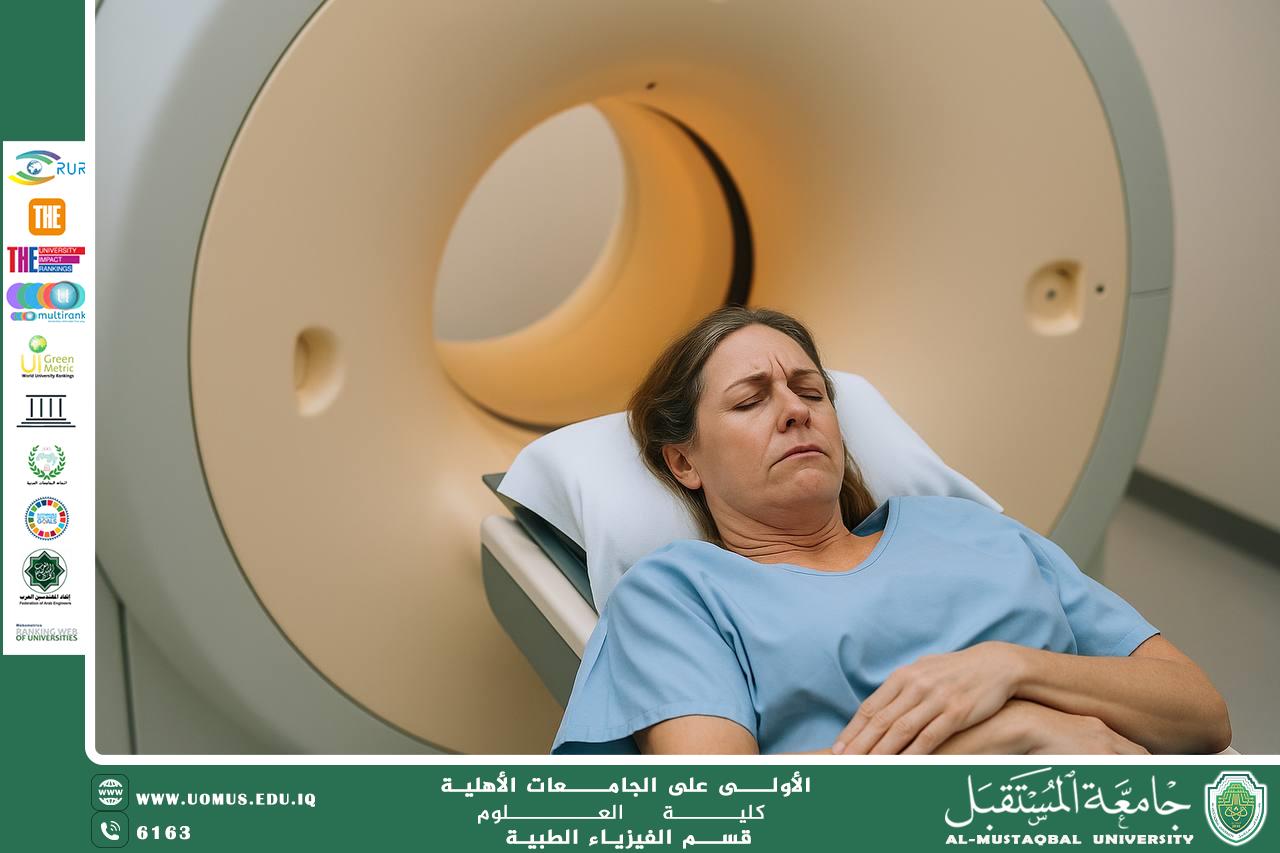
A scientific article by the teaching assistant (Ahmed Abdel Salam) entitled “Analysis of the psychological impact of repeated medical imaging on patients: a physical-psychological perspective”
Abstract:<br /><br />Medical imaging has become an essential tool in modern diagnosis and treatment. However, the repeated use of imaging procedures may have psychological effects on patients, depending on the technique used and the number of sessions required. This study aims to highlight the psychological dimension of repeated radiological examinations, offering a “psychophysical” perspective that connects physical imaging factors (such as radiation, noise, and isolation within the devices) with patients’ emotional responses.<br /><br />⸻<br /><br />✧ Introduction:<br /><br />In recent decades, medical imaging technologies have advanced significantly. Procedures such as Magnetic Resonance Imaging (MRI), Computed Tomography (CT), and nuclear imaging (PET/SPECT) have become indispensable in diagnosing and monitoring complex medical conditions, especially in oncology and chronic diseases.<br /><br />With the increased frequency of these imaging procedures, questions have arisen regarding their non-physiological effects—particularly the psychological impact on patients, caused by factors such as device-related isolation, loud noises, radiation warnings, or anxiety regarding scan outcomes.<br /><br />Despite the relevance of this issue, the psychological burden of repeated imaging remains understudied. This underscores the need for a scientific approach that integrates medical physics with health psychology to assess and manage these effects effectively.<br /><br />⸻<br /><br />✧ Objectives:<br /><br />This article aims to:<br /> 1. Identify the most prominent psychological stressors associated with repeated medical imaging.<br /> 2. Analyze the relationship between physical imaging factors (device type, session duration, frequency) and psychological responses.<br /> 3. Propose practical strategies to improve patient experience in imaging departments.<br /> 4. Emphasize the role of the medical physicist in enhancing psychological well-being during imaging procedures.<br /><br />⸻<br /><br />✧ Scientific Content:<br /><br />1. Physical Factors Affecting Patient Psychology<br /><br />Studies show that certain imaging modalities—particularly MRI—trigger varying degrees of psychological distress due to:<br /> • High and repetitive acoustic noise<br /> • Claustrophobic experience inside the scanner<br /> • Extended scan durations<br /> • Requirement to remain still for long periods<br /> • Radiation warnings that may alarm patients<br /><br />2. Associated Psychological Factors<br /><br />Many patients may experience:<br /> • Pre-scan anxiety (anticipatory stress before imaging)<br /> • Acute stress symptoms during imaging (elevated heart rate, sweating, etc.)<br /> • Persistent imaging-related anxiety, especially when scans are frequent<br /> • Obsessive thoughts about radiation dose or scan results<br /><br />3. Individual Differences<br /><br />The psychological impact of imaging varies by gender, age, medical condition, socio-economic status, and the patient’s level of health literacy.<br /><br />4. Suggested Interventions<br /> • Implement therapeutic music during scans<br /> • Provide pre-scan psychological preparation<br /> • Simplify communication to reduce patient confusion and fear<br /> • Use open or silent imaging devices to minimize discomfort<br /> • Involve medical physicists and psychologists in patient support protocols<br /><br />⸻<br /><br />✧ Expected Outcomes:<br /> • Decreased anxiety levels among patients who receive proper psychological support<br /> • Improved image quality due to reduced motion during scans<br /> • Greater patient satisfaction and trust in the healthcare system<br /> • Encouragement for imaging centers to develop better patient communication strategies<br /><br />⸻<br /><br />✧ Conclusion:<br /><br />Medical imaging should not be viewed solely as a technical diagnostic tool; it is part of a comprehensive healthcare experience that includes psychological and emotional dimensions. Repeated imaging—especially in chronic cases—can have a profound psychological impact if left unaddressed. Therefore, adopting a psychophysical approach to imaging can significantly enhance patient care, and highlights the vital role of medical physicists not only in technical optimization, but also in improving the human experience of medical diagnostics.<br /><br /><br /><br /><br />"AL_mustaqbal University is the first university in Iraq"<br/><br/><a href=https://uomus.edu.iq/Default.aspx target=_blank>al-mustaqbal University Website</a>