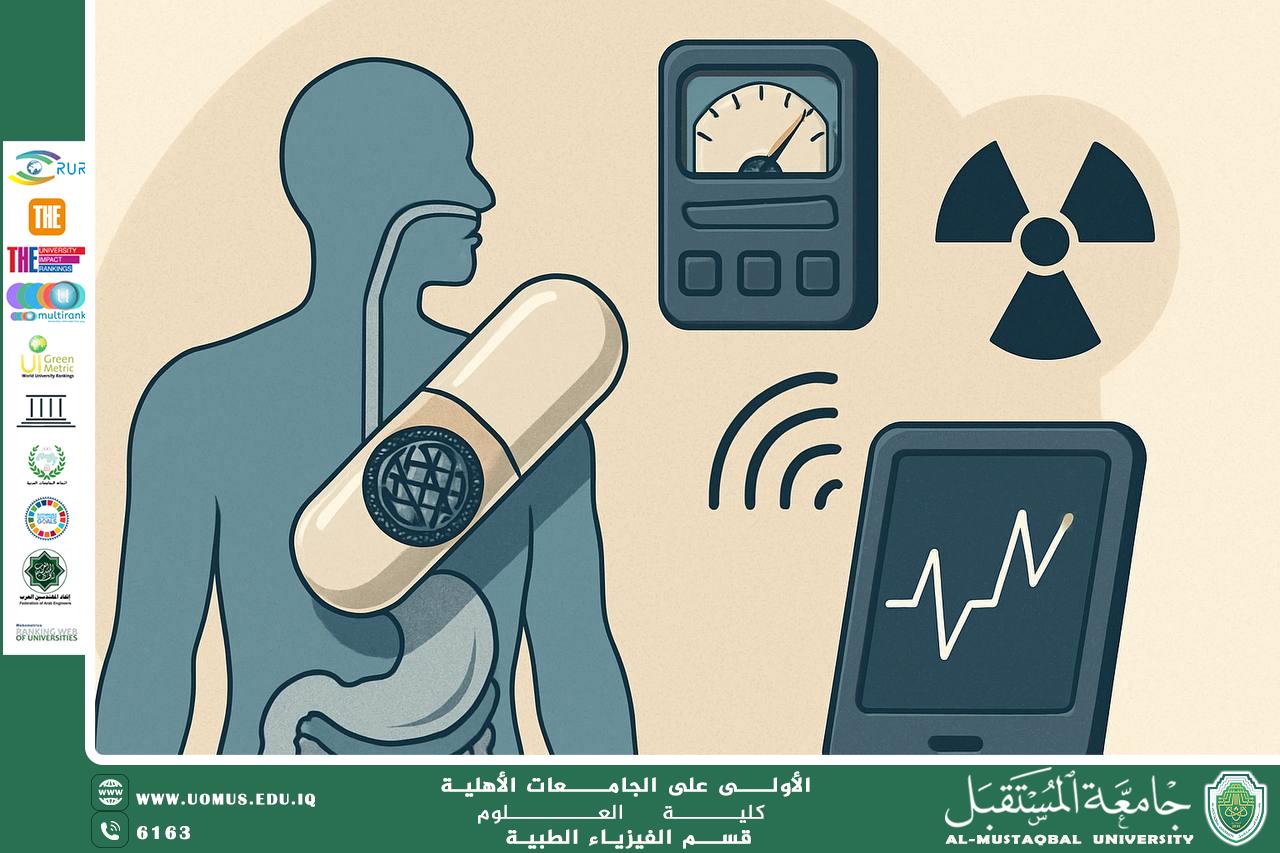
A scientific article by the lecturer (Assistant Lecturer Ammar Karim) entitled “Developing swallowable nanosensors to measure internal radiation levels: A step towards accurate and safe patient monitoring”
Abstract:<br /><br />With the increasing use of radioactive isotopes in nuclear medicine and internal imaging, the need for intelligent tools capable of accurately and safely monitoring internal radiation exposure has emerged. The development of ingestible nanosensors is a recent innovation in this field, allowing real-time measurement of radiation doses from within the gastrointestinal tract or deep tissues, without the need for surgical intervention or bulky equipment. This article discusses the physical and technological foundations of these nanosensors, their potential applications in diagnostic and therapeutic medicine, and the challenges surrounding their clinical implementation.<br /><br /><br />✧ Introduction:<br /><br />Rapid advancements in nanotechnology have opened new frontiers in healthcare, especially in disease diagnosis and treatment monitoring through unconventional, miniaturized technologies. Among these promising applications is the concept of ingestible nanosensors—ultra-small devices that can be swallowed like a capsule to record and transmit physiological or chemical data from inside the human body.<br /><br />In medical physics, there is a growing demand for tools that can monitor radiation levels internally, particularly for patients undergoing nuclear therapy or repeated imaging involving radioactive tracers. Here, ingestible smart sensors offer an innovative solution that could revolutionize traditional monitoring methods.<br /><br /><br />✧ Mechanism of Action:<br /><br />These nanosensors utilize nanotechnology-based materials to fabricate ultra-sensitive components (typically under 100 nanometers), coated with biocompatible layers that can withstand the harsh conditions of the gastrointestinal environment.<br />The sensors work by:<br /> • Detecting ionizing radiation (gamma, beta) within the body.<br /> • Measuring the absorbed dose in real-time at various locations.<br /> • Transmitting data wirelessly to an external device via RF or low-power Bluetooth signals.<br /><br />Some models are also equipped with additional sensors to monitor temperature, pH, and pressure, providing a multi-dimensional view of the internal environment in parallel with radiation levels.<br /><br /><br />✧ Medical Applications:<br /> 1. Monitoring internal radiation during nuclear therapy<br />Especially with internal isotopes such as Iodine-131 or Lutetium.<br /> 2. Diagnosing absorption disorders or evaluating gastrointestinal motility using small amounts of radiotracers.<br /> 3. Tracking cumulative radiation exposure in patients undergoing frequent PET-CT or SPECT imaging.<br /> 4. Clinical trials to assess the efficiency of radiation protection protocols at the tissue level.<br /><br /><br />✧ Technical and Research Challenges:<br /><br />Despite the great promise of this technology, several challenges remain:<br /> • Ensuring complete biocompatibility and safety throughout the digestive tract.<br /> • Developing energy-efficient power sources to sustain sensor function.<br /> • Managing signal stability and data accuracy inside the body.<br /> • Minimizing electromagnetic interference and transmission errors.<br /><br />Research teams are also exploring bioenergy-based power sources, such as those harnessing gastric acid or muscle movement, to make these devices fully autonomous.<br /><br /><br />✧ Future Prospects:<br /><br />As the world shifts toward personalized medicine and precision monitoring, ingestible nanosensors are poised to become key components in the future of medical physics and radiological imaging. Over the next few years, we may see these technologies integrated into clinical protocols—particularly in oncology and thyroid medicine—as well as used as intelligent diagnostic tools in preventive medicine.<br /><br />✧ Conclusion:<br /><br />The development of ingestible nanosensors represents a transformative step in internal radiation monitoring, showcasing the powerful synergy between physics, nanotechnology, and biotechnology in advancing modern medicine. While implementation challenges remain, the potential for these tools to reduce radiation risks and improve diagnostic accuracy offers a compelling vision for the future of safe and personalized patient care.<br /><br /><br /><br /><br />"AL_mustaqbal University is the first university in Iraq"<br/><br/><a href=https://uomus.edu.iq/Default.aspx target=_blank>al-mustaqbal University Website</a>