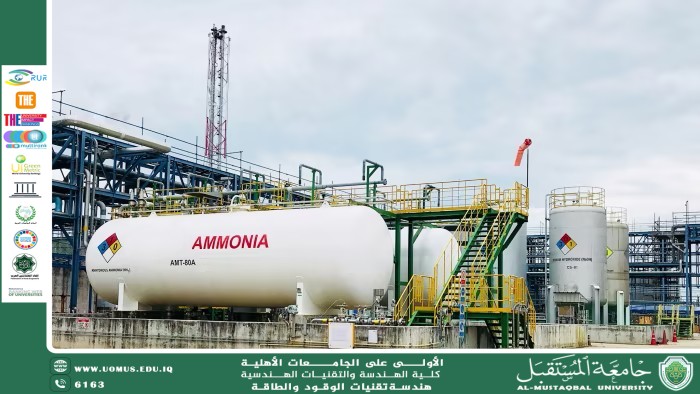
Ammonia fuel
Ammonia fuel<br />Assist. Prof. Malik Mustafa Mohammed<br /><br />• SDG 7: Affordable and Clean Energy<br />• SDG 9: Industry, Innovation, and Infrastructure<br />• SDG 12: Responsible Consumption and Production<br />Ammonia fuel is a synthetic chemical compound composed of nitrogen and hydrogen (NH₃) that is increasingly recognized as a promising carbon-free energy carrier and alternative fuel source. Here's a detailed breakdown of its role and properties:<br /> 1. Key Characteristics <br />- Hydrogen Carrier: Ammonia has a high hydrogen density, storing 1.5 moles of hydrogen per mole of NH₃, making it easier to transport and store than pure hydrogen [citation:8]. <br />- Zero-Carbon Combustion: When burned, it produces nitrogen gas (N₂) and water (H₂O), avoiding greenhouse gas emissions like CO₂ or methane <br />- Versatile Applications: <br /> - Can power internal combustion engines (similar to traditional fuel systems).<br /> - Used in gas turbines and fuel cells for electricity generation.<br /> - Emerging as a maritime fuel due to its energy density. <br /> 2. Production Methods <br />Ammonia is synthesized through: <br />- Renewable Energy: "Green ammonia" is produced using wind, solar, or hydropower to extract hydrogen via electrolysis, then combining it with nitrogen from the air. <br />- Fossil Fuels or Biomass: Traditional methods rely on natural gas reforming or biomass gasification, though these are less sustainable.<br /> 3. Advantages <br />- Energy Storage & Transport: Ammonia’s stability and high energy density make it practical for long-term storage and global shipping, addressing hydrogen’s storage challenges.<br />- Existing Infrastructure: Can leverage current fertilizer industry production and shipping systems.<br /> 4. Challenges <br />- Toxicity: Ammonia is hazardous to handle and requires careful safety protocols. <br />- Combustion Efficiency: Requires high ignition temperatures, posing engineering hurdles for engines.<br /> 5. Future Outlook <br />Ammonia is positioned as a critical component in a decarbonized fuel ecosystem, particularly for industries like shipping and power generation where electrification is impractical.<br />First, looking at the search results, I notice that most of the information is about ammonia production in general, not specifically as a fuel. But there are a few mentions of green ammonia plants, which are likely for fuel use. <br />- Louisiana plant: 20,000 tons/year.<br />- China plant: 1.52 million tons/year.<br />- Saudi Arabia/Middle East: 1.1 million tones.<br />- Donaldsonville, Louisiana: 4.335 million tons (but is this for fuel? The citation 19 says CF Industries' capacity, but the use isn't specified. Maybe it's general production.)<br />- Alberta: 3.5 million tons <br /><br />So, the Louisiana green ammonia plant (20k tons) and the China plant (1.52M tons) are likely for fuel. The Saudi plant (1.1M) might be general, but maybe it's part of green initiatives. The Alberta production is 3.5M, but again, need to check if it's for fuel.<br />The Louisiana plant (20k tons) is green. The China plant (1.52M) is also green. The Saudi plant (1.1M) is a new plant, maybe green? The text says "a new ammonia production plant" but doesn't specify green. However, webpage 8 mentions renewable ammonia, so maybe that's related.<br />"Alberta is the leading region in this regard, producing about 3.5 million metric tons of ammonia per year." The "this regard" refers to the previous sentence, which in the original text is about production rates. But without context, it's unclear if it's for fuel. Since the user is asking about fuel, maybe only the green ones are relevant.<br />The original text "Alberta is the leading region in this regard, producing about 3.5 million metric tons of ammonia per year." The "this regard" refers to the previous sentence, which in the original text is about production rates. Without more context, it's unclear if it's for fuel. Since the user is asking about fuel, maybe only the explicitly mentioned green plants are relevant.<br />Alternatively, perhaps the Alberta plant is a major producer but not specifically for fuel. The user might want all major production sites, but the question specifies "ammonia fuel", so only the green ones.<br /><br />"Al-Mustaqbal University – The No. 1 Private University in Iraq"<br />