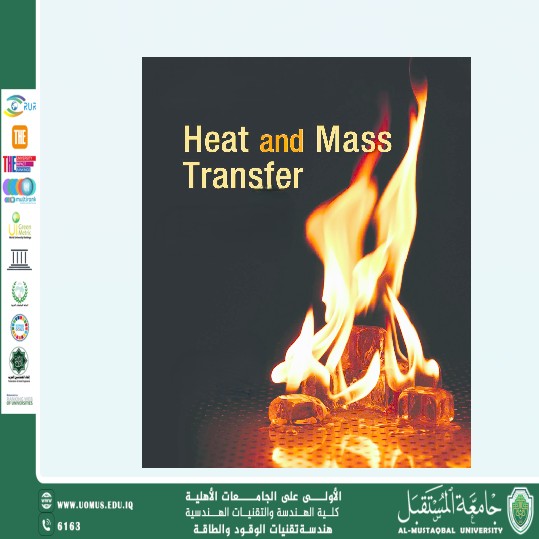
Heat and Mass Transfer in Fuel Systems: From Theory to Application
Heat and Mass Transfer in Fuel Systems: From Theory to Application<br />By: Asst. Lecturer Shahad Ammar Hatam<br /><br />Relevant Sustainable Development Goals (SDGs):<br /> SDG 7: Affordable and Clean Energy<br /> SDG 9: Industry, Innovation, and Infrastructure<br /> SDG 12: Responsible Consumption and Production<br />Introduction<br />Heat and mass transfer processes are critical in designing and operating fuel systemsfrom combustion chambers to reactors and heat exchangers. Understanding how energy and matter move within these systems allows engineers to improve efficiency and safety.<br />Heat Transfer in Fuel Systems<br />There are three modes of heat transfer:<br />Conduction: Through solid materials, important in engine walls or insulation.<br />Convection: Through fluids (liquids/gases), crucial in fuel-air mixing.<br />Radiation: High-temperature heat transfer, especially in combustion zones.<br />Efficient heat management reduces energy loss and enhances performance.<br />Mass Transfer in Fuel Processes<br />Mass transfer governs how substances like fuel and air, or fuel and oxidizer, mix and react.<br />Key examples include:<br />Diffusion in porous media (e.g., fuel cells)<br />Evaporation of liquid fuels into vapor<br />Separation processes (e.g., distillation, absorption)<br />Optimizing these processes leads to better combustion and cleaner emissions.<br />Practical Applications<br />Designing combustion chambers with optimal fuel-air mixing<br />Improving fuel reforming systems for hydrogen production<br />Enhancing cooling systems in energy plants and engines<br />Simulation tools such as CFD (Computational Fluid Dynamics) help visualize and predict complex behaviors.<br />Sustainability Connection<br />Better heat and mass transfer design means:<br />Less fuel consumption<br />Lower emissions<br />Higher system durability<br />This directly supports SDGs 7, 9, and 12, by making energy systems cleaner and more efficient.<br /><br />Conclusion<br /><br />From equations on paper to high-performance fuel systems, heat and mass transfer principles guide innovation in the energy sector. Mastering these fundamentals empowers engineers to create more sustainable and effective technologies..<br /><br />"Al-Mustaqbal University – The No. 1 Private University in Iraq"<br />