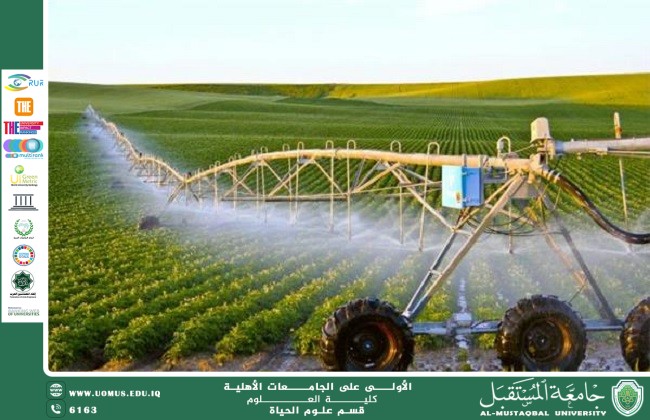
A scientific article by lecturer Ms. Zainab Nazim Aziz entitled "Smart irrigation systems and their role in rationalizing water consumption."
In light of water scarcity, climate change, and increasing pressure on natural resources, smart irrigation systems have become a leading solution for achieving high water efficiency in agriculture, without compromising crop productivity. These systems rely on technology and automated control to deliver the right amount of water at the right time and place.<br />What are smart irrigation systems?<br />Smart irrigation systems are modern technologies that use sensors, software, and the Internet of Things (IoT) to determine a plant's actual water needs based on multiple factors, such as:<br />Soil moisture<br />Air temperature<br />Plant type and age<br />Expected weather conditions<br />Components of smart irrigation systems<br />1. Soil moisture sensors:<br />Measure soil moisture and transmit data to the system.<br />2. Mini weather stations:<br />Monitors temperature, wind speed, evaporation rate, and rainfall.<br />3. Control and programming devices:<br />Automatically adjust irrigation schedules and quantities based on the data.<br />4. Mobile and web applications:<br />Enable farmers to remotely monitor and control their irrigation system.<br />5. Smart valves and pumps:<br />Automatically open and close according to commands received from the system.<br />Benefits of smart irrigation systems in rationalizing water consumption<br />1. Reducing water loss: Directing water directly to the roots only when needed, reducing evaporation and runoff.<br />2. Improving crop productivity: Providing plants with water according to their actual needs, enhancing their growth and quality of production.<br />3. Reducing costs: Reducing electricity, water, and labor bills.<br />4. Responding to climate change: Automatically adjusting schedules according to weather and environmental changes.<br />5. Soil protection: Avoiding over-irrigation, which leads to nutrient leaching and soil salinization.<br /><br />Challenges facing smart irrigation implementation<br /><br />High initial installation costs.<br /><br />Weak digital infrastructure in rural areas.<br /><br />The need to train farmers on the use of modern systems.<br /><br />Reliance on energy (electricity/solar) to operate systems.<br />Recommendations:<br />Government support to provide smart irrigation systems at subsidized prices.<br />Provide training workshops for farmers.<br />Integrate smart irrigation with renewable energy sources (such as solar energy).<br />Encourage local innovation to reduce dependence on imports.<br /><br /><br />Al-Mustaqbal University is the first university in Iraq.