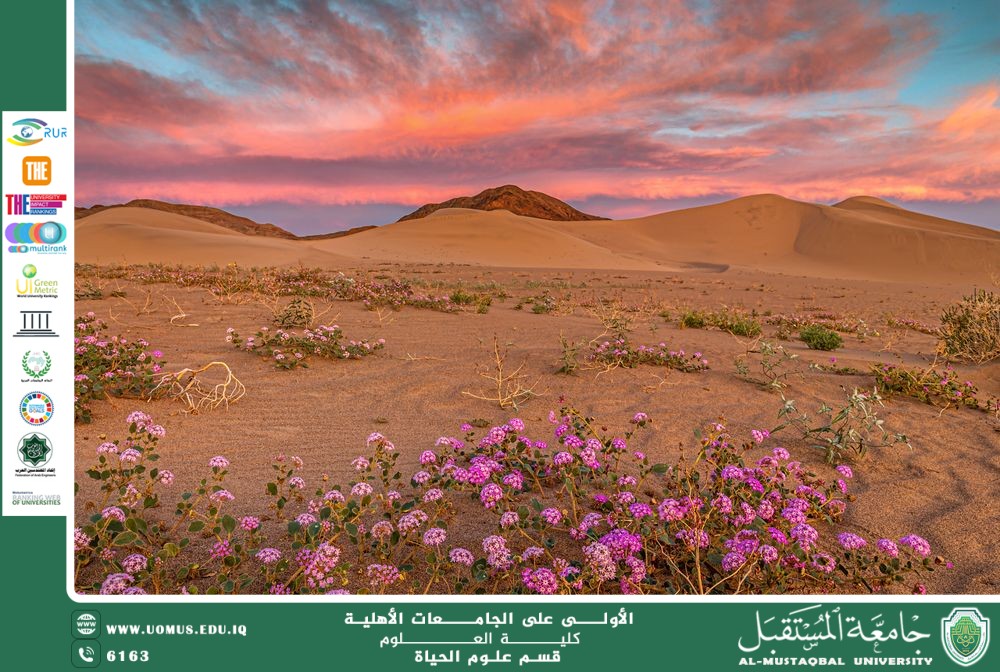
A scientific article by Ms. Banin Maan Karim entitled "Flower Transformations in Desert Environments"
Flower adaptations in desert environments reflect their adaptation to harsh conditions such as high temperatures, scarce water, and limited pollination. These adaptations help plants conserve water, ensure pollination, and produce seeds quickly before the end of the short growing season.<br /><br />Flower adaptations in desert environments:<br />1. Small flower size<br />Flowers in desert plants are often small to reduce water loss through evaporation.<br /><br />2. Short life cycle (annual plants)<br />Some plants germinate, flower, and produce seeds within a few weeks of rainfall.<br /><br />Examples: Ramram and Ribla.<br /><br />This allows the plant to complete its life cycle before drought returns.<br /><br />3. Flowers open at specific times<br />Flowers open during cooler times of the day (such as dawn or sunset) to reduce water loss.<br /><br />Or they open only after rainfall to ensure sufficient moisture.<br /><br />4. Bright colors and a strong scent<br />To attract a small number of pollinating insects or birds in the desert environment.<br /><br />Because pollinators are scarce, a flower needs to attract them effectively.<br /><br />5. Protecting Reproductive Organs<br />Some flowers are covered with plant parts (such as thorns or hairs) to reduce direct exposure to heat or water loss.<br /><br />In some cases, flowers are close to the ground to protect them from strong, dry winds.<br /><br />6. Adapting Pollination<br />Some species rely on self-pollination when pollinators are absent.<br /><br />Or rely on wind if the flower is exposed.<br /><br />7. Producing Drought-Resistant Seeds<br />Flowers produce hardy, resistant seeds that can survive in desert soil for years until suitable conditions are available.<br /><br />Examples of desert-adapted flowering plants:<br />Cactus: Its flowers open at night to reduce water loss.<br /><br />Desert Daisy: Small, brightly colored flowers that attract insects.<br /><br />Al-Mustaqbal University is the first university in Iraq.