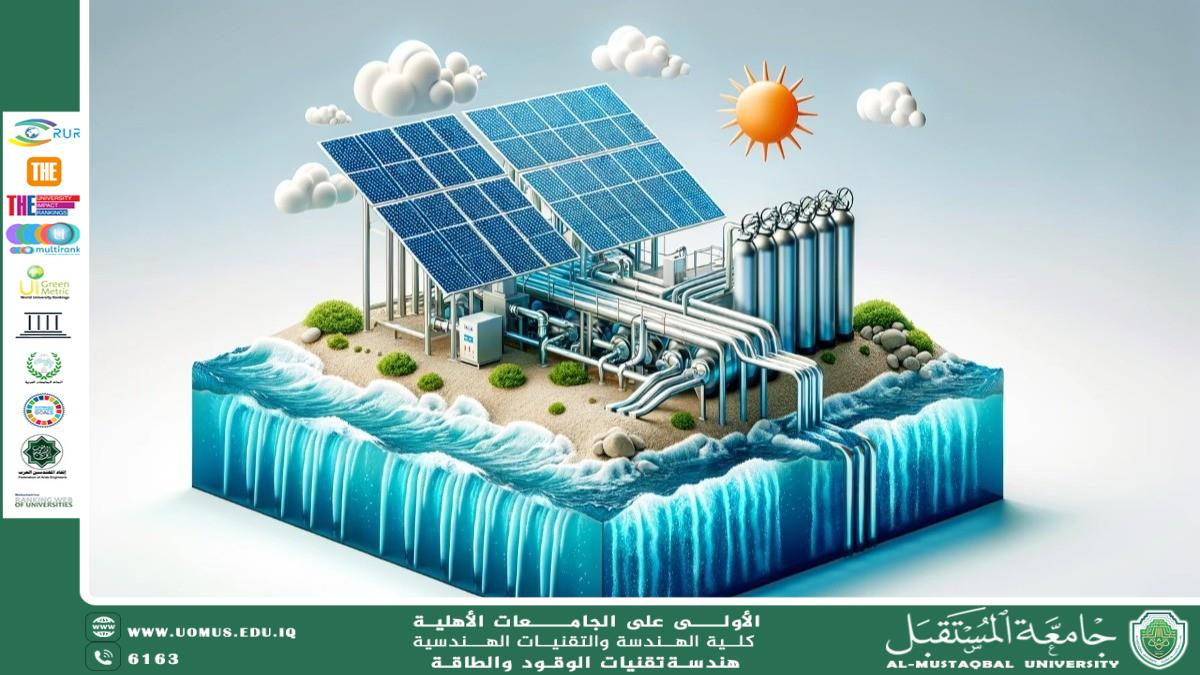
Integrating Solar Power with Water Desalination in Arid Regions
Integrating Solar Power with Water Desalination in Arid Regions<br />By: Asst. Lecturer Shahad Ammar Hatem<br /><br />Sustainable Development Goals:<br /> Goal 6: Clean Water and Sanitation<br /> Goal 7: Affordable and Clean Energy<br /> Goal 13: Climate Action<br /><br />Access to clean water is a growing challenge in arid and semi-arid regions, where freshwater resources are scarce and traditional supply methods are unsustainable. Integrating solar power with water desalination technologies offers a sustainable and scalable solution to address water scarcity while minimizing environmental impact.<br />Solar-powered desalination systems harness renewable energy to drive processes like reverse osmosis (RO), multi-effect distillation (MED), or newer technologies such as membrane distillation (MD). These systems reduce dependency on fossil fuels, lower greenhouse gas emissions, and allow off-grid operation in remote communities.<br />In particular, photovoltaic (PV) panels can be paired with energy-efficient RO systems, while solar thermal collectors can supply the heat required for distillation-based methods. Hybrid designs, which combine both PV and thermal inputs, offer greater operational flexibility and efficiency.<br />Advancements in energy storage, smart controllers, and nanofiltration membranes further improve system performance and reliability. These developments enable 24/7 water production, even when solar input fluctuates due to weather conditions.<br /><br />Beyond environmental benefits, solar desalination empowers local communities by providing decentralized water access, supporting agriculture, and enhancing health outcomes. It also aligns with national strategies for climate adaptation and sustainable infrastructure development.<br />As climate pressures increase and demand for water grows, solar-powered desalination presents a resilient pathway toward ensuring water and energy security in the world’s driest regions.<br /><br />Al-Mustaqbal University – The No. 1 Private University in Iraq