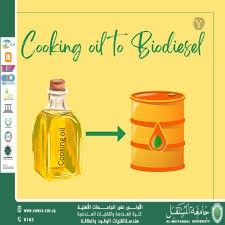
Biodiesel from Waste Cooking Oil: Turning Household Waste into Clean Energy
<br />Biodiesel from Waste Cooking Oil: Turning Household Waste into Clean Energy<br /><br />By: Eng. Abdullah Marza Hamza<br /><br />Sustainable Development Goals (SDGs) Addressed:<br /> Goal 7: Affordable and Clean Energy<br /> Goal 12: Responsible Consumption and Production<br /> Goal 13: Climate Action<br /><br />Waste cooking oil is often discarded down drains or into landfills, contributing to pollution and health hazards. However, this waste can be converted into biodiesel — a clean, renewable fuel — through a chemical process known as transesterification.<br /><br />The production of biodiesel from waste oil not only reduces waste but also provides a sustainable alternative to petroleum diesel. It emits significantly fewer greenhouse gases and particulate matter during combustion.<br /><br />This approach promotes circular economy principles by turning household and restaurant waste into valuable energy. It also reduces dependence on food-based biofuels, avoiding conflicts with food supply chains.<br /><br />Small-scale biodiesel units can be established at the community level, while larger facilities can collect oil from restaurants and food industries. Challenges such as quality control and collection logistics remain, but policy support and awareness can help scale up adoption.<br /><br />Using waste to produce energy aligns with both environmental and economic sustainability goals.<br /><br />Al-Mustaqbal University – The No. 1 Private University in Iraq