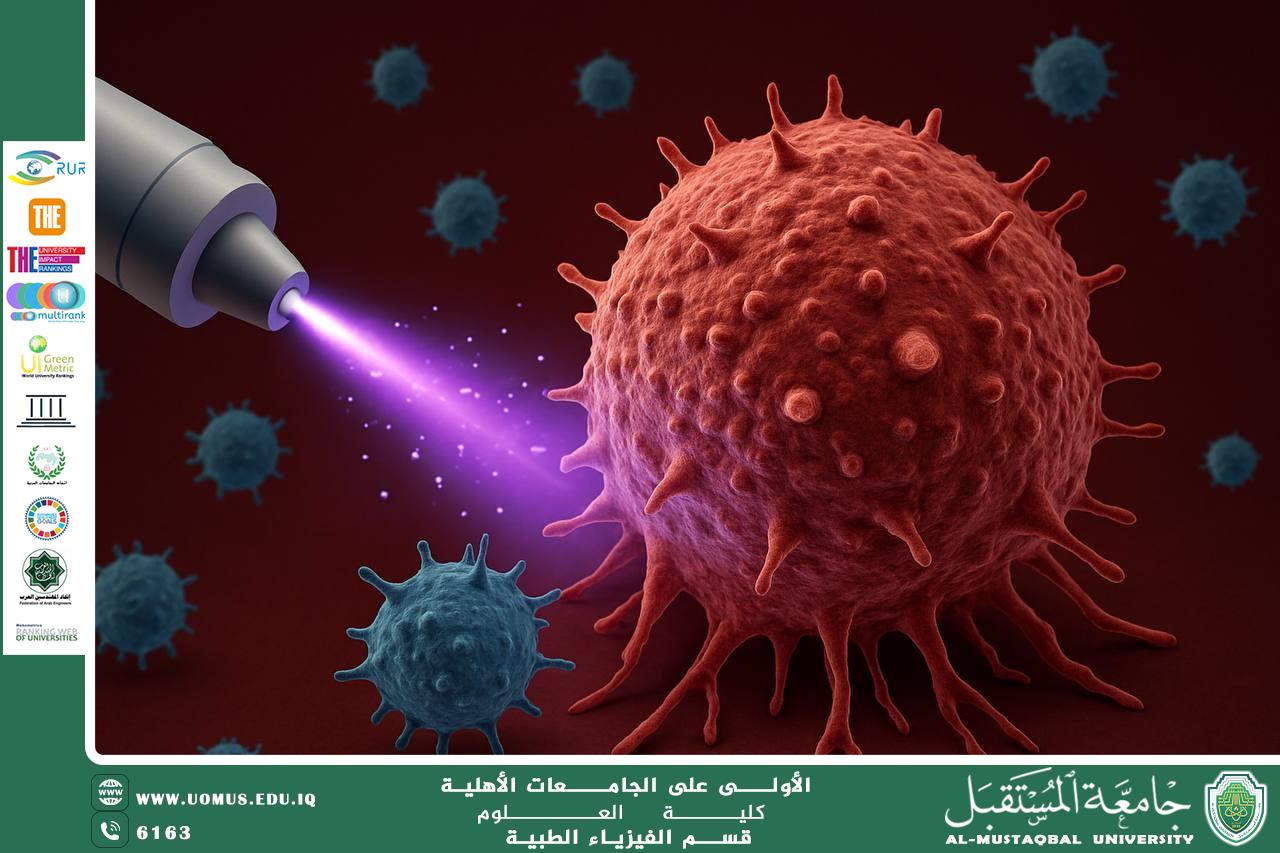
A scientific article by the teaching assistant (Maryam Reda Al-Sharaa) entitled “The Potential of Plasma Physics in Cancer Treatment: Hope for Non-Surgical Treatment”
The Potential of Plasma Physics in Cancer Treatment: A Hope for Non-Invasive Therapy<br /><br />Introduction<br /><br />Cancer remains one of the most critical medical challenges of the modern era. With the continuous advancement of physical sciences, plasma physics is emerging as a promising tool in the non-invasive treatment of tumors. In particular, the use of cold plasma has shown significant effectiveness in targeting cancer cells without damaging healthy tissues.<br /><br />⸻<br /><br />What is Cold Plasma?<br /><br />Cold plasma is a state of matter composed of electrically charged particles (electrons and ions) at relatively low temperatures. Unlike thermal plasma, which requires extremely high temperatures, cold plasma can be generated at room temperature, making it suitable for medical applications.<br /><br />⸻<br /><br />How Does Plasma Affect Cancer Cells?<br /><br />Research indicates that cold plasma affects cancer cells through several mechanisms:<br /> 1. Generation of Reactive Oxygen Species (ROS) and Reactive Nitrogen Species (RNS), which create oxidative stress leading to the death of cancer cells.<br /> 2. Altering the cell membrane, making cancer cells more vulnerable to damage.<br /> 3. Inducing apoptosis – a form of natural programmed cell death for eliminating damaged cells.<br /> 4. Inhibiting cancer cell proliferation without affecting nearby healthy cells.<br /><br />⸻<br /><br />Advantages of Using Plasma in Cancer Treatment<br /> • ✅ Non-invasive and painless<br /> • ✅ Highly targeted with minimal effect on healthy tissue<br /> • ✅ Applicable to a wide range of tumor types<br /> • ✅ Low cost compared to radiotherapy or chemotherapy<br /> • ✅ Produces localized effects with minimal side effects<br /><br />⸻<br /><br />Potential Clinical Applications<br /><br />Although clinical use is still in its experimental stages, studies have explored the application of plasma in various types of cancer, including:<br /> • Skin cancer<br /> • Leukemia<br /> • Breast cancer<br /> • Head and neck cancers<br /><br />Future applications may involve internal tumor treatment using fine plasma probes.<br /><br />⸻<br /><br />Future Challenges<br /> • A need for deeper understanding of the biochemical mechanisms behind plasma-cell interactions<br /> • Development of safe, compact, and user-friendly plasma devices for medical settings<br /> • Conducting large-scale clinical trials to confirm safety and effectiveness<br /><br />⸻<br /><br />Conclusion<br /><br />Plasma physics opens new doors in the fight against cancer. It presents a promising, non-invasive, and cost-effective approach that may revolutionize cancer treatment. As research progresses, plasma therapy could become a standard component of future cancer treatment protocols.<br /><br /><br /><br />"AL_mustaqbal University is the first university in Iraq"<br/><br/><a href=https://uomus.edu.iq/Default.aspx target=_blank>al-mustaqbal University Website</a>