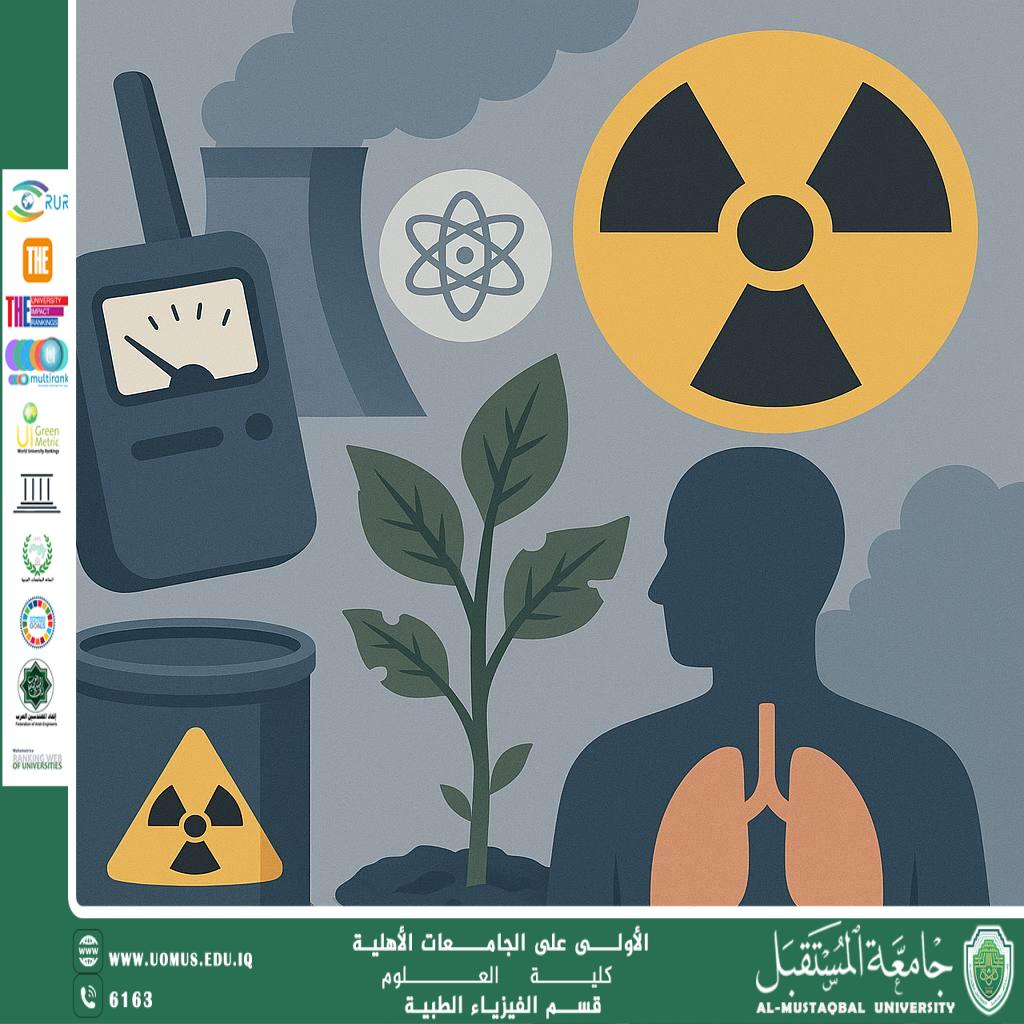
A scientific article by the lecturer (Assistant Lecturer Fatima Basem) entitled “Ionizing radiation and its effects on living organisms in the environment”
Introduction:<br />Ionizing radiation is a form of energy that has the ability to alter the structure of atoms and molecules. It is widely used in various industrial, medical, and agricultural applications. However, when it exceeds safe limits, it can have serious effects on living organisms and the surrounding environment.<br /><br />Content:<br />🔹 What is Ionizing Radiation?<br />It is a type of radiation that has enough energy to remove electrons from atoms, resulting in the formation of ions. Examples include alpha, beta, and gamma rays, as well as X-rays.<br /><br />🔹 Sources of Radiation in the Environment:<br />• Natural: Such as radon gas and radioactive minerals in the soil.<br />• Man-made: Such as nuclear reactor waste and materials used in medical imaging and radiation therapy.<br />• Agricultural: Through the use of some phosphate fertilizers that contain natural uranium.<br /><br />🔹 Effects of Radiation on Living Organisms:<br />• Plants: May experience genetic mutations, stunted growth, or cell death.<br />• Animals: Can suffer from tissue damage or reproductive and nervous system disorders.<br />• Humans: Chronic exposure may lead to diseases such as cancer or immune system dysfunctions.<br /><br />🔹 The Role of Physics in Radiation Measurement:<br />Tools used include:<br />• Geiger counter<br />• Scintillation detectors<br />• Measurement units such as Sievert (Sv) and Gray (Gy) to determine the absorbed dose and its biological impact.<br /><br />Conclusion:<br />The presence of radiation in the environment is inevitable, but controlling its sources and continuous monitoring are essential for protecting both humans and nature. It is crucial to raise awareness among farmers and field workers about radiation protection methods and to follow safety guidelines in areas suspected of radioactive contamination.<br /><br /><br /><br /><br />"AL_mustaqbal University is the first university in Iraq"<br/><br/><a href=https://uomus.edu.iq/Default.aspx target=_blank>al-mustaqbal University Website</a>