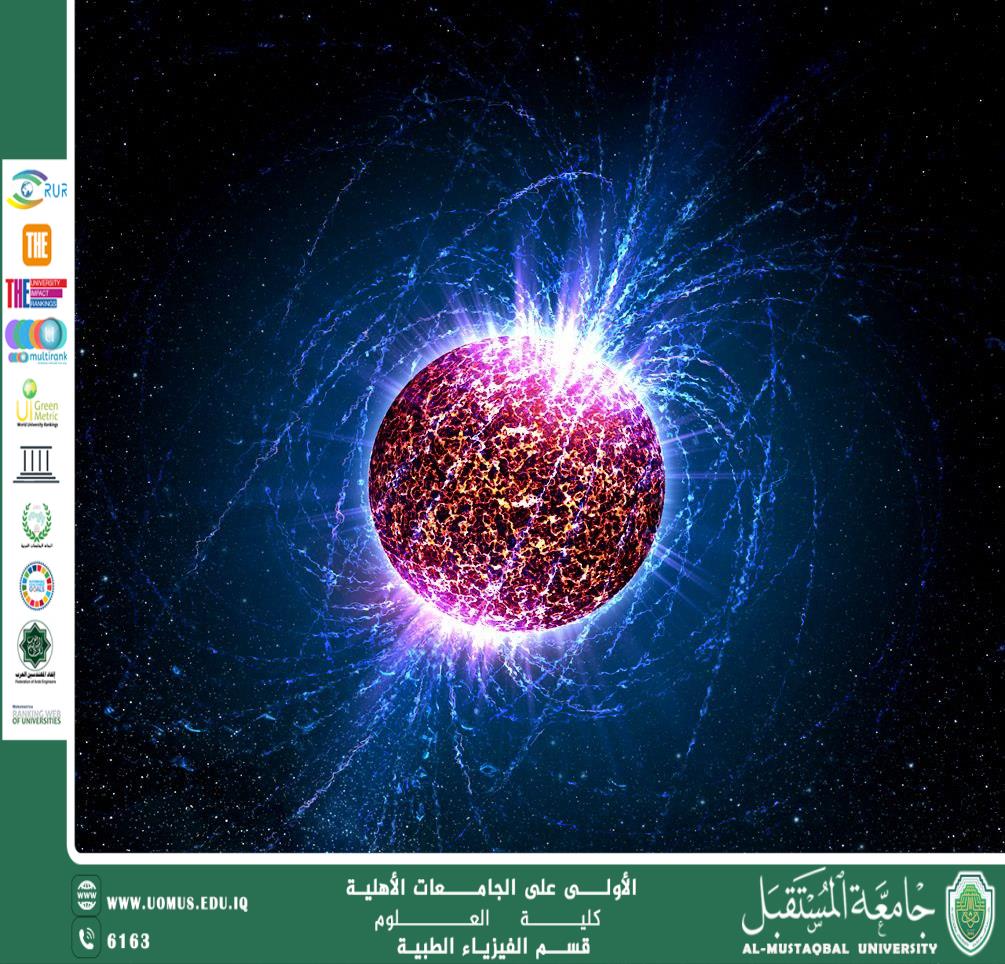
A scientific article by the teaching assistant (Ahmed Abdel Salam) entitled "The interaction of neutrons with the body and their medical benefits"
Neutrons play a significant role in medical applications, particularly in the treatment of cancerous tumors. Unlike X-rays or photons, neutrons are uncharged particles that can penetrate matter differently and interact directly with atomic nuclei in the body.<br />Mechanism of Interaction:<br />When neutrons enter the human body, they interact with atomic nuclei through processes such as elastic and inelastic scattering or neutron capture. These interactions release high energy within a very localized region, making them highly effective in destroying cancer cells.<br />Medical Benefits:<br />Neutron and Proton Therapy: Neutron therapy is used in treating certain cancers such as head and neck tumors, prostate cancer, and brain tumors.<br />Boron Neutron Capture Therapy (BNCT): A modern technique where the patient receives boron-containing compounds, and then the body is exposed to a neutron beam. The boron reacts with neutrons, releasing radiation that selectively destroys cancer cells while sparing healthy tissue.<br />Neutron Imaging: Neutrons are sometimes used for detailed imaging of body parts that are not clearly visible with X-rays.<br />Conclusion:<br />Neutrons are powerful tools in modern medicine, offering an effective alternative or complement to traditional radiation therapies. As technology evolves, their use in imaging and therapy continues to expand.<br /><br /><br /><br />"AL_mustaqbal University is the first university in Iraq"<br/><br/><a href=https://uomus.edu.iq/Default.aspx target=_blank>al-mustaqbal University Website</a>