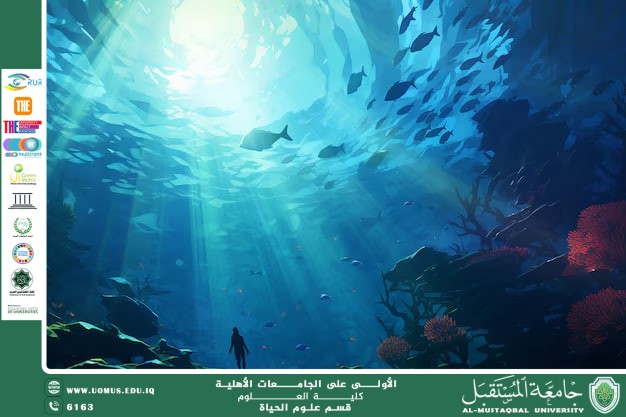
A scientific article by teaching assistant Banin Maan Karim entitled "The Importance of Deep Sea Organisms"
Although deep-sea organisms live in remote and harsh environments, they are of great ecological, scientific, and economic importance, making them a major focus of marine biology and modern research.<br /><br />1. Maintaining ecological balance<br />Deep-sea organisms, such as fish, crustaceans, and mollusks, play a vital role in the carbon cycle and nutrient transport between ocean layers. Some species migrate vertically daily between the depths and the surface, transporting carbon to the depths where it is stored away from the atmosphere, contributing to global climate regulation.<br /><br />2. A source of rare medicinal compounds<br />Organisms that live under high pressure and harsh chemical conditions produce unique chemical compounds to protect themselves or interact with their environment. These compounds have proven effective in:<br /><br />Cancer resistance<br /><br />Production of new antibiotics<br /><br />Neurological research and anti-inflammatory drugs<br />For example, therapeutic compounds extracted from deep-sea sponges have been used in cancer and AIDS drug research.<br /><br />3. Scientific Exploration and Understanding the Origin of Life<br />Due to their harsh environment, deep-sea organisms are believed to offer a model similar to Earth's primitive environment, and perhaps even to the conditions of life on other planets.<br /><br />4. Bioindicators<br />Deep-sea organisms serve as accurate indicators of changes in the marine environment, such as:<br /><br />Deep-sea oxygen deficiency (dead zone).<br /><br />The effects of metal or plastic pollution.<br /><br />Changing ocean currents due to global warming.<br /><br />Deep-sea organisms are not just strange creatures in the dark ocean; they are biological and environmental treasures that must be protected and understood. Investing in the study of these organisms opens up vast horizons in science, medicine, and technology, and represents a step toward preserving our planet's biodiversity.<br /><br />Al-Mustaqbal University is the first university in Iraq.