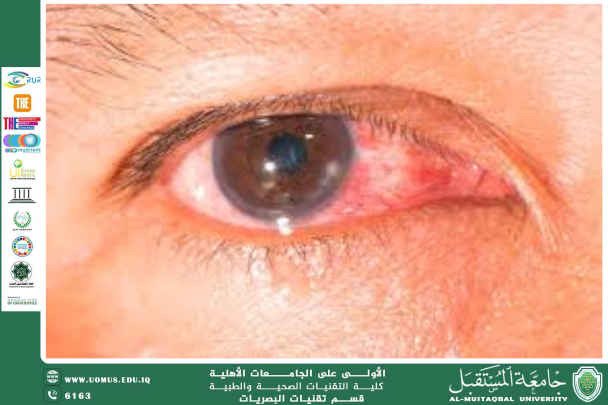
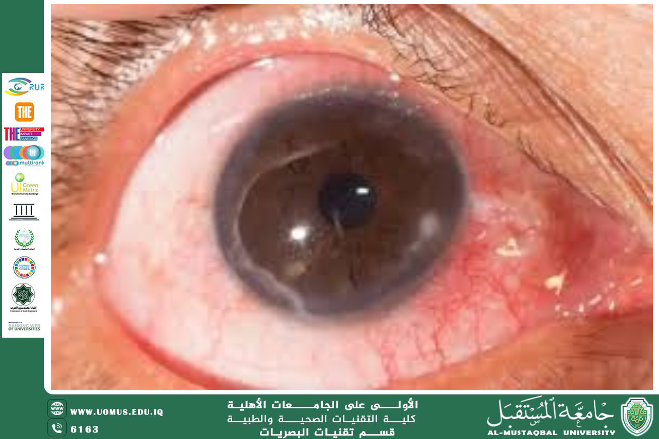
A scientific article by the lecturers, Assist.Prof.Dr. Munther Sameen Shukur / Asst. Lecturer. Mohaimen Sameer Aref / Asst. Lecturer. Ali Hadi Al-Husseini (Keratitis: Clinical Overview)
Introduction<br />Keratitis is an inflammatory condition affecting the cornea—the transparent, dome-shaped surface that covers the pupil and iris. It may be infectious (caused by bacteria, viruses, fungi, or parasites) or non-infectious (resulting from mechanical trauma or prolonged contact lens use). While minor corneal injuries can lead to non-infectious keratitis, microbial invasion may occur if the corneal epithelium is compromised.<br />Clinical Symptoms<br />Common signs and symptoms of keratitis include:<br />• Ocular redness<br />• Eye pain<br />• Excessive tearing or ocular discharge<br />• Photophobia (light sensitivity)<br />• Blurred or decreased vision<br />• Difficulty opening the eyelids due to discomfort<br />• Foreign body sensation<br />Etiology<br />Keratitis can result from several causes:<br />• Mechanical trauma: Corneal abrasions or foreign body injuries can trigger inflammation and facilitate microbial entry.<br />• Microbial agents:<br />o Bacteria (e.g., Staphylococcus spp., Streptococcus spp., Pseudomonas aeruginosa)<br />o Fungi (often from contaminated contact lenses or storage cases)<br />o Viruses (notably Herpes simplex and Herpes zoster)<br />o Parasites (e.g., Acanthamoeba, particularly from water exposure)<br />• Contaminated water exposure: Lakes, hot tubs, or ocean water may harbor microorganisms that infect damaged corneas.<br />• Contact lens misuse: Extended wear or poor hygiene significantly increases the risk of infectious and non-infectious keratitis.<br /> <br />Risk Factors<br />Risk factors include:<br />• Contact lens use, especially overnight wear or inadequate disinfection practices<br />• Immunosuppression, due to illness or immunosuppressive medications<br />• Corticosteroid eye drops, which may suppress immune response and worsen infections<br />• Previous ocular trauma, which predisposes the eye to future infections<br />Complications<br />Untreated or improperly managed keratitis can lead to:<br />• Chronic keratitis and corneal scarring<br />• Persistent or recurrent viral infections<br />• Corneal ulcers<br />• Temporary or permanent vision impairment<br />• Complete blindness in severe cases<br />Preventive Measures<br />Especially for contact lens users, prevention strategies include:<br />• Use daily disposable lenses if possible<br />• Wash, rinse, and dry hands thoroughly before handling lenses<br />• Follow all care instructions from eye care professionals<br />• Use only sterile products designed for your lens type<br />• Replace the contact lens case every 3–6 months<br />• Discard used solution after each use—never “top off” old solution<br />• Avoid wearing contact lenses while swimming<br />Diagnosis<br />Diagnostic evaluation may include:<br />• Penlight examination: Assessing pupillary reflex and applying fluorescein dye to highlight corneal damage<br />• Slit-lamp examination: Magnified inspection of corneal integrity, ulceration, and inflammation<br />• Laboratory analysis: Cultures or smears from corneal scrapings or tears to identify the causative organism<br /><br /><br /><br />Treatment<br />Non-Infectious Keratitis<br />Treatment depends on severity. Mild cases may require only lubricating eye drops, while more severe inflammation may necessitate topical anti-inflammatory medications.<br />Infectious Keratitis<br />Treatment varies according to the causative agent:<br />• Bacterial keratitis: First-line therapy includes antibiotic eye drops, administered from 4 times per day up to every 30 minutes for severe cases. Oral antibiotics may be added if needed.<br />• Fungal keratitis: Requires topical antifungal agents and possibly oral antifungal medication.<br />• Viral keratitis: Treated with topical antiviral drops and/or oral antiviral medications. Some cases may also benefit from supportive care using lubricants.<br />• Acanthamoeba keratitis: One of the most challenging forms to treat. Requires long-term topical antiparasitic therapy (often months). Severe or resistant cases may necessitate corneal transplantation.<br />Conclusion<br />Keratitis is a potentially sight-threatening condition that requires prompt diagnosis and appropriate intervention. Proper hygiene, responsible contact lens use, and regular ophthalmologic assessments remain critical in reducing the incidence and complications of this corneal disorder.<br />