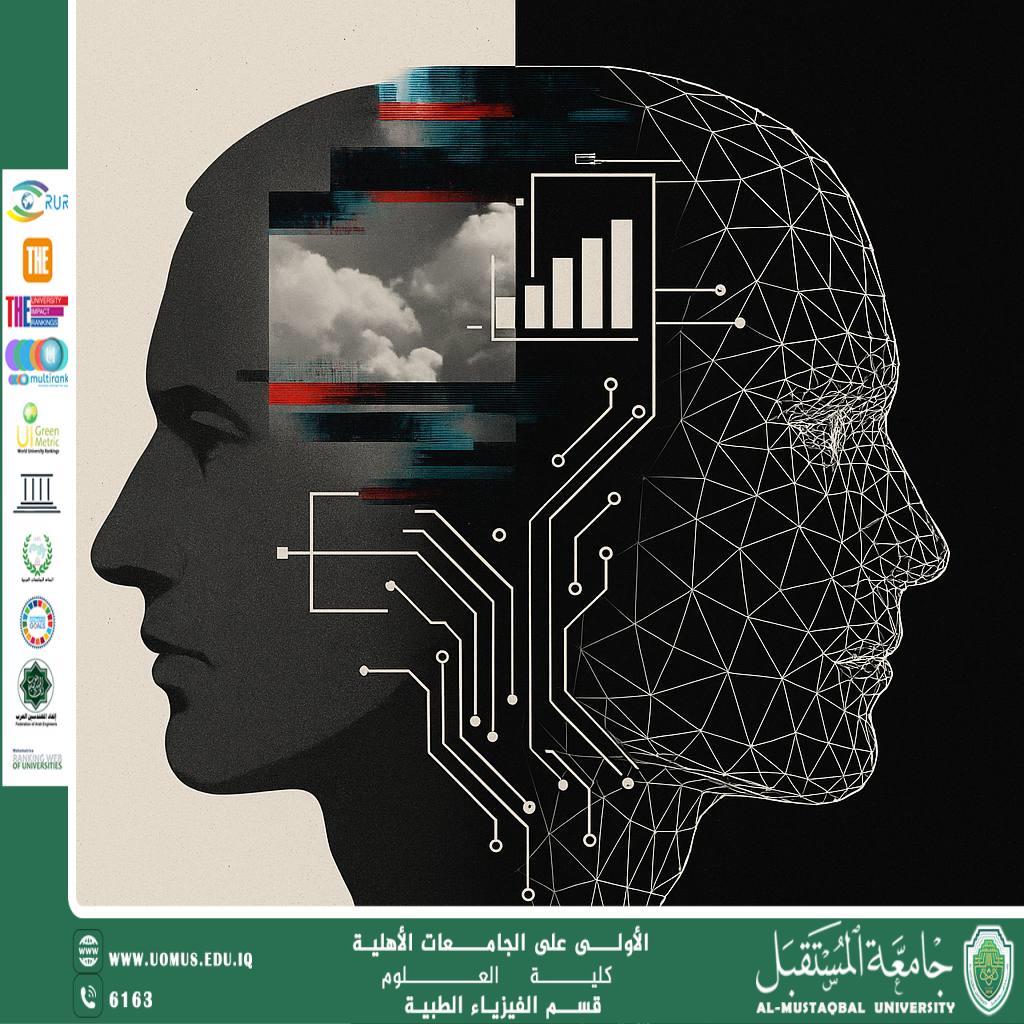
A scientific article by the teaching assistant (Mohammed Abdel Zahra) entitled “Fake Content: Who Owns the Truth?”
Introduction:<br /><br />In the beginning, humans searched for truth the way a child searches for their mother in a crowd — truth was a light, and everything else mere shadow.<br />But today, we do not live in the shadows of truth… we live in its replicas.<br />We are no longer seeking the truth; we are choosing the version that pleases us most.<br /><br />So who owns the truth now?<br />Who guards its gate?<br />And is truth still something we discover… or has it become a commodity we manufacture and consume?<br /><br />⸻<br /><br />I. What Is Fabricated Content?<br /><br />In physics, the universe is made of energy, particles, and information.<br />But in the digital world, it is built of images, videos, and words.<br />Change this content… and you change how people see reality.<br /><br />Fabricated content refers to everything presented as “real,” yet forged, edited, or algorithmically generated for certain purposes:<br /> • A smiling image of a leader among the people — taken while he’s actually in a luxury resort.<br /> • A deepfake video of a politician saying things they never said.<br /> • A viral “breaking news” story — entirely made up to provoke or manipulate.<br /><br />It’s as if we now live in a reversed Platonic cave —<br />Instead of images being reflections of reality, images have started to create reality.<br /><br />⸻<br /><br />II. Why Do Minds Believe What Is False?<br /><br />As Nietzsche once said:<br /><br />“Truth is not what is said. Truth is what is believed.”<br /><br />The human mind often seeks comfort, not correctness.<br />We tend to believe what aligns with our emotions — even if it’s false.<br />Truth is no longer measured by logic… but by engagement.<br /><br />Social media platforms have made lies travel faster than light —<br />Because light requires a path… but lies spread with a single click.<br />We no longer analyze — we share.<br />We no longer verify — we react.<br />And so, the false becomes stronger than the true.<br /><br />⸻<br /><br />III. Who Holds the Keys to Truth Today?<br /><br />In the past, philosophers and scientists were the guardians of truth.<br />Today, those who own algorithms shape what is seen — and what is believed.<br /><br />Tech giants like Google, Meta, and OpenAI have the power to:<br /> • Decide what content appears<br /> • Hide what’s inconvenient<br /> • Amplify certain narratives<br /> • Suppress others<br /><br />Truth has left the realm of reality and entered the domain of trend.<br /><br />In physics, we say: “Observation alters the phenomenon.”<br />In digital media, we say: “Funding alters the truth.”<br /><br />⸻<br /><br />IV. Artificial Intelligence: Guardian or Fabricator?<br /><br />Here lies the great paradox:<br />AI can both create fake content — and detect it.<br /><br />But can a machine distinguish between a malicious intent and a noble one?<br />Can artificial intelligence understand that truth is rooted in conviction, not merely in data?<br /><br />Quantum physics teaches us that probability is the fabric of reality.<br />Perhaps, in today’s world, truth too has become… a probability.<br /><br />⸻<br /><br />Conclusion: Can Truth Be Reclaimed?<br /><br />Truth has not died… but it has gone into hiding.<br />Our mission is not to cry out, “Where is the truth?”<br />But to ask ourselves:<br />Do we really want to find it? Or are we content to live in the comfort of illusion?<br /><br />In the age of artificial intelligence, the search for truth becomes a philosophical task, not a mere informational one.<br />Those who do not seek — shall never find.<br /><br /><br /><br /><br />"AL_mustaqbal University is the first university in Iraq"<br/><br/><a href=https://uomus.edu.iq/Default.aspx target=_blank>al-mustaqbal University Website</a>