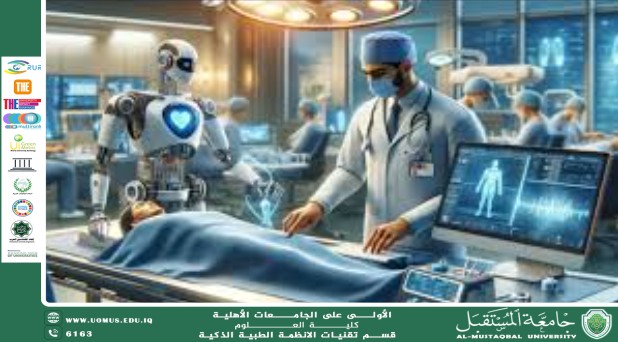
Intelligent Medical Systems and Early Disease Diagnosis (Asst. Lecturer Qusay Munir Diab)
In recent decades, medical technologies have witnessed a qualitative leap thanks to the introduction of intelligent systems into the field of diagnosis. It is now possible to rely on programming to develop algorithms capable of analyzing massive amounts of medical data quickly and accurately, helping to detect diseases in their early stages before clear symptoms appear in the patient.<br /><br />These systems rely on artificial intelligence and machine learning, where computational models are programmed to recognize specific patterns in medical imaging or laboratory test results. Such models benefit from millions of previous examples and learn from doctors’ past experiences, enabling them to provide fast and accurate predictions.<br /><br />Programming in this field is not merely about writing commands, but rather a complex process that involves collecting medical data from multiple sources, cleaning it from errors, and designing algorithms that strike a balance between accuracy and speed. Languages such as Python and R have become essential for developing these models, alongside libraries such as TensorFlow and PyTorch.<br /><br />These systems are not intended to replace the physician, but to support them with additional information that assists in making the right decision. With the advancement of programming and computing capabilities, early diagnosis will become more comprehensive and will play a greater role in reducing mortality rates and improving quality of life.<br /><br />Al-Mustaqbal University — The First University in Iraq