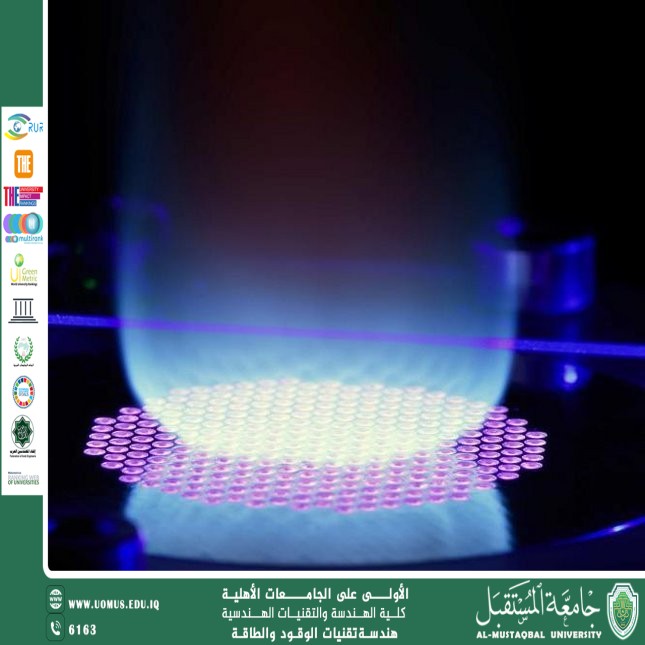
Plasma-Assisted Combustion for Efficient Power Generation
Plasma-Assisted Combustion for Efficient Power Generation<br />Author: Asst. Lecturer Shahad Ammar Hatem<br /><br />Sustainable Development Goals:<br /> Affordable and Clean Energy<br /> Industry, Innovation, and Infrastructure<br /> Climate Action<br /><br />Introduction<br />As the demand for cleaner and more efficient power generation grows, innovative combustion technologies are gaining attention. One such promising approach is plasma-assisted combustion (PAC), which utilizes plasma—an ionized gas containing highly reactive species—to initiate and sustain fuel combustion under otherwise challenging conditions. PAC offers significant advantages in enhancing combustion efficiency, reducing emissions, and enabling low-temperature ignition.<br /><br />Working Principle<br />In plasma-assisted combustion, electrical energy is used to generate plasma using devices such as dielectric barrier discharges (DBD) or pulsed nanosecond discharges. The plasma interacts with the fuel-air mixture, producing radicals and ions that accelerate chemical reactions. This makes it possible to ignite lean or low-reactivity mixtures that traditional systems struggle to burn. It also enables stable combustion in high-altitude or low-temperature environments.<br /><br />Applications and Benefits<br />PAC is particularly valuable in gas turbines, jet engines, and industrial burners where fuel efficiency and low emissions are critical. It allows for the operation of engines at lower temperatures, reducing NOx formation and improving thermal efficiency. Additionally, PAC supports the use of alternative fuels such as hydrogen, biofuels, and syngas by enhancing their ignition characteristics. Its flexibility and responsiveness make it suitable for dynamic systems such as hybrid or variable-speed power generators.<br /><br />Challenges and Future Potential<br />Despite its advantages, PAC technology faces hurdles including high initial costs, complexity of integration into existing systems, and durability of plasma-generating components. Nevertheless, ongoing research is focusing on improving power electronics, miniaturizing plasma devices, and optimizing designs for long-term reliability. As advancements continue, PAC is expected to play a key role in the future of clean and efficient energy systems.<br /><br />Al-Mustaqbal University – The No. 1 Private University in Iraq