Energy Harvesting from Vibrations: Powering Microdevices
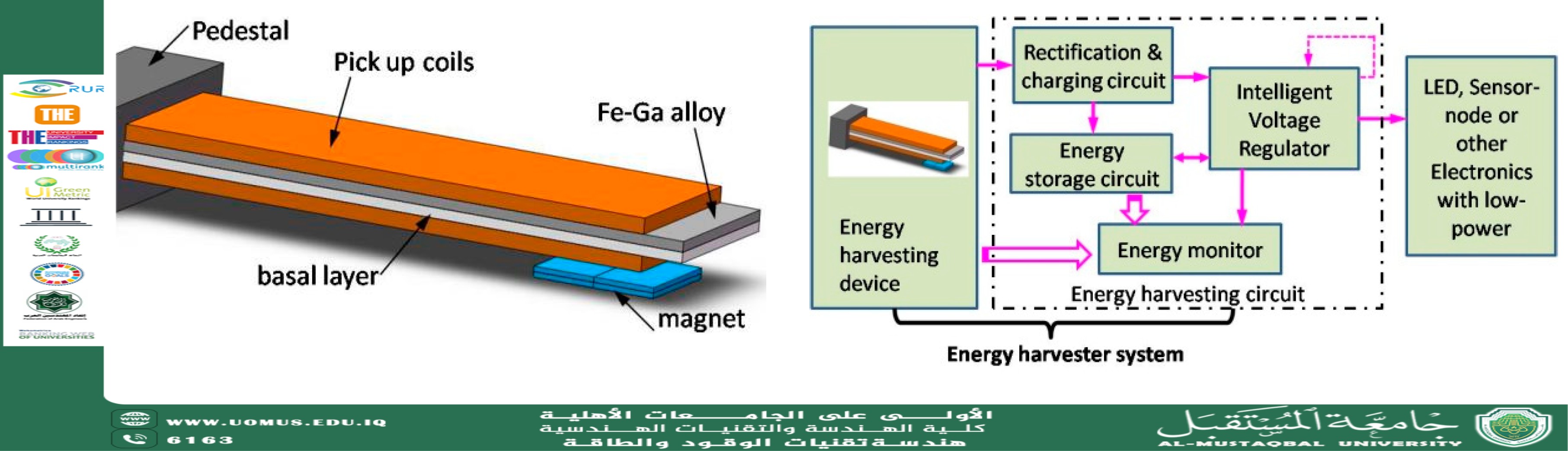
Energy Harvesting from Vibrations: Powering Microdevices<br />Author: Eng. Abdullah Marza Hamza<br /><br />Sustainable Development Goals:<br /> Affordable and Clean Energy<br /> Industry, Innovation, and Infrastructure<br /> Sustainable Cities and Communities<br /><br />Introduction<br />As the world moves toward wireless technologies and miniaturized electronics, powering small-scale devices in remote or hard-to-reach areas has become a growing challenge. Energy harvesting from mechanical vibrations provides an innovative and sustainable solution, enabling microdevices to operate independently without the need for batteries or wired power sources. This method captures ambient mechanical energy—such as vibrations from machinery, human movement, or structural oscillations—and converts it into usable electrical power.<br /><br />Mechanism of Vibration Energy Harvesting<br />Vibration energy harvesting systems typically rely on electromechanical transducers such as piezoelectric, electromagnetic, or electrostatic generators. Among these, piezoelectric materials are most commonly used due to their simplicity and high energy density. When subjected to stress or deformation from vibrations, these materials generate an electric charge, which is then stored or used directly to power microelectronic systems like sensors, actuators, or communication modules.<br /><br />Applications in Modern Systems<br />The integration of vibration energy harvesting is increasingly seen in Internet of Things (IoT) networks, structural health monitoring, biomedical implants, and wearable electronics. For instance, sensors embedded in bridges or aircraft can self-power through ambient vibrations, reducing maintenance needs and enhancing reliability. In biomedical applications, such systems can reduce the need for surgeries to replace batteries in implants.<br /><br />Advantages and Challenges<br />This technology reduces dependency on batteries, thus minimizing environmental waste and maintenance costs. However, the energy output from vibration harvesters is often low and inconsistent, which requires efficient energy management circuits and storage solutions. Moreover, tuning the harvester to resonate with the frequency of the source vibration is essential for optimal performance. Advances in materials science and circuit design are addressing these limitations, bringing this promising technology closer to widespread adoption.<br /><br />Al-Mustaqbal University – The No. 1 Private University in Iraq