A scientific article by the lecturer, Lect. Mohaimen Sameer Aref/Teaching Assist. Danah Mohammed Salim (Vision in Animals)
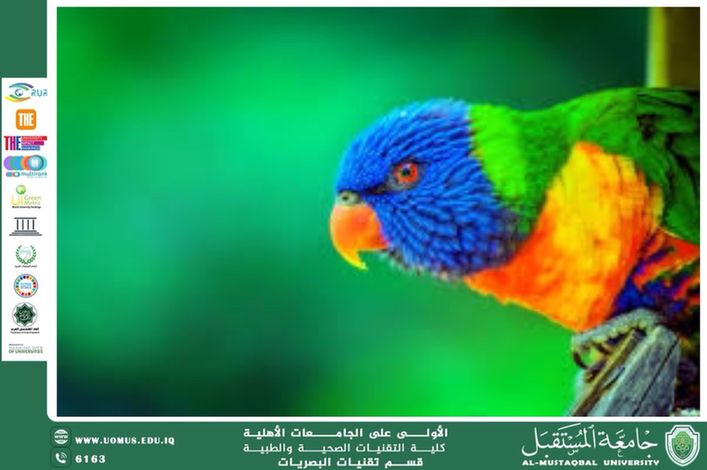
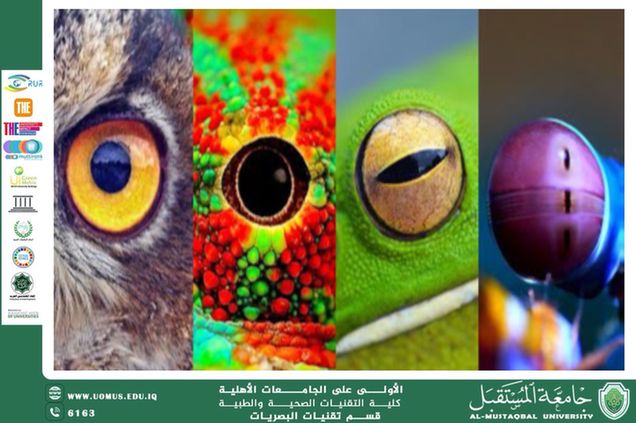
Vision is one of the fundamental senses in the animal kingdom and serves as a vital tool for survival and adaptation to the surrounding environment. Visual capabilities vary greatly among animals depending on their ecological needs and behavioral patterns. The eyes of each species are uniquely designed to match its lifestyle—whether it is a predator requiring high focusing accuracy or a prey species needing a wide visual field to detect threats. This remarkable diversity reflects the creativity of the Creator in designing and constructing visual systems suited to the functional requirements of every living being.<br />Anatomical and Functional Diversity of Animal Eyes<br />Animal eyes differ structurally between compound eyes and simple eyes:<br />• Compound eyes, found in insects, are composed of hundreds of optical units (ommatidia), providing a wide visual field and exceptional motion detection.<br />• Simple eyes, found in mammals and birds, consist of a lens, retina, and specialized structures enabling color perception and fine detail recognition.<br />Eye placement on the head also varies:<br />• Predators generally possess binocular vision, with eyes positioned at the front of the head, allowing for depth perception and accurate distance judgment.<br />• Prey animals often have monocular vision due to lateral placement of the eyes, granting them a broader visual field for early predator detection.<br />Visual Characteristics in Selected Animal Groups<br />• Birds of prey exhibit extraordinary visual acuity, capable of detecting small prey from great distances due to the high density of photoreceptor cells in the retina.<br />• Cats and nocturnal animals have more rod cells than cone cells, enabling superior vision in low-light environments.<br />• Fish possess spherical lenses adapted for underwater vision, enhancing light focus in aquatic conditions.<br />• Insects can detect wavelengths beyond the human visible spectrum, such as ultraviolet light, aiding in navigation and flower detection.<br /><br />The Creativity of the Creator in Eye Design<br />Observing the eyes of animals reveals unmatched precision and ingenuity in design. Every component of the eye—from the cornea to the retina and optic nerve—is adapted to serve a specific function that supports survival. This visual diversity is a testament to the greatness of the Creator, who has endowed each creature with the means to adapt to its habitat, thereby maintaining ecological balance.<br />Conclusion<br />Vision in animals is not merely a sensory tool but a complex system that reflects environmental adaptation and anatomical specialization. Studying these visual systems unveils the beauty of creation and the precision of design, encouraging the protection of biodiversity and the preservation of natural habitats. Each eye in the animal world stands as living evidence of divine greatness and serves as a call for reflection, gratitude, and conservation.<br />