A scientific article by the lecturer, Lect. Mohaimen Sameer Aref (Ocular Accommodation: Types, Measurement Techniques, and Associated Anomalies)
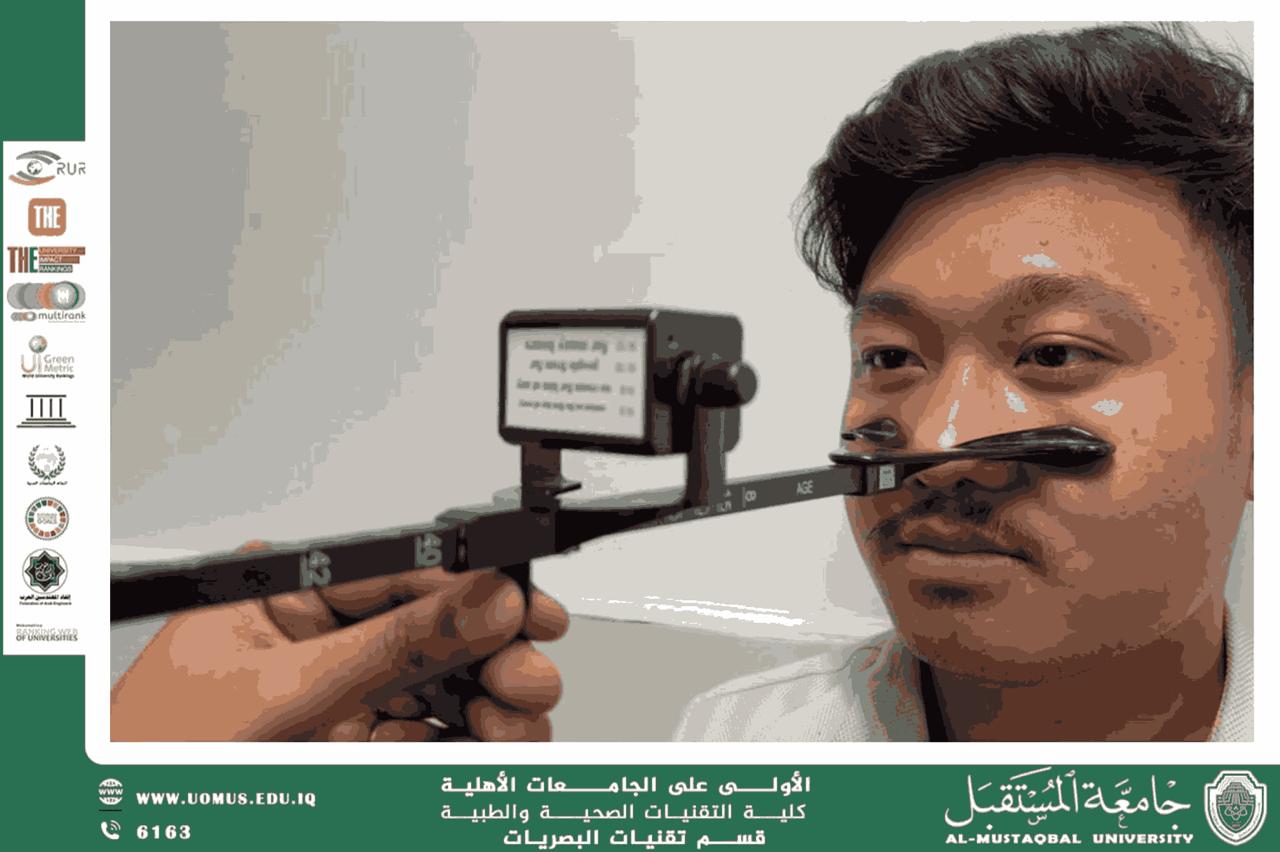
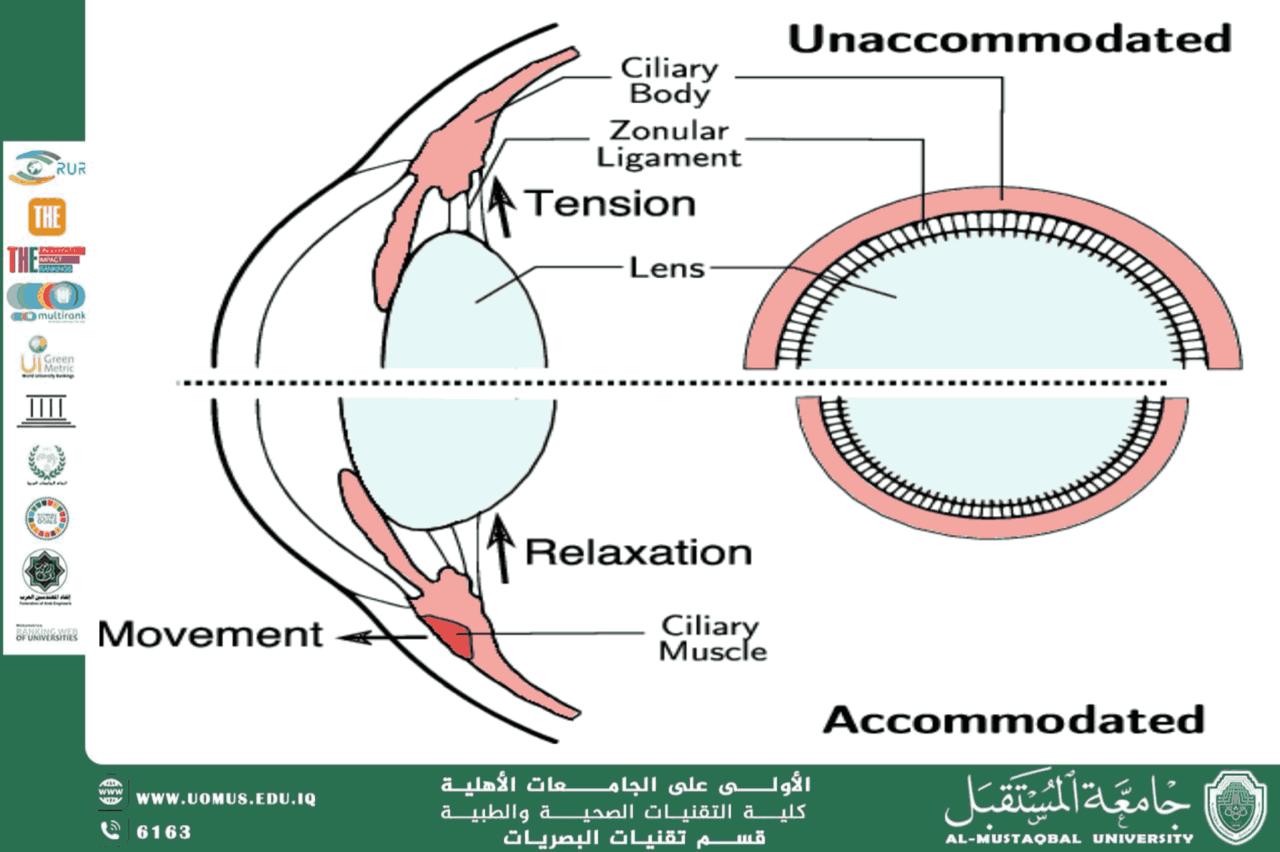
Accommodation is a vital visual function that allows the eye to maintain clear focus on objects at varying distances. It is achieved through a dynamic process involving the contraction of the ciliary muscle, relaxation of the zonular fibers, and a subsequent change in the curvature of the crystalline lens. This process increases the refractive power of the lens when viewing near objects and decreases it for distant ones.<br />Types of Accommodation<br />Accommodation can be categorized into five distinct types based on the nature of the stimulus and the type of response:<br />1. Tonic Accommodation<br />This refers to the resting state of accommodation in the absence of a visual stimulus. It is typically observed when a person looks at a blank wall or is in complete darkness, where the eye maintains a slight accommodative tone due to residual ciliary muscle activity.<br />2. Reflex Accommodation<br />This is the automatic response of the eye to maintain clarity as an object moves closer or farther from the observer. It is continuously active during normal visual tasks such as reading or watching moving objects.<br />3. Voluntary Accommodation<br />This type involves conscious effort to change the focus, typically when trying to view a small or blurry object clearly. It is less commonly used but can be activated under specific visual demands.<br />4. Convergence Accommodation (CA/C Ratio)<br />Occurs as a result of convergence of the eyes on a near target, where the accommodation is stimulated secondarily. It is often tested when evaluating binocular vision and is significant in near-vision tasks.<br />5. Proximal Accommodation<br />Triggered by the awareness or perception of an object being near, even before it becomes blurry. This type depends more on psychological cues than visual clarity.<br />Measurement Techniques of Accommodation<br />Several clinical techniques are used to assess accommodative amplitude and efficiency:<br />1. RAF Rule (Royal Air Force Rule):<br />This tool consists of a 50 cm ruler with a movable target. The patient fixates on the target as it is moved slowly closer until a sustained blur is reported. It is commonly used to measure:<br />o Near Point of Accommodation (NPA): Closest point at which the eye can maintain clear focus.<br />o Near Point of Convergence (NPC): Closest point at which the eyes can maintain binocular fusion.<br />2. Minus Lens Method:<br />In this method, a patient views a target at 40 cm while negative-powered lenses are introduced in 0.25 D increments until the patient reports blur. The total accommodative amplitude is the sum of the lens power added and the 2.50 D required to view the target at 40 cm.<br />Accommodation Anomalies<br /><br />1. Accommodative Insufficiency<br />This is a condition in which the eye fails to exert the expected amount of accommodation for the individual’s age. Common symptoms include blurred near vision, visual fatigue, headaches, and difficulty in reading. It is prevalent among children and older adults. Management includes near correction with plus lenses and accommodative therapy.<br /><br />2. Accommodative Excess (Spasm of Accommodation)<br />This occurs when the eye exhibits excessive or involuntary accommodation, even when viewing distant objects. Symptoms include fluctuating vision, headaches, and difficulty shifting focus. It is common among students or individuals engaged in prolonged near work. Treatment may involve cycloplegic drops, visual hygiene counseling, and accommodative relaxation techniques.<br />Conclusion<br />Accommodation is an essential function of the visual system that enables clear vision at different distances through complex neuromuscular mechanisms. Proper assessment of its types, measurement, and associated disorders is crucial for diagnosing visual stress and guiding appropriate interventions. Routine accommodative testing is recommended, particularly for students, digital device users, and individuals experiencing visual discomfort.<br />