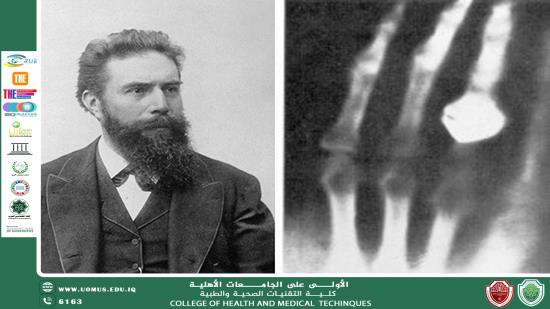
"Radiology: Between the Past and the Present"
Introduction<br /><br />Since the discovery of X-rays by the German physicist Wilhelm Conrad Roentgen in 1895, the world has witnessed a tremendous revolution in the field of medical diagnostics. This groundbreaking discovery opened a new window for exploring the human body from within, without the need for direct surgical intervention, leading to a paradigm shift in medicine and contributing to the saving of millions of lives. With the advancement of science and technology, radiology has evolved from a simple imaging tool into an integrated system encompassing diagnosis, treatment, and precise disease monitoring.<br /><br />Radiology in the Past<br /><br />In the early 20th century, the use of X-rays was very limited, restricted mainly to bone imaging and fracture detection. The machines were primitive, bulky, and produced poor image quality. Moreover, the lack of awareness regarding radiation hazards exposed many patients and physicians to high doses, causing long-term health problems.<br />Despite these challenges, the discovery of X-rays represented a groundbreaking leap in medicine, making it possible to visualize what was once hidden and to confirm diagnoses rather than relying solely on clinical examination.<br /><br />Radiology in the Present<br /><br />Today, radiology has transformed into a comprehensive discipline known as Radiological Medicine, encompassing advanced techniques such as:<br /><br />1. Computed Tomography (CT): Provides three-dimensional images of body organs.<br />2. Magnetic Resonance Imaging (MRI): Displays highly detailed structures without the use of ionizing radiation.<br />3. Interventional Radiology: Enables the treatment of complex conditions, such as arterial blockages and tumors, through minimally invasive procedures instead of major surgeries.<br />4. Digital Imaging and Artificial Intelligence: Have accelerated diagnosis and significantly improved accuracy.<br /><br />Radiology today has become an essential tool across nearly all medical specialties—from oncology, cardiology, and neurology to orthopedics, obstetrics, and fetal monitoring.<br /><br />Between the past and the present, radiology has evolved from faint images of bones to highly sophisticated techniques capable of diagnosing and treating diseases without surgery. The journey of radiology through time is not merely a scientific narrative but a profoundly human story, as it has reduced suffering, accelerated treatment, and saved countless lives. Looking ahead, the future promises even greater advancements with the integration of artificial intelligence and nanotechnology imaging, positioning radiology as one of the cornerstones of modern medicine.<br /><br />References<br /><br />Abdel-Latif, Mahmoud. Introduction to Diagnostic Radiology. Cairo: Dar Al-Fikr Al-Arabi, 2018.<br /><br />Al-Bahnasawi, Ahmed. Medical Radiology: Development and Applications. Amman: Dar Al-Safaa, 2020.<br /><br />Journal of Medical Sciences. The Development of Medical Imaging Techniques: Between the Past and the Present. Issue 12, 2022.<br /><br />Bushberg, J. T., Seibert, J. A., Leidholdt, E. M., & Boone, J. M. The Essential Physics of Medical Imaging. 4th ed., Lippincott Williams & Wilkins, 2020.<br /><br />Huda, W. Review of Radiologic Physics. 5th ed., Lippincott Williams & Wilkins, 2019.<br /><br />Thrall, J. H., & Arenson, R. L. Radiology: Current Trends and Future Directions. Academic Press, 2021.<br /><br />World Health Organization (WHO). Diagnostic Imaging. 2023. https://www.who.int<br /><br />Mustaqbal University<br />The First University in Iraq