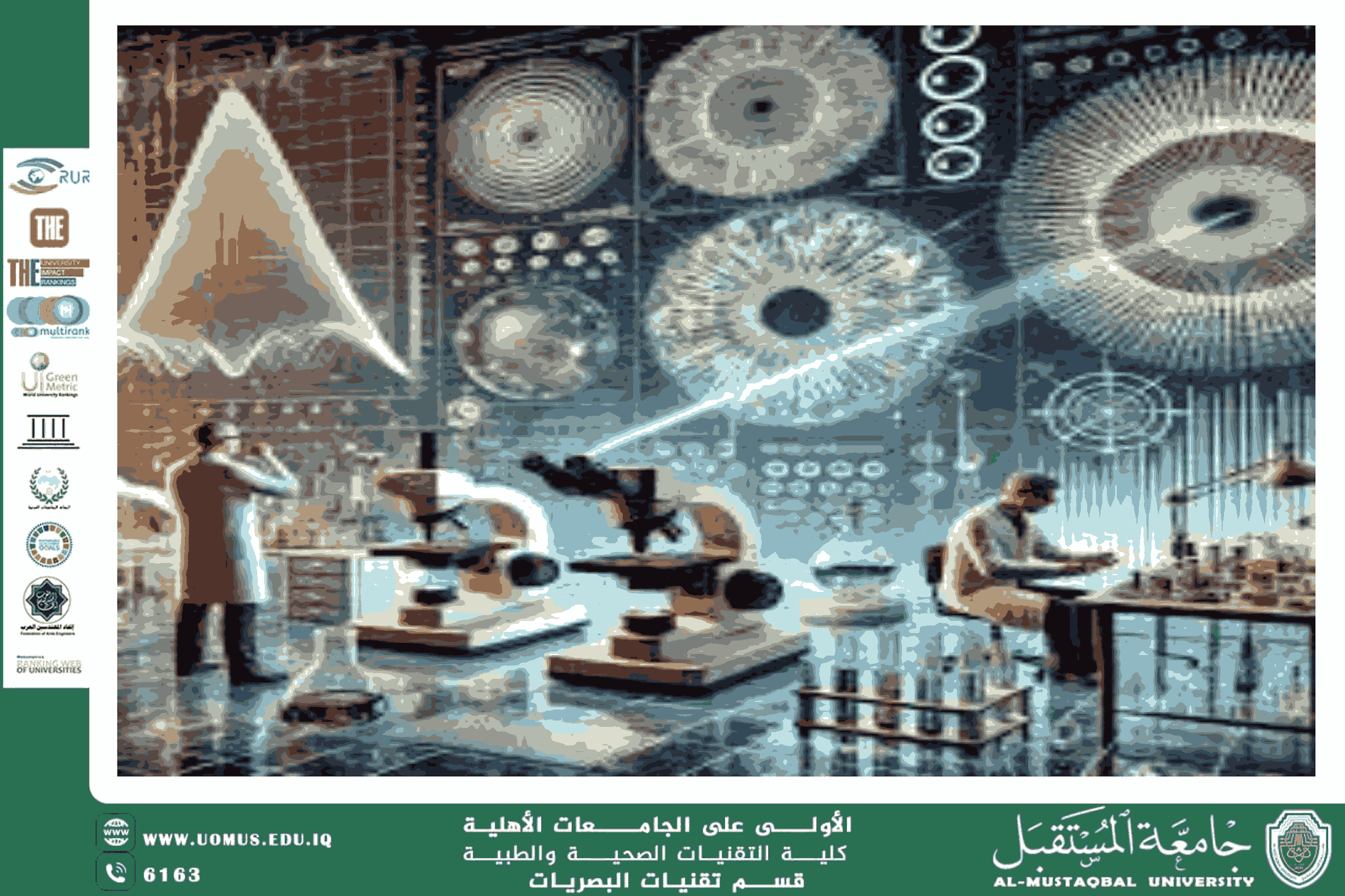
A scientific article by the lecturer, Assist.Lect. Mohaimen Sameer Aref (Future Applications of Holography in Ophthalmic Lens Manufacturing: Towards a Revolution in Vision Science)
The technology of ophthalmic lens manufacturing has evolved remarkably over the past decades, progressing from conventional glass lenses to polycarbonate and advanced smart materials. A novel and promising field, however, lies in the development of holographic lenses, which has recently captured the attention of researchers. These lenses rely on recording light interference patterns within the lens material, enabling the reconstruction of optical wavefronts in ways that surpass the capabilities of traditional refractive optics.<br />Holographic lenses have the unique ability to correct complex higher-order aberrations such as spherical aberration, coma, and other high-order visual distortions that conventional lenses fail to manage efficiently. Furthermore, holography enables the design of dynamic multifocal lenses, capable of adapting to various illumination conditions and visual tasks, whether reading, driving, or prolonged screen use.<br />One of the most promising applications is within medical augmented and virtual reality systems, where holographic lenses could be integrated into 3D visual environments. These would provide therapeutic benefits for patients with amblyopia or strabismus, while also enhancing the performance of smart glasses by improving image quality, depth perception, and adaptive optics.<br />Holographic lenses represent not merely a theoretical innovation, but a transformative leap in visual science. They may redefine ophthalmic optics, shifting the role of lenses from passive corrective devices to intelligent optical systems that interact dynamically with both the brain and the eye.<br />