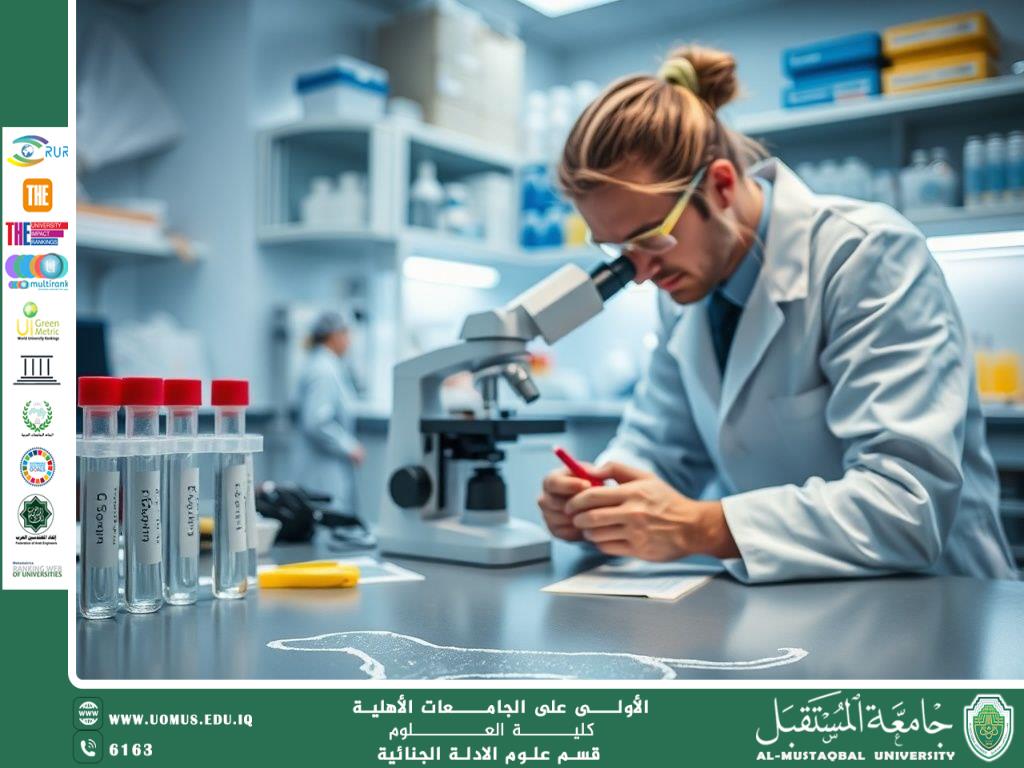
Microtraces and Their Impact in Linking a Suspect to a Crime Scene (M.M. Howayda Nazzal Hussein)
Introduction:<br />Microscopic evidence, such as dead skin cells or fine tissue fibers, has become a major focus of forensic investigations.<br /><br />Context:<br />Microtrace includes:<br /><br />Skin cells attached to objects or surfaces<br /><br />Small fragments of hair or skin<br /><br />Plant particles or tissue fibers<br /><br />Analysis Methods:<br /><br />Light and Electron Microscopy<br /><br />DNA Analysis of Remaining Cells<br /><br />Chemical Examination of Fibers<br /><br />Application:<br /><br />Linking a Person to a Crime Without Leaving a Clear Trace<br /><br />Supporting a Crime Scenario with Contact Analysis<br /><br />Revealing Hidden Events Through Invisible Traces<br /><br />Conclusion:<br />Microscopic evidence confirms that "nothing ever disappears completely," and every small detail can hold the key to solving a crime.<br /><br />Al-Mustaqbal University – The First University in Iraq