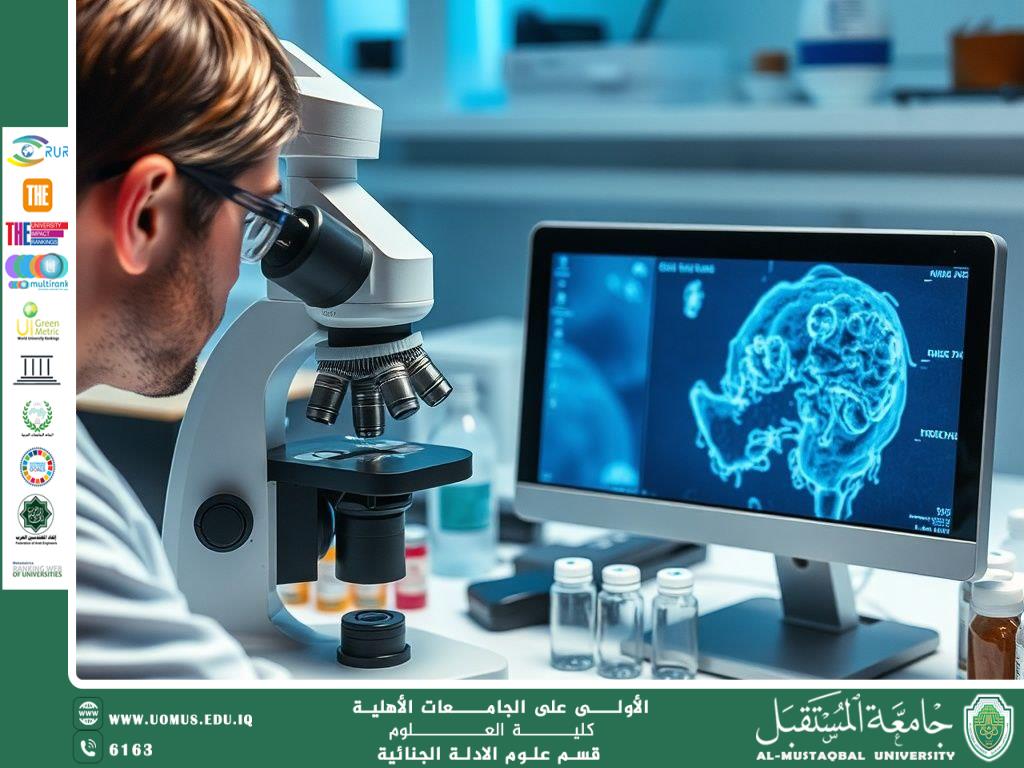
Microtraces and Their Role in Linking Suspects to Crime Scenes (M.M. Howayda Nazzal Hussein)
Introduction:<br /><br />Microtraces — such as dead skin cells or microscopic fibers — have gained significant attention in forensic science. These tiny biological traces can provide powerful evidence in criminal investigations.<br /><br />Content:<br /><br />Microtraces include:<br /><br />Skin cells adhered to objects or surfaces<br /><br />Tiny fragments of hair or skin<br /><br />Microscopic plant particles or textile fibers<br /><br />Methods of Analysis:<br /><br />Light and electron microscopy<br /><br />DNA analysis from residual cells<br /><br />Chemical examination of fibers<br /><br />Applications:<br /><br />Linking a suspect to a crime without visible evidence<br /><br />Supporting crime scene scenarios through contact trace analysis<br /><br />Revealing hidden events via invisible or overlooked evidence<br /><br />Conclusion:<br /><br />Microtraces prove that "nothing ever truly disappears." Every tiny detail can carry the key to solving a crime. Forensic science continues to uncover the truth, one microscopic clue at a time.<br /><br />Al-Mustaqbal University – the first university in Iraq.<br/><br/><a href=https://www.un.org/sustainabledevelopment/ar/ target=_blank>SDGS</a>