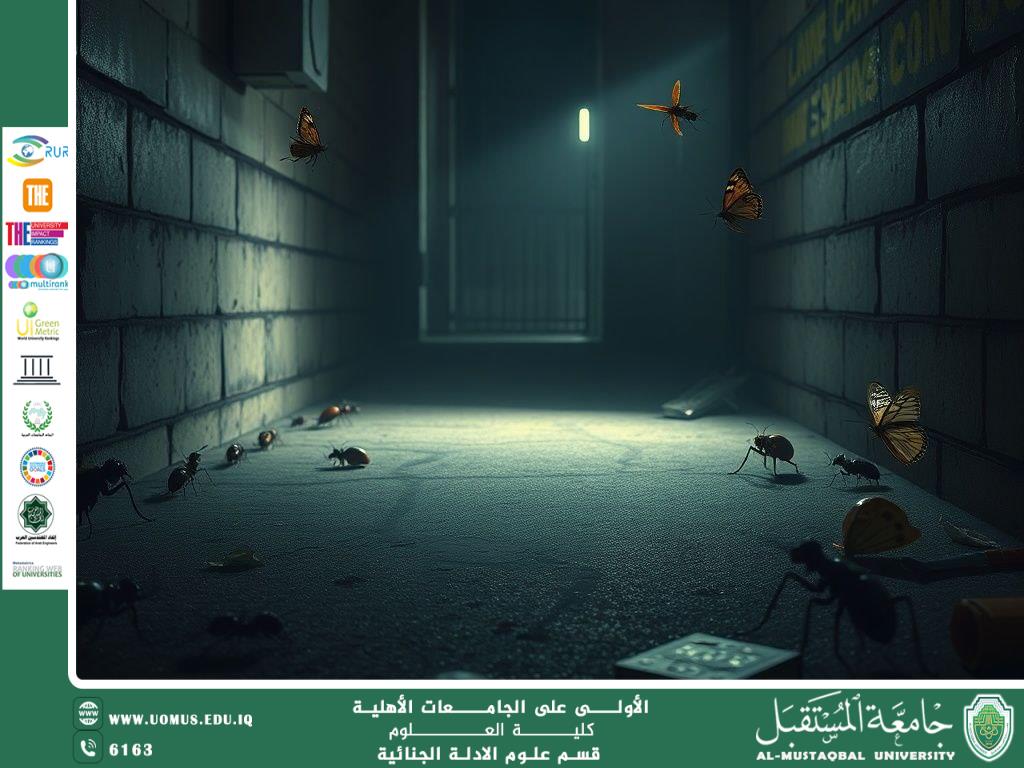
Silent Witnesses: Insects at the Crime Scene (M.M. Howayda Nazzal Hussein)
In the world of criminal investigations, it may seem strange to think of insects as key players in solving crimes. Yet, these tiny creatures often serve as silent witnesses, offering crucial clues about the time, location, and circumstances of death. Forensic entomology – the study of insects in legal investigations – has become an essential tool in modern forensic science.<br /><br />Forensic Entomology: Where Biology Meets Justice<br /><br />Forensic entomology is a branch of forensic science that focuses on studying insects and other arthropods found on decomposing bodies. These organisms can help forensic experts estimate the postmortem interval (PMI) – the time that has passed since death – based on the species present and the stages of insect development.<br /><br />How Insects Provide Evidence<br /><br />When a person dies and the body begins to decompose, certain insects – particularly blowflies – are attracted to the body within minutes or hours. These flies lay eggs in natural openings or wounds, and the eggs hatch into larvae (maggots) that feed on the soft tissues.<br /><br />By examining the species of insects and the developmental stage of the larvae, forensic entomologists can:<br /><br />Estimate the time of death<br /><br />Identify if a body has been moved from the original place of death<br /><br />Detect the presence of drugs or toxins by analyzing insect tissue<br /><br />For instance, maggots can absorb chemicals from the body they feed on, which can later be detected even if the human tissue has decomposed completely.<br /><br />Famous Cases Solved with Insect Evidence<br /><br />In multiple criminal cases around the world, insect evidence has been critical. In one case, larvae analysis revealed that a body had been moved postmortem. In another, toxic substances were found in insect remains, revealing the real cause of death long after the body had decomposed.<br /><br />Challenges in Forensic Entomology<br /><br />Despite its usefulness, insect evidence can be influenced by several factors:<br /><br />Temperature: Affects the speed of insect development.<br /><br />Access to the body: If a body is buried or sealed, insect colonization may be delayed.<br /><br />Geographic variation: Different species exist in different regions, requiring local expertise.<br /><br />Conclusion<br /><br />Though they cannot speak, insects remain among the most reliable witnesses at a crime scene. They don’t lie, forget, or miss details—they tell the story of death through biological evidence. As forensic science advances, these silent witnesses are gaining recognition as powerful tools for justice.<br /><br />Al-Mustaqbal University – the first university in Iraq.<br/><br/><a href=https://www.un.org/sustainabledevelopment/ar/ target=_blank>SDGS</a>