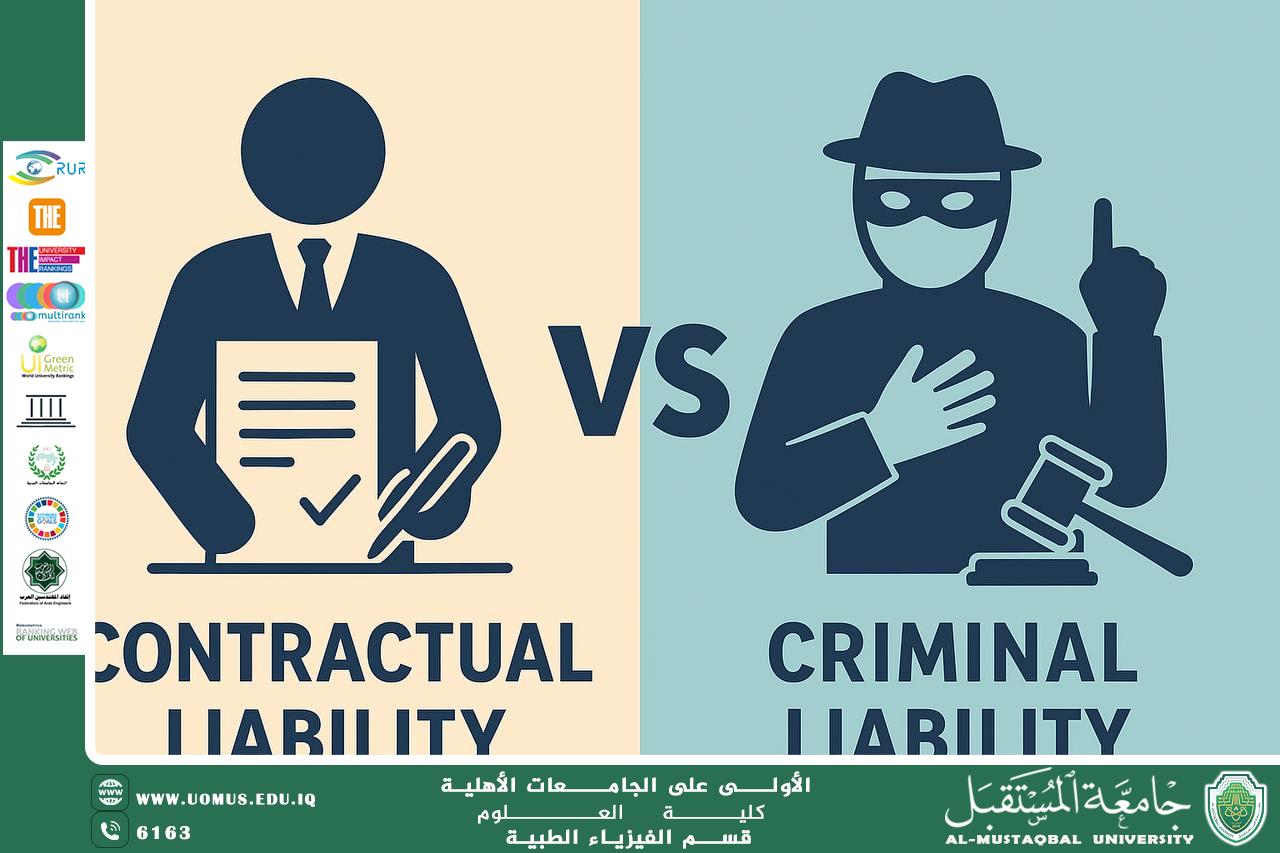
A scientific article by the lecturer (Assistant Professor Fatima Makki Shaalan) entitled “Contractual and Criminal Liability in Civil Law: A Comparative Study”
Introduction<br /><br />Legal liability represents one of the cornerstones of any legal system, as it aims to ensure the stability of transactions, safeguard rights, and achieve justice. Legal liability is generally divided into two main types: contractual liability, which arises from the failure of one party to fulfill contractual obligations, and criminal liability, which arises from committing an act defined by law as a crime, thereby threatening public interest or order. Although the legal foundations of each differ, there are significant intersections and distinctions that warrant careful study and analysis.<br /><br />I. Contractual Liability in Civil Law<br /><br />Contractual liability is a legal obligation imposed on one of the contracting parties as a result of a breach of contractual commitments.<br /> • Legal basis: It derives from the principle of “pacta sunt servanda” (contracts are binding upon the parties), which is enshrined in most civil law systems and obligates the parties to respect what they have agreed upon.<br /> • Conditions: The existence of a valid contract, the occurrence of a breach, and the establishment of damage directly linked to the breach.<br /> • Effects: The breaching party is required to compensate the other for the damages sustained, whether material or moral, with the remedy typically taking the form of monetary compensation.<br /><br />II. Criminal Liability<br /><br />Criminal liability arises from an individual’s violation of public order by committing an act defined by law as a crime.<br /> • Legal basis: The principle of “nullum crimen, nulla poena sine lege” (no crime or punishment without law), which means that an act cannot constitute a crime unless explicitly provided for by legislation.<br /> • Conditions: The legal element (existence of a statutory provision), the material element (the act or omission constituting the crime), and the moral element (criminal intent or negligence).<br /> • Effects: The imposition of penalties, which may include deprivation of liberty (imprisonment), financial penalties (fines), or other preventive measures.<br /><br />III. Comparative Aspects Between Contractual and Criminal Liability<br /> 1. Legal basis:<br /> • Contractual liability arises from private will and agreements between individuals.<br /> • Criminal liability arises from an individual’s violation of public interest.<br /> 2. Objective:<br /> • Contractual liability seeks to redress harm and restore balance between the contracting parties.<br /> • Criminal liability seeks to protect society and deter offenders.<br /> 3. Sanctions:<br /> • In contractual liability: primarily financial compensation.<br /> • In criminal liability: punishment in the form of imprisonment, fines, or other sanctions.<br /> 4. Parties involved:<br /> • Contractual liability exists exclusively between private individuals.<br /> • Criminal liability necessarily involves the state as the representative of society.<br /><br />IV. The Intersection Between the Two Liabilities<br /><br />In certain situations, both systems may overlap, as when an individual commits an act that constitutes both a contractual breach and a criminal offense. For example, if a contractor commits fraud in executing a construction project, his conduct constitutes a breach of contract (contractual liability) and, at the same time, a crime of fraud (criminal liability). In such cases, both civil compensation and criminal punishment may be imposed concurrently.<br /><br />Conclusion<br /><br />This comparative study highlights that contractual liability and criminal liability differ in their legal foundation, objectives, and sanctions. Nevertheless, important links emerge when private interests intersect with public interests. Striking a balance between these two forms of liability is essential for safeguarding individual rights while maintaining public order, thereby achieving justice in its comprehensive sense.<br /><br /><br /><br /><br />"AL_mustaqbal University is the first university in Iraq"<br/><br/><a href=https://uomus.edu.iq/Default.aspx target=_blank>al-mustaqbal University Website</a>