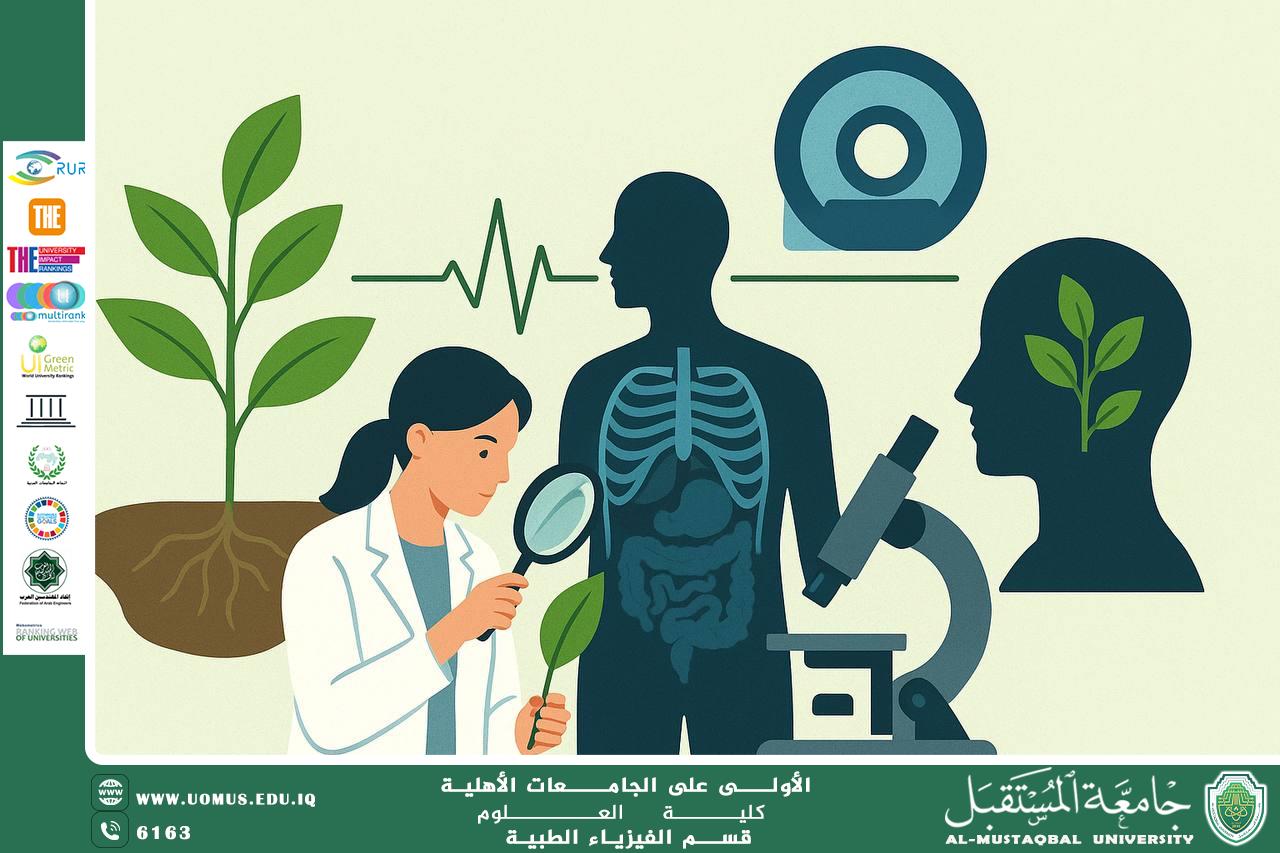
A scientific article by the lecturer ( Assistant Lecturer Samaher Saad) entitled “Plants and Medical Physics: Linking Natural Sciences and Sustainable Technology”
Introduction<br /><br />In recent decades, there has been a growing convergence between natural sciences and medical technology, opening new horizons in both research and practical applications. The connection between plants, as complex biological systems, and medical physics, with its diagnostic and therapeutic tools, emerges as a promising pathway toward achieving sustainable development goals. Plants are not merely ecological or nutritional resources; they represent natural laboratories for bioactive compounds, while medical physics provides the techniques necessary to explore their properties and apply them for human well-being.<br /><br />I. Plants as a Natural Source for Medical Applications<br /><br />Since ancient times, plants have been the cornerstone of traditional medicine, as they contain chemical compounds with therapeutic effects. With scientific advancement, it has become possible to study these compounds at the molecular level using advanced physical techniques such as:<br /> • Spectroscopy, to determine chemical structures.<br /> • Nuclear Magnetic Resonance (NMR), to study biological interactions.<br /> • Electron Microscopy, to examine the fine structures of plant cells.<br /><br />These physical tools have enabled scientists to understand how plant-derived substances interact with the human body, opening the door to the development of more effective and environmentally friendly medicines.<br /><br />II. Medical Physics as a Bridge Between Nature and Humans<br /><br />Medical physics applies physical principles to develop diagnostic and therapeutic techniques, such as X-rays, ultrasound, and magnetic resonance imaging. When combined with plant studies, these tools can:<br /> • Trace the effects of plant compounds within the human body with precision.<br /> • Assess the efficacy of plant-derived substances through non-invasive imaging techniques.<br /> • Design personalized treatments that account for individual differences among patients.<br /><br />III. Towards Sustainable Technology<br /><br />The integration of plants and medical physics extends beyond therapeutic applications to sustainability. Harnessing plant resources in the medical field allows for:<br /> 1. Reducing dependence on synthetic chemicals that have harmful environmental impacts.<br /> 2. Promoting a green economy through a pharmaceutical industry based on renewable natural sources.<br /> 3. Supporting sustainable development goals by merging environmental conservation with healthcare advancement.<br /><br />Conclusion<br /><br />The intersection between plants and medical physics represents an advanced model of integration between natural sciences and technology. It combines the wisdom of nature with the precision of physics to serve human health and build a more sustainable future. By deepening this integration, humanity can achieve significant breakthroughs in sustainable medicine, relying on renewable natural resources and advanced scientific tools.<br /><br /><br /><br /><br /><br /><br />"AL_mustaqbal University is the first university in Iraq"<br/><br/><a href=https://uomus.edu.iq/Default.aspx target=_blank>al-mustaqbal University Website</a>