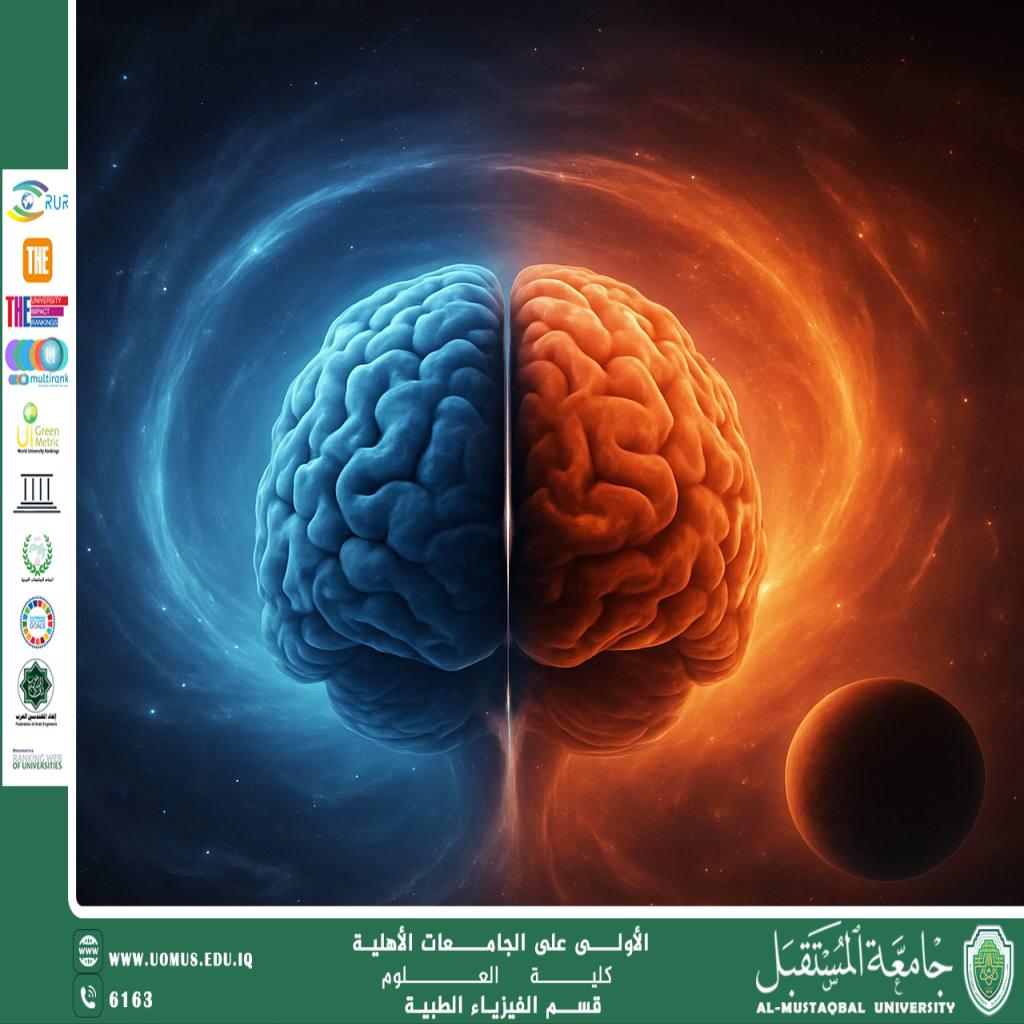
A scientific article by the teaching assistant (Mohammed Abdel Zahra) entitled “Broken Time: Experiencing Moments of the Past and Future at the Same Time”
Introduction<br /><br />Time is a complex and relative concept that has long puzzled philosophers and scientists alike. We perceive time as a continuous line from the past to the present and onward to the future. However, modern physics, particularly relativity and quantum mechanics, suggests that time may be far more flexible and intricate than we imagine. This idea is referred to as “broken time,” where it is possible to experience moments from the past and the future simultaneously or to relive past events in different ways.<br /><br />⸻<br /><br />Scientific Foundations<br /> 1. General and Special Relativity<br />Albert Einstein demonstrated in his theories that time is relative, not absolute. It can pass faster or slower depending on an object’s speed and proximity to gravitational forces. This implies that our experience of time is not fixed and may vary under specific conditions.<br /> 2. Quantum Mechanics<br />At the subatomic level, time does not necessarily move in a straight line. Some experiments suggest that events can interfere in ways that make it seem as though the future and past interact unpredictably, opening the door to the concept of “broken time.”<br /> 3. Wormholes and Multidimensional Theory<br />Wormholes and modern cosmic theories propose theoretical pathways connecting two different points in time through shorter routes, giving the impression of experiencing multiple moments simultaneously.<br /><br />⸻<br /><br />Theoretical Applications<br /> • Psychological Therapy and Memory: The concept of broken time may help understand how memories are retrieved or past experiences are re-evaluated.<br /> • Future Prediction: By simulating quantum and cosmic models, it is possible to study multiple future possibilities without following a single linear timeline.<br /> • Literature and Virtual Reality: Broken time can be used to create storytelling or VR experiences that allow users to experience multiple events simultaneously.<br /><br />⸻<br /><br />Conclusion<br /><br />Broken time remains largely theoretical, but it opens vast possibilities for understanding the universe, human consciousness, and even potential time travel in the future. Our grasp of time may one day evolve from a purely theoretical concept into a practical tool for reshaping experiences and enhancing our understanding of existence.<br /><br /><br /><br /><br /><br />"AL_mustaqbal University is the first university in Iraq"<br/><br/><a href=https://uomus.edu.iq/Default.aspx target=_blank>al-mustaqbal University Website</a>