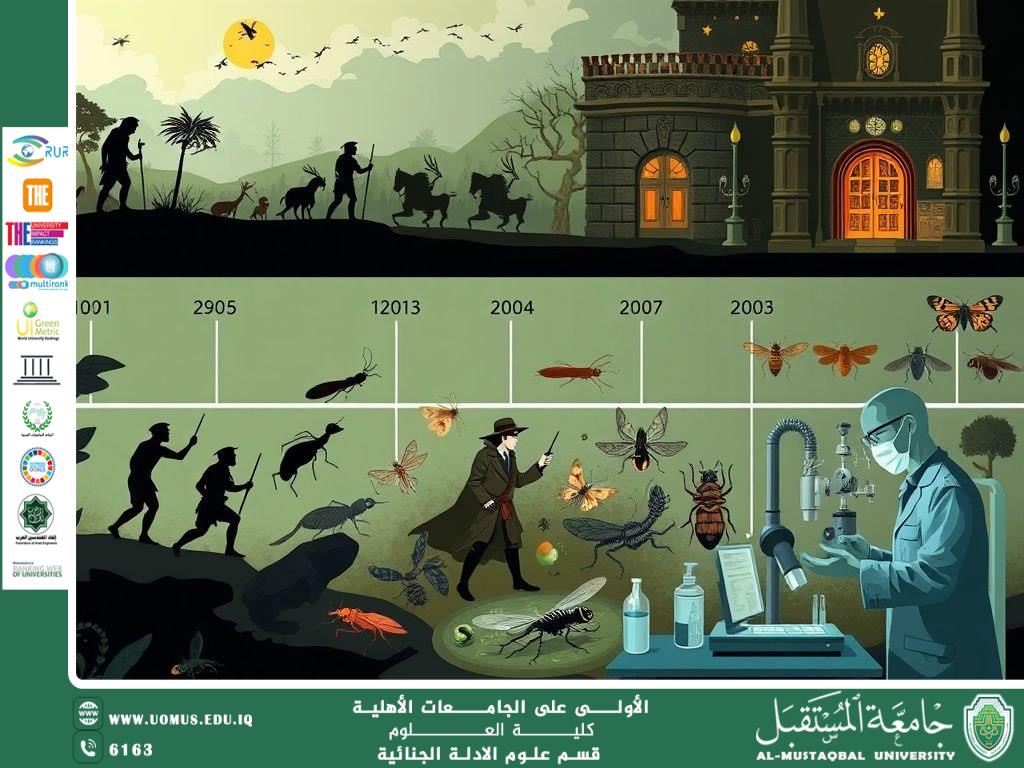
The Evolution of Insect Use in Forensic Investigations Throughout History (M.M. Howayda Nazzal Hussein)
Forensic entomology is one of the oldest applied sciences in criminal investigations, where insects have long been used as indicators to uncover the circumstances and causes of crimes. The earliest documented case dates back to 13th-century China, when Judge Song Ci described in his book The Washing Away of Wrongs how blowflies were attracted to traces of blood on a sickle, thereby identifying the murder weapon.<br /><br />For centuries after, insect-based investigations remained sporadic. It was not until the 19th century that European scientists began systematically studying the relationship between insect succession and the decomposition of human remains. A key figure was the Belgian scientist Jean Pierre Mégnin, whose 1894 publication outlined the role of insects in estimating the postmortem interval (PMI).<br /><br />During the 20th century, forensic entomology advanced into a recognized branch of forensic science. Researchers refined techniques to analyze insect life cycles, environmental factors, and their correlation with body decomposition. The scope also broadened beyond homicide cases to include investigations of corpse relocation, burial practices, and even trafficking of remains.<br /><br />Today, forensic entomology is integrated with modern scientific methods, including DNA analysis from larvae and molecular studies, offering precise insights into criminal cases. This progression—from the simple observation of fly behavior to the application of molecular biology—illustrates the remarkable evolution of insect use in forensic investigations.<br /><br /><br />Al-Mustaqbal University – the first university in Iraq.<br/><br/><a href=https://www.un.org/sustainabledevelopment/ar/ target=_blank>SDGS</a>