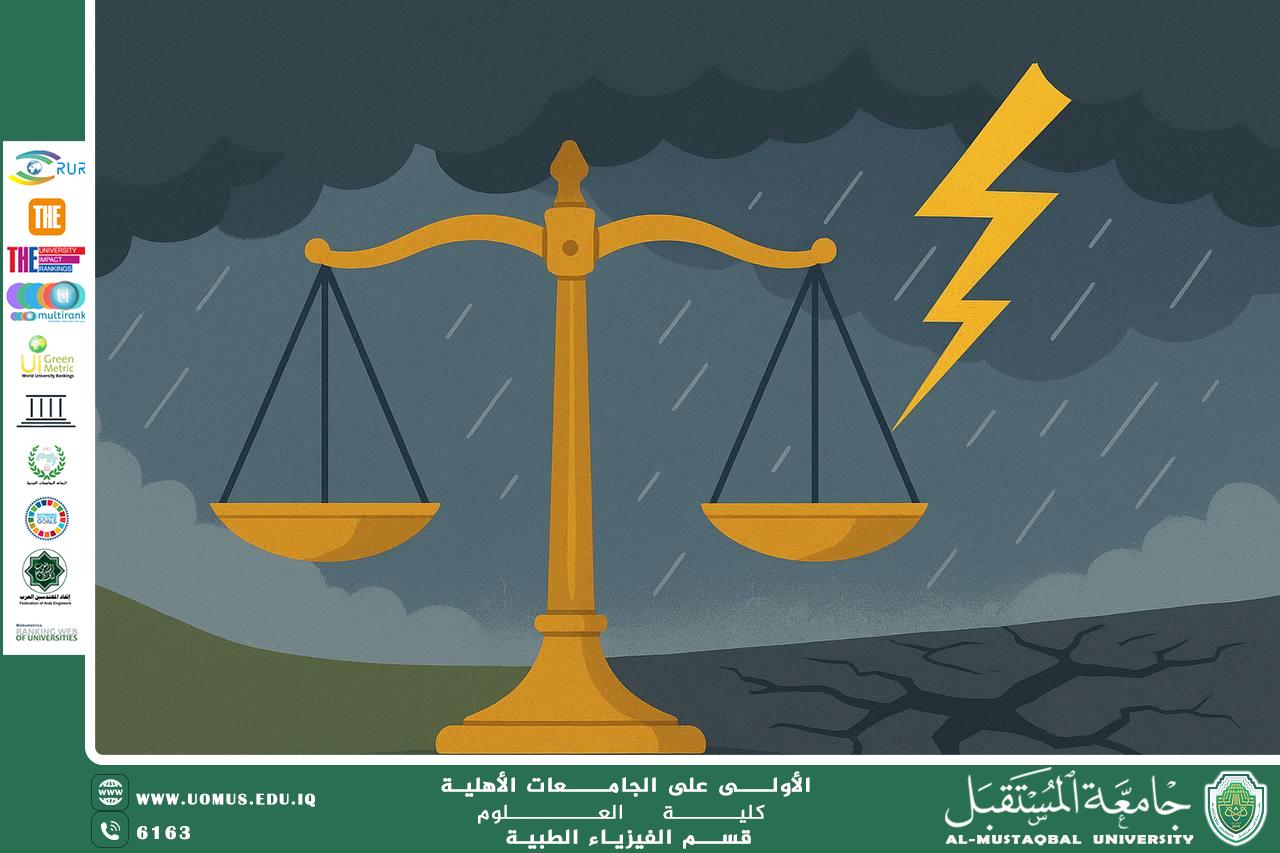
A scientific article by the lecturer (Assistant Professor Fatima Makki Shaalan) entitled “The Impact of Force Majeure on Contractual Obligations in Iraqi Civil Law”
Introduction<br /><br />A contract is one of the most important sources of obligations in civil law, as it reflects the agreement of two parties to establish, amend, or terminate an obligation. However, the performance of contractual obligations may sometimes face exceptional and uncontrollable circumstances known as force majeure—events that are unforeseeable and unavoidable, rendering the execution of the obligation absolutely impossible. The Iraqi Civil Law has given considerable attention to this matter, given its direct connection to the stability of transactions and the achievement of fairness between contracting parties.<br /><br />First: The Concept of Force Majeure in Iraqi Civil Law<br /><br />Doctrine and jurisprudence define force majeure as any extraordinary event that cannot be foreseen or prevented, and which makes the execution of an obligation absolutely impossible. According to Article (211) of the Iraqi Civil Code, the debtor shall not be liable for compensation if he proves that non-performance was due to an external cause beyond his control, such as force majeure or an unforeseen accident.<br /><br />Thus, for an event to be considered force majeure, the following conditions must be met:<br /> 1. Unpredictability: The event must be unforeseeable at the time of contract formation.<br /> 2. Unavoidability: The event must be impossible to prevent or overcome, even with the diligence of a reasonable person.<br /> 3. Absolute impossibility: The event must result in absolute impossibility of performance, not mere difficulty or hardship.<br /><br />Second: The Effect of Force Majeure on Contractual Obligations<br /> 1. Extinction of the obligation: If force majeure permanently renders performance impossible, the obligation is extinguished, and liability for delay or damages is removed.<br /> 2. Exemption from liability: Establishing force majeure exempts the debtor from paying compensation, as fault is absent on his part.<br /> 3. Partial performance: If force majeure renders only part of the obligation impossible, that part is extinguished, while the debtor remains bound by the possible portion.<br /> 4. Termination or dissolution: A contract may be terminated or dissolved by operation of law if its performance becomes completely and permanently impossible due to force majeure.<br /><br />Third: Distinction Between Force Majeure and Hardship<br /><br />It is essential to distinguish between the doctrine of force majeure and that of hardship:<br /> • Force majeure: Makes performance impossible and leads to the extinction of the obligation.<br /> • Hardship: Makes performance excessively burdensome but not impossible; in such cases, the judge may adjust the obligation to restore fairness.<br /><br />Conclusion<br /><br />The study of the effect of force majeure in Iraqi civil law reflects the legislator’s concern with balancing the interests of contracting parties. On one hand, it protects the debtor from bearing the consequences of events beyond his control. On the other, it ensures that the creditor is not unfairly disadvantaged. Ultimately, the judiciary plays a crucial role in verifying the conditions of force majeure and determining its effects, thereby safeguarding justice and preserving the stability of civil and commercial transactions.<br /><br /><br /><br /><br />"AL_mustaqbal University is the first university in Iraq"<br/><br/><a href=https://uomus.edu.iq/Default.aspx target=_blank>al-mustaqbal University Website</a>