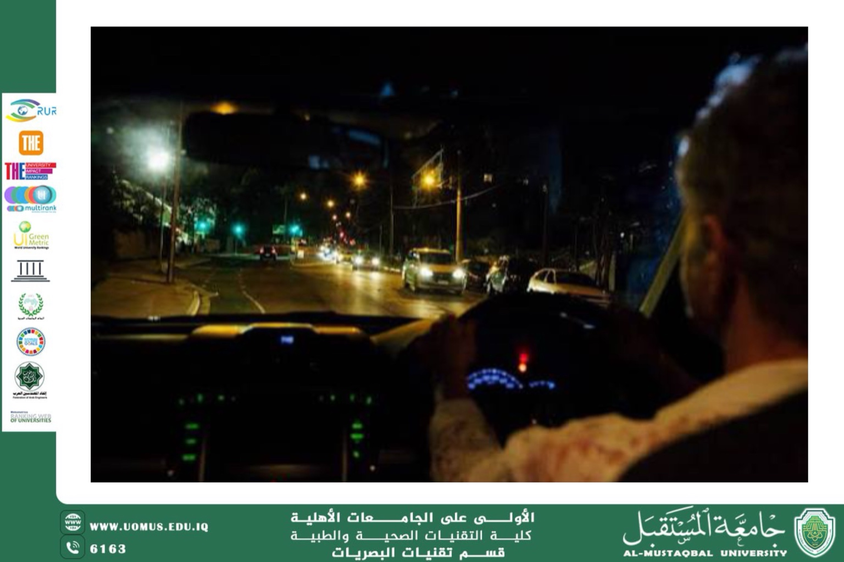
A scientific article by Assistant Lecturer Mohaimen Sameer Aref titled ( Dynamic Visual Assessment During Night Driving: An Innovative Approach to Understanding Ocular Performance in Low-Light Conditions)
<br />Night driving presents a significant visual challenge that demands high-performance visual processing under limited illumination. This paper explores the dynamic visual functions affected by low-light conditions, including contrast sensitivity, glare recovery, peripheral awareness, and night myopia. The study proposes innovative diagnostic strategies to evaluate ocular performance during night driving using simulated environments and advanced optometric tools.<br /><br />Driving at night is associated with increased accident risk, often due to decreased visual performance. Although standard visual acuity tests are widely used in clinical settings, they fail to fully capture the complexity of night-time vision. This research emphasizes the need to assess dynamic vision under realistic conditions that reflect actual visual demands during night driving.<br /><br />The proposed assessment involves:<br /> • Simulated night driving environments using LED variable lighting and high-contrast moving targets.<br /> • Testing contrast sensitivity under mesopic and scotopic conditions.<br /> • Evaluating glare recovery time using photostress tests.<br /> • Assessing peripheral field awareness during rapid motion.<br /> • Participants include individuals aged 20–50 years with no significant ocular pathology.<br /><br />Results revealed that reduced contrast sensitivity and prolonged glare recovery significantly impaired driving performance. Night myopia also emerged as a contributing factor, especially in younger drivers. Findings indicate the necessity of incorporating night-driving simulations into optometric practice to better tailor vision correction strategies.<br /><br />A comprehensive dynamic visual assessment protocol under low-light simulation can improve the understanding and management of visual limitations during night driving. This approach promotes safer roads by guiding the development of better visual correction methods, such as anti-glare lenses or adaptive optics.