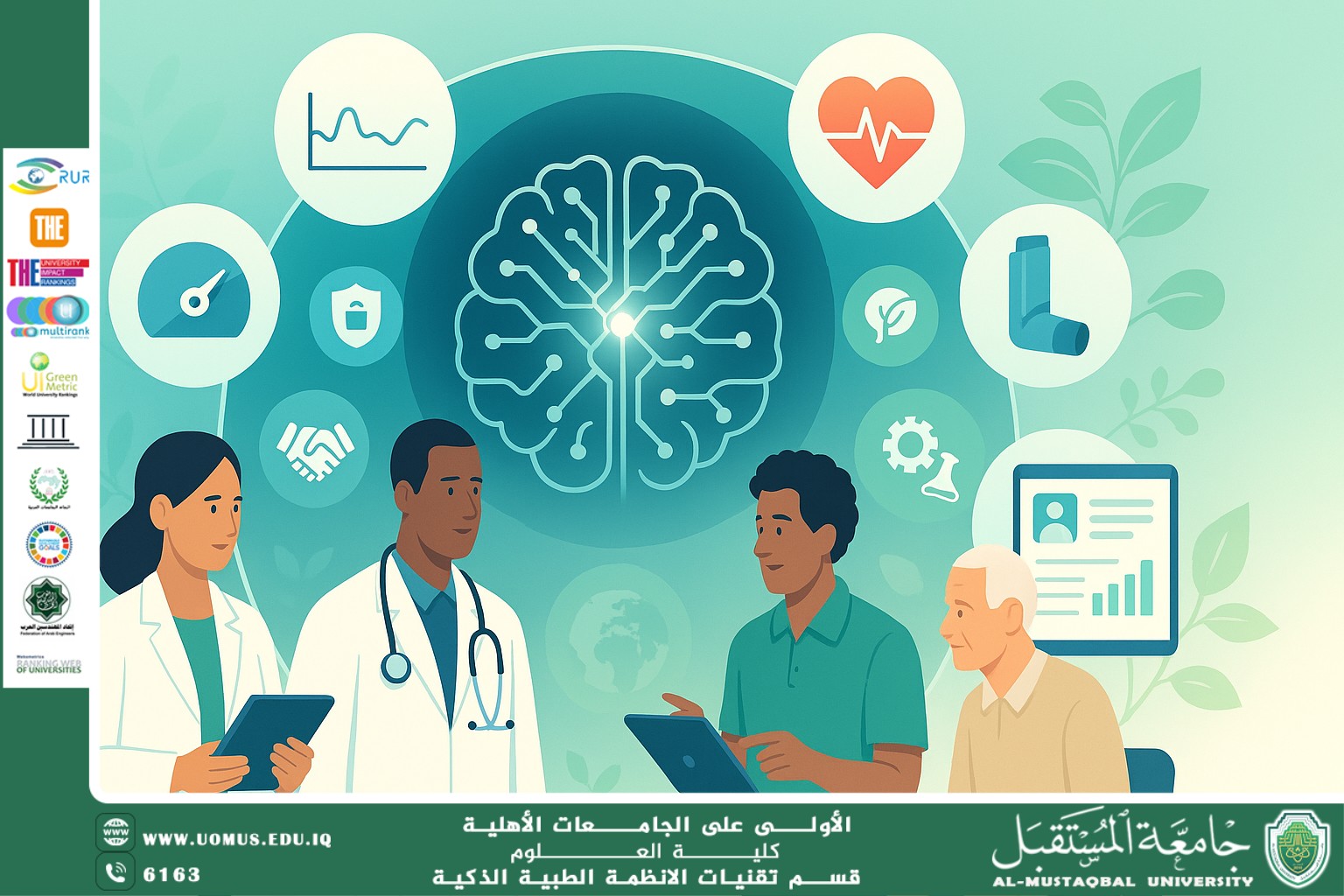

Predictive Modeling of Health Data to Reduce the Spread of Chronic Diseases and Its Link to Sustainable Development Goals<br />(Prof. Dr. Mehdi Ebady Manaa)<br />Chronic diseases—such as diabetes, hypertension, heart disease, and chronic obstructive pulmonary disease (COPD)—represent the greatest burden on health systems, economies, and societies. With the availability of electronic health records, wearable device data, lifestyle patterns, and social determinants, predictive modeling has become possible for early risk detection, efficient targeting of interventions, and reducing prevalence and complications. This approach is not just a technological upgrade; it is a tangible lever to achieve the Sustainable Development Goals (SDGs) by 2030.<br />What Is Predictive Modeling in Health?<br />It is the use of statistical and machine learning algorithms (logistic regression, decision trees, random forests, XGBoost, deep networks, and survival models such as Cox) to predict a future event: disease onset, condition deterioration, or hospital admission.<br />Data sources include: electronic health records (EHRs), laboratory and imaging results, prescriptions, vaccinations, insurance claims, home-monitoring and wearable devices, and social determinants of health (income, housing, access to food and transportation).<br />How Does It Practically Reduce the Spread of Chronic Diseases?<br />1. Early detection and precise targeting: Population risk stratification enables directed screenings for pre-disease stages (e.g., prediabetes, undiagnosed hypertension).<br />2. Smart behavioral interventions: Tailored messages, digital nudges, and apps aligned with risk levels, integrated with community health teams.<br />3. Improved treatment adherence: Predicting who is likely to miss treatment or follow-ups allows personalized interventions (reminder calls, drug delivery, brief consultations).<br />4. Population health management: Dashboards for hypertension, diabetes, and COPD cases reveal geographic and temporal hotspots for proactive action.<br />5. Enhanced care pathways: Clinical decision support (CDS) alerts within hospital systems activate standardized care protocols when risk scores cross thresholds.<br />Direct Alignment with the Sustainable Development Goals (SDGs)<br />• Goal 3: Good Health and Well-being<br />o Target 3.4: Reduce premature mortality from noncommunicable diseases by one-third—predictive models enable early detection and targeted prevention programs.<br />o Target 3.8: Universal health coverage—directing resources toward high-risk groups lowers costs and enhances equity.<br />o Targets 3.c and 3.d: Strengthening workforce and risk preparedness—risk dashboards and optimized workload distribution.<br />• Goal 9: Industry, Innovation, and Infrastructure<br />o Target 9.5: Research and innovation—building machine learning platforms and standardized data infrastructures (FHIR/HL7).<br />• Goal 10: Reduced Inequalities<br />o Targets 10.2 and 10.3: Models designed to address bias and ensure equitable access to preventive interventions.<br />• Goal 5: Gender Equality<br />o Target 5.b: Leveraging technology for women’s health (predicting gestational diabetes/hypertension and tailoring interventions).<br />• Goal 17: Partnerships for the Goals<br />o Target 17.18: Improve availability of high-quality, disaggregated data—responsible data-sharing ecosystems across public and private partners.<br />• Goal 16: Peace, Justice, and Strong Institutions<br />o Target 16.6: Effective governance—clear privacy and ethical governance frameworks for predictive models.<br />Governance, Privacy, and Equity<br />• Privacy and security: End-to-end encryption, role-based access controls, and audit trails. For multi-stakeholder collaboration, federated learning and differential privacy can be applied.<br />• Equity: Incorporating social determinants of health, testing model performance on vulnerable groups, and adjusting thresholds or weights to ensure fair outcomes.<br />• Ethics and transparency: Documenting objectives, data sources, limitations, and misuse risks; providing clear explanations for patients and healthcare providers.<br />Success Indicators (Health & SDG KPIs)<br />• Clinical: Reduced rates of undiagnosed/irregularly monitored cases; decreased HbA1c ≥9%; better blood pressure control; fewer asthma and COPD exacerbations.<br />• System-level: Fewer 30-day hospital admissions, reduced readmissions, and improved medication adherence (MPR/PDC).<br />• Economic: Net savings per high-risk individual; cost per QALY gained compared with standard care.<br />• SDG impact: Quantitative contribution to Target 3.4 (reduced premature mortality), improved equity indicators (Goal 10), and enhanced data quality (Target 17.18).<br />Quick Application Examples<br />• Type 2 Diabetes: A model predicting 12-month progression risk using age, BMI, HbA1c trajectories, prescriptions, and wearable activity data; triggers intensive lifestyle programs and reminder calls.<br />• Hypertension: Identifying “high-risk uncontrolled” patients for home blood pressure monitors, weekly nursing calls, and medication reminders.<br />• COPD/Asthma: Predicting exacerbations using weather, pollution exposure, and inhaler adherence; preparing pre-emptive rescue plans.<br />• Heart Disease: Short-term heart failure risk model automatically refers patients to community cardiology clinics and adjusts appointments and medications.<br />Roadmap for Resource-Limited Settings<br />1. Start with what’s available: basic records + labs + prescriptions.<br />2. Use simple, interpretable models first, piloted on small scales.<br />3. Low-cost communication tools (SMS/secure WhatsApp) for behavioral interventions.<br />4. Train primary care teams on risk interpretation and case management.<br />5. Partner with universities and startups (Goal 17) for capacity building and knowledge transfer.<br />6. Measure impact early, transparently, and share with decision-makers and communities.<br />Predictive modeling is not a “digital luxury” but a practical tool to reduce the spread of chronic diseases through early detection, smart targeting, improved adherence, and more efficient health systems. When implemented within a clear framework of governance, equity, and privacy, it directly advances SDG Goal 3 and supports innovation, data, and justice goals. Investment today in data, models, and people will translate into longer lives, better quality of life, and more sustainable health systems tomorrow.<br />Al-Mustaqbal University – The First University in Iraq.<br />