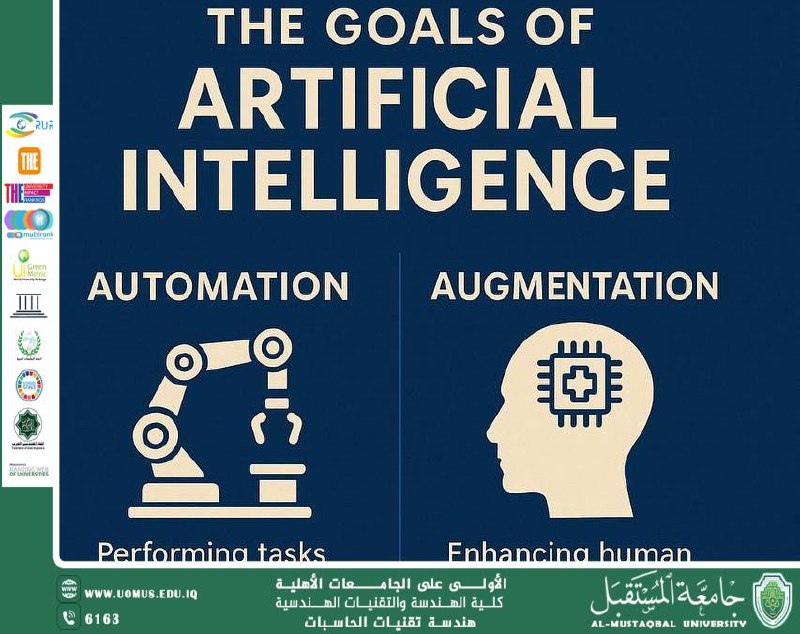
The Goals of Artificial Intelligence?
Dr. Abdullah J. Hussain <br />The goals of Artificial Intelligence (AI) serve as guiding principles that drive research, <br />development, and practical applications in the field. These objectives focus on replicating, <br />enhancing, and optimizing human intelligence to address complex challenges and improve <br />overall efficiency. <br />At its core, AI strives to create systems that can perform tasks requiring reasoning, learning, <br />perception, and decision-making. By mimicking human cognitive functions, AI seeks to <br />automate repetitive processes, analyze vast datasets, and enable machines to make decisions <br />faster and more accurately than humans. <br />The overarching aim of AI is to solve real-world problems across industries, enhance <br />productivity, and deliver innovative solutions. Whether it’s predicting trends, improving <br />medical diagnoses, or enabling autonomous systems, AI’s goals align with transforming how <br />humans interact with technology and information. <br />Primary Goals of AI <br />AI’s primary goals revolve around solving real-world problems, improving human decision<br />making capabilities, automating tasks, and driving innovation. These goals make AI integral <br />to enhancing efficiency across industries, fostering creativity, and enabling groundbreaking <br />advancements. Below, we delve into the major goals of AI, their applications, and how they <br />bring value to modern society. <br />1. Problem-Solving and Decision-Making <br />One of the fundamental goals of Artificial Intelligence is to enable systems to solve complex <br />problems and automate decision-making processes. AI algorithms use data-driven insights to <br />analyze vast amounts of information, identify patterns, and make accurate, informed <br />decisions in real time. By automating these processes, AI enhances operational efficiency and <br />ensures faster outcomes. <br />Applications: <br /> Chess Engines: AI-powered engines like Deep Blue demonstrate decision-making <br />capabilities by evaluating countless possible moves to find the optimal solution. <br /> Predictive Analytics: In finance, AI forecasts stock market trends, optimizes <br />investments, and identifies potential risks. <br /> Logistics Optimization: AI tools streamline supply chains by minimizing delivery <br />times, optimizing routes, and predicting maintenance needs. <br />Benefits: AI’s ability to solve problems efficiently allows businesses to reduce human errors, <br />make data-backed decisions, and boost productivity. By analyzing vast datasets, AI uncovers <br />insights that human decision-makers might overlook, ensuring real-time solutions in critical <br />situations. <br />2. Natural Language Processing (NLP) <br />Natural Language Processing is another critical goal of AI. It focuses on enabling machines <br />to understand, interpret, and generate human language. NLP bridges the communication gap <br />between humans and machines, making interactions more seamless and technology more <br />accessible. <br />Applications: <br /> Chatbots: AI-powered chatbots, such as those used in customer service, provide <br />instant and accurate responses to user queries, reducing response time and improving <br />user satisfaction. <br /> Translation Tools: Applications like Google Translate overcome language barriers <br />by accurately translating text and speech into multiple languages. <br /> Voice Assistants: AI assistants like Siri, Alexa, and Google Assistant use NLP to <br />understand voice commands and perform tasks such as setting reminders, providing <br />information, or controlling smart devices. <br />Benefits: NLP enhances communication between humans and machines, simplifying <br />complex interactions. It plays a vital role in automating customer service, enabling cross<br />language communication, and offering personalized user experiences. <br />3. Machine Learning and Deep Learning <br />Machine Learning (ML) and Deep Learning (DL) are at the heart of AI systems, allowing <br />machines to learn from data and improve their performance over time without human <br />intervention. ML focuses on building models that identify patterns and make predictions, <br />while DL uses neural networks to solve more complex problems. <br />Applications: <br /> Image Recognition: AI tools identify objects, people, and activities in images, which <br />is widely used in healthcare for diagnosing diseases and in security systems for facial <br />recognition. <br /> Recommendation Systems: Platforms like Netflix, YouTube, and Amazon analyze <br />user behavior to recommend movies, videos, or products, improving customer <br />engagement and satisfaction. <br /> Fraud Detection: In the finance industry, ML algorithms analyze transactions to <br />detect anomalies and flag fraudulent activities. <br />Benefits: ML and DL automate insights, predictions, and decision-making processes across <br />various domains. They power applications ranging from autonomous vehicles to predictive <br />healthcare, transforming industries by providing innovative, data-driven solutions. <br />4. Robotics and Automation <br />Robotics and automation aim to combine AI with machines to perform tasks with precision, <br />consistency, and autonomy. AI-powered robots are designed to handle labor-intensive, <br />repetitive, or hazardous tasks, enabling improved operational efficiency and workplace <br />safety. <br />Applications: <br /> Manufacturing Automation: AI-driven robots assemble products, conduct quality <br />inspections, and manage production lines, increasing accuracy and reducing <br />production costs. <br /> Autonomous Vehicles: Companies like Tesla and Waymo develop self-driving cars <br />that navigate roads using AI, minimizing human intervention and reducing accidents. <br /> Delivery Drones: Logistics companies use drones to ensure faster and more efficient <br />package deliveries, particularly in remote or inaccessible areas. <br />Benefits: Robotics and automation streamline workflows, enhance productivity, and reduce <br />human involvement in dangerous tasks. Industries such as manufacturing, logistics, and <br />healthcare rely on AI-powered robots to drive innovation and ensure operational excellence. <br />5. Enhancing Healthcare and Medicine <br />AI is revolutionizing the healthcare sector by enabling better diagnosis, treatment, and <br />research capabilities. AI systems analyze vast medical datasets to uncover insights, <br />improving patient outcomes while reducing healthcare costs. <br />Applications: <br /> Medical Imaging: AI-powered tools like DeepMind analyze radiology scans to detect <br />diseases such as cancer at early stages, improving diagnosis accuracy. <br /> Personalized Treatments: AI tailors treatment plans based on patient data, ensuring <br />customized and effective care. <br /> Drug Discovery: AI accelerates drug research and development by predicting the <br />efficacy of compounds, reducing the time and cost of clinical trials. <br />Benefits: By leveraging AI, healthcare providers can diagnose diseases faster, reduce costs, <br />and deliver personalized treatments. AI’s integration into healthcare ensures improved patient <br />care and better resource management. <br />6. Fostering Creativity and Innovation <br />Contrary to the perception that AI focuses solely on analytical tasks, one of its emerging <br />goals is fostering creativity and innovation. AI tools assist humans in generating creative <br />outputs across industries, enabling professionals to push the boundaries of art, design, and <br />technology. <br />Applications: <br /> Generative AI: Tools like DALL·E and MidJourney create unique artworks, images, <br />and designs based on textual descriptions, enabling artists and designers to experiment <br />with new ideas. <br /> Music Composition: AI-powered platforms generate original music compositions, <br />helping artists streamline their creative processes. <br /> Content Creation: AI tools assist in writing articles, brainstorming ideas, and <br />automating storytelling, boosting productivity for writers and marketers. <br />Benefits: AI enhances human creativity by automating repetitive tasks, offering fresh <br />perspectives, and accelerating innovation. It empowers professionals to focus on high-value, <br />imaginative work, transforming industries like art, media, and entertainment. <br />AI’s primary goals encompass solving complex challenges, improving decision-making, and <br />driving innovation across diverse sectors. From automating workflows and enhancing <br />healthcare to fostering creativity, AI continues to reshape industries and improve lives <br />worldwide. Each goal plays a critical role in harnessing the true potential of Artificial <br />Intelligence, making it a transformative force in modern society. <br />Advancements Driving AI Goals <br />Forward <br />The continuous evolution of Artificial Intelligence is fueled by groundbreaking advancements <br />that align with and accelerate its core goals. These innovations are transforming industries, <br />solving real-world problems, and ensuring AI’s responsible growth. <br />Deep Learning <br />Deep learning, powered by neural networks, has significantly improved AI’s accuracy in <br />vision, speech, and language-related tasks. Technologies like convolutional neural networks <br />(CNNs) and recurrent neural networks (RNNs) enable AI to perform complex operations <br />such as image recognition, natural language processing, and real-time translation with <br />unparalleled precision. For instance, applications like Google Translate and Siri rely heavily <br />on deep learning advancements. <br />Reinforcement Learning <br />Reinforcement learning enables AI systems to learn through trial and error, making it critical <br />for robotics and autonomous systems. Algorithms like Q-learning and deep reinforcement <br />learning help AI agents navigate dynamic environments, such as self-driving cars, industrial <br />automation, and advanced gaming systems like AlphaGo. <br />Ethical AI <br />The push toward ethical AI ensures that systems are developed responsibly, addressing <br />concerns like bias, transparency, and fairness. Tools are emerging to audit AI decisions, <br />ensuring inclusivity and reducing discriminatory outcomes, particularly in sensitive domains <br />like finance, hiring, and law enforcement. <br />AI in Environmental Sustainability <br />AI is playing a crucial role in combating climate change and promoting environmental <br />sustainability. From monitoring deforestation using satellite imagery to optimizing energy <br />consumption in smart grids, AI-driven tools provide actionable insights to address <br />environmental challenges. <br />Impact of AI Goals on Society <br />The goals of Artificial Intelligence are driving transformative changes across industries, <br />reshaping the way we work, live, and solve challenges. <br />Healthcare <br />AI is revolutionizing healthcare by enabling faster medical discoveries, precise diagnostics, <br />and personalized treatments. Tools powered by AI analyze medical imaging, predict disease <br />progression, and support drug discovery, improving patient outcomes and reducing healthcare <br />costs. <br />Finance <br />In finance, AI automates critical tasks like fraud detection, risk assessment, and algorithmic <br />trading. AI systems can analyze vast datasets in real time to identify suspicious transactions, <br />ensure regulatory compliance, and optimize trading strategies, enhancing efficiency and <br />security. <br />Education <br />AI-powered systems create personalized learning experiences by adapting to each student’s <br />pace and learning style. Intelligent tutoring systems and AI-driven analytics help educators <br />identify areas where students need improvement, fostering better educational outcomes. <br />Smart Cities and Urban Life <br />AI plays a pivotal role in building smart cities by improving traffic management, energy <br />efficiency, and public safety. AI-enabled solutions optimize urban infrastructure, reduce <br />pollution, and enhance quality of life through automation and predictive analytics. <br />Challenges in Achieving the Goals <br />of AI <br />While AI holds immense potential, several challenges hinder its progress toward achieving its <br />goals. <br />1. Ethical Concerns: Bias in AI decision-making remains a critical issue. Algorithms <br />often reflect biases in the data they are trained on, leading to unfair outcomes in areas <br />like hiring, lending, and law enforcement. Ensuring transparency and fairness in AI <br />systems is essential. <br />2. Resource-Intensive Development:AI systems, particularly deep learning models, <br />require substantial computational power and energy. The high cost of infrastructure, <br />such as GPUs and cloud computing, makes AI development resource-intensive and <br />less accessible to smaller organizations. <br />3. Job Displacement: AI-driven automation raises concerns about job losses, <br />particularly in repetitive and manual roles. While AI creates opportunities in tech<br />driven industries, balancing innovation with workforce reskilling remains a significant <br />challenge. <br />Conclusion <br />The primary goals of Artificial Intelligence — from solving complex problems to enhancing <br />creativity and automating tasks — are transforming industries and society. By revolutionizing <br />healthcare, finance, education, and more, AI has proven to be a cornerstone of innovation and <br />progress. <br />However, achieving these goals responsibly requires addressing ethical challenges, ensuring <br />fairness, and prioritizing sustainable development. Continued advancements in AI, driven by <br />research and innovation, hold the promise of creating a future where intelligent systems <br />empower humanity to solve pressing global challenges and unlock new possibilities. <br />جامعة المستقبل الجامعة الاولى بالعراق