A scientific article by teaching assistant (M. Ahmed Abdel Salam) entitled "Laser Alignment"
Introduction:
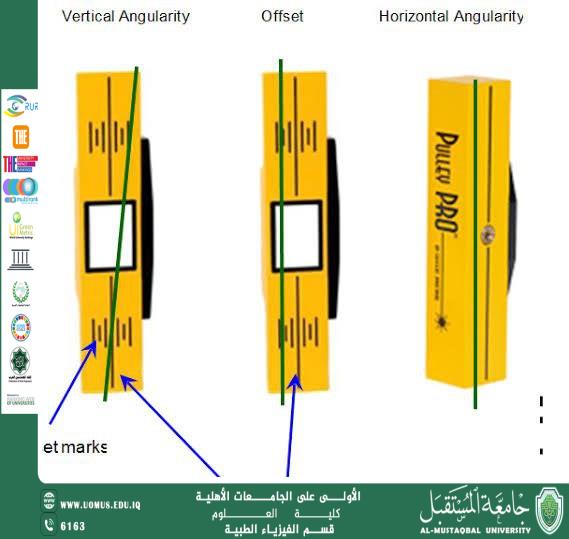
Laser alignment is a fundamental procedure in operating optical systems that rely on coherent light. It ensures that the laser beam travels accurately along the intended path within the device or between optical components such as mirrors and lenses. Even a slight misalignment can cause significant power loss or beam distortion.
Objective:
The main goal of laser alignment is to achieve maximum efficiency and beam stability. This is done by precisely adjusting optical components so that the laser’s optical axis is perfectly centered.
Equipment:
Low-power laser source (usually Helium-Neon laser).
Adjustable mirrors.
Lenses and beam expanders/apertures.
Screens or optical detectors for beam observation.
Procedure:
1. Secure the laser source on a stable platform.
2. Direct the beam through predetermined reference points.
3. Gradually adjust mirrors and lenses until the beam follows a straight path.
4. Verify beam stability over time to ensure proper alignment.
Importance and Applications:
Laser alignment plays a vital role in:
Optical communication systems.
Precision measurement devices.
Medical laser surgery.
Physics and optics experiments.
Accurate laser alignment is not only a technical requirement but also a key factor in the success of any coherent light-based system or experiment.
"AL_mustaqbal University is the first university in Iraq"