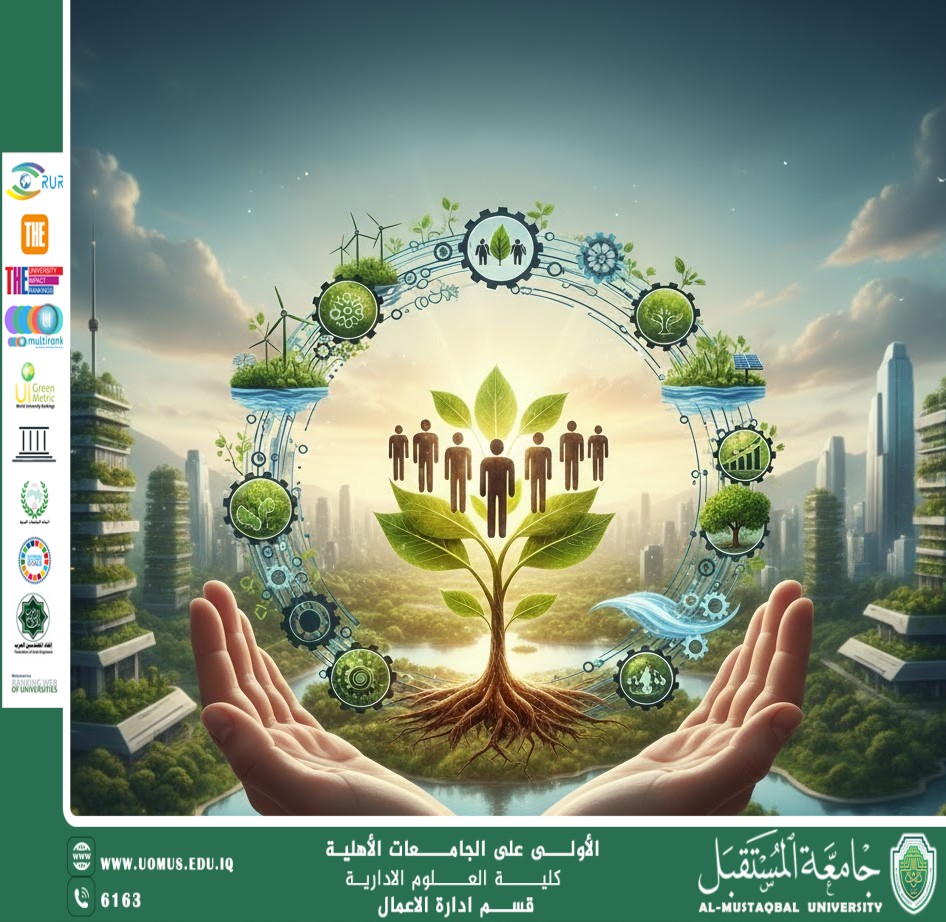

An article titled : Green Human Resources and Their Role in Achieving Sustainable Development
The lecturer M.M. Karrar Haider Hassoun
In light of the environmental challenges the world is witnessing today, such as climate change, pollution, and the depletion of natural resources, attention to sustainability has become an urgent necessity, not just an option. From this perspective, Green Human Resources (Green HR) emerged as one of the modern concepts in HR management, aiming to integrate environmental practices into all HR activities to contribute to achieving sustainable development at both the institutional and societal levels.
First: The Concept of Green Human Resources
Green Human Resources means employing sustainable environmental practices in HR management, starting from recruitment and selection, through training and development, and ending with performance appraisal and rewards. The goal is to create an environmentally friendly organizational culture, enhance employees' awareness of the importance of environmental preservation, and encourage them to adopt environmentally responsible behaviors inside and outside the workplace.
Second: Objectives of Green Human Resources
Green HR seeks to achieve a set of objectives, the most prominent of which are:
Enhancing environmental awareness among employees and institutions.
Reducing the consumption of natural resources such as energy and water.
Limiting waste and harmful emissions.
Encouraging innovation in environmentally friendly products and services.
Contributing to the achievement of the sustainable development vision.
Third: Green Human Resources Practices
Green HR management includes several practical practices, the most prominent of which are:
Green Recruitment and Selection: Selecting candidates who possess environmental awareness or are willing to participate in sustainable initiatives.
Green Training and Development: Designing training programs aimed at educating employees on the importance of environmental protection and implementing green practices within the institution.
Green Performance and Rewards: Linking performance appraisal and incentive systems to the employee's commitment to environmental practices, such as energy rationalization and waste reduction.
Green Organizational Culture: Instilling sustainability values in the work environment and encouraging teamwork towards achieving shared environmental goals.
Fourth: The Role of Green Human Resources in Sustainable Development
Green HR plays a pivotal role in achieving sustainable development by:
Improving the efficiency of resource use within institutions and reducing negative environmental impact.
Stimulating environmental innovation that contributes to the development of environmentally friendly products and services.
Creating a generation of environmentally conscious employees capable of contributing to the shift towards the green economy.
Achieving balance between the economic, social, and environmental dimensions in the workplace.
Fifth: Challenges Facing the Implementation of Green Human Resources
Despite the importance of this concept, institutions face several challenges, including:
Lack of environmental awareness among some employees and management.
Lack of funding for implementing green initiatives.
Absence of mandatory laws and legislation.
Resistance to organizational change by some employees.
Conclusion
Green Human Resources is one of the modern trends that contributes to achieving sustainable development by integrating the environmental dimension into HR policies and strategies. An institution that invests in its employees and instills environmental values in them is laying a solid foundation for a more sustainable future. Hence, adopting Green HR practices is no longer an administrative luxury but has become a strategic choice for achieving competitiveness and sustainability in the long term.
Al-Mustaqbal University ranks first among private universities